Showing posts with label tomatoes. Show all posts

Sunday, November 24, 2013

Beef Stew with Bacon & Vegetables

I’ve known for a few days that it was going to be cold today. And by cold, I don’t mean “Waaahhh, a coat ruins this outfit,” I mean “I am legitimately concerned for my extremities.”

As much as I complain about the cold, I can’t help but love the excuse to spend a day next to the stove. Yesterday, when the weather wasn’t so frostbitey, I planned in advance and bought the ingredients I needed to make a lovely slow-cooked beef stew.

This recipe makes a lot—and by “a lot,” I mean “Hey, East Coast, I’ve got enough for all of you!” Nah, just kidding—but this recipe definitely yields enough for 8-10 cold, hungry people! And it has plenty of healthy vegetables, which I think makes up for the fact that bacon fat is the key to the best flavor.


Beef Stew with Bacon & Vegetables

4-5 slices of thick-cut streaky bacon, sliced into ½” pieces
1.5 lbs. chuck steak, cut into bite-sized pieces
1 large onion, diced
3 leafy stalks celery, diced, leaves set aside
3-4 carrots, diced
3 juicy tomatoes, diced
2-3 c. dry red wine
1 32-oz. box organic low-sodium beef broth*
1-2 turnips, diced
3-4 red potatoes, diced
1 large bunch kale, ribs removed, leaves torn into pieces
1 t. dried thyme (or half the amount fresh)
1 t. crumbled dried sage leaves (or 3 fresh leaves, minced)
½ t. ground ginger
½ t. garlic powder
1 lb. green beans, sliced into 1-inch lengths
Smoked sea salt, to taste
Cracked black pepper, to taste


Before you even start chopping, make sure you have a huge pot (I used my 6.75 quart Le Creuset risotto pot). Otherwise, you’re screwed.

Just before adding the liquid
Once your pot is ready, add the bacon over medium heat and cook it until the fat is melted away and the meaty bits are cooked but not burnt. Then, add the beef chunks and cook, stirring frequently, for about 5 minutes until the beef chunks are mostly browned. Then, add the onion, carrots, and celery stalk (make sure to keep the leaves separate and set them aside—they will be added later). Cook for about 5 more minutes, stirring frequently, until the onion has softened a bit.

Next, add the tomatoes (I added a few yellow cherry tomatoes, as you can see in the photo) and 1 cup of the wine. Turn the heat to high, and cook until the wine has reduced and most of the liquid has evaporated.

Now, add one more cup of wine and the beef broth, the turnips, potatoes, and kale, and the thyme, sage, ginger, and garlic. Reduce heat to medium-low and cover. Cook for 30 minutes, stirring occasionally.

Once the kale is completely wilted, add the green beans. If it seems dry, add the remaining wine (if you don’t need to add it, you should probably drink it). Cook for about 5 minutes until the green beans are cooked, then add the smoked sea salt and the cracked pepper. Give it a few good stirs until it is well-blended, then serve piping hot. This dish will stick to your bones!


* If you use pre-made beef broth, make sure to use low-sodium, and preferably organic. Of course, if you have your own beef broth, even better!

Not the prettiest, but it's wicked good!

Tuesday, December 18, 2012

Feast of the Seven Fishes: Vodka-Braised Calamari with Celery and Tomatoes

It’s almost time for the Feast of the Seven Fishes! Stemming from the Catholic tradition of abstaining from meat on Christmas Eve, many Italians create elaborate meals featuring seven seafood dishes. If you’re in the mood for a less-traditional preparation, try this calamari dish that I created this weekend.

My inspiration for this recipe arrived while I wrestled with whether or not to make a bottle of chile-infused vodka—I wondered what I could do with the spicy booze other than pour it into bloody marys, and I decided to try cooking calamari in vodka with some chiles. The result? A fantastic, fresh-tasting sauce that would be a delight on any Christmas Eve table! If you’re bored with the same old calamari recipes, give this one a shot!


Vodka-Braised Calamari with Celery and Tomatoes

16 oz. / 455 g dry linguine
3 slices streaky bacon (optional)
1 T. butter (if omitting bacon, increase to 2 T. butter)
2 leafy stalks celery, minced (reserve minced leaves)
2 shallots, minced
2 serrano chiles, minced
2 bay leaves
3 medium tomatoes, chopped
1/3 c. golden raisins
1 T. capers in salt
1 c. vodka
1.5 lb. calamari (I prefer a 50/50 mix of tubes and tentacles)
Generous splash olive oil


First, cook the pasta in heavily salted water. In the meantime, if using the bacon, cook the bacon slices in a large, heavy-bottomed pot over medium-high heat until crisp, then remove and place on paper towels. Do not drain the bacon fat from the pot. Add the butter and let it melt (if not using the bacon, simply add the butter to the pot and let it melt), then add the minced celery stalk (keep the minced celery leaves set aside for later), shallot, chiles, and bay leaves. Cook, stirring frequently, for 3-5 minutes or until the shallot and celery are translucent.

Next, add the tomatoes, raisins, capers and vodka. Stir, scraping up any browned bits of bacon from the bottom of the pot. Lower heat to simmer and cook for 8-10 minutes.

When the pasta is just about ready and the tomatoes have simmered in the vodka, add the calamari to the pot with the vodka and tomatoes and raise the heat to medium-high. Cook, stirring frequently, for 1-2 minutes.

Drain the pasta from the cooking water and add the cooked pasta to the pot with the vodka and calamari. Add a generous splash of olive oil, and stir gently until blended. Serve the pasta in individual bowls, and garnish by sprinkling with the minced celery leaves.

* To purchase ingredients used in this recipe, click the picture below:


* Nutritional info: serves six. 610 calories, 13.5 g fat, 68 g carbohydrates, 30 g protein.


Wednesday, October 17, 2012

Ingredient Spotlight – Tripe; Recipe – Tripe and Red Bean Stew

The other day, I had a craving for tripe…I am well aware that that’s a very odd thing for an American to say, but I love tripe. Its flavor is great, similar to a mild chicken liver, and it readily absorbs flavors of accompanying ingredients and sauces. Tripe’s texture is what makes it amazing. If you like the texture of barely-cooked sautéed calamari, you’ll love the texture of tripe! Thinly sliced in Vietnamese Pho, it blends in with the noodles and gives you a lovely, chewy surprise when you sink your teeth into it. In Spanish Callos, it adds a soft and silky counter to chorizo and morcilla, two dense, spicy sausages. In my recipe below, it simply satisfied my craving.

If you are unfamiliar with tripe, it is the lining of a cow’s stomach. If you’re put off by this, don’t be—if you’ve eaten sausage, you’ve eaten tripe. In fact, Wikipedia gives a list of global dishes containing tripe, and this list includes American breakfast sausage, which typically uses tripe as a filler. Most tripe sold in American markets is sold prepared, which means that it has already been dressed and pre-boiled. Even if it has been boiled, tripe benefits from slow cooking, so I boiled mine for an hour before adding it to the stew.

It may be hard to find tripe at your run-of-the-mill supermarket, but if you know of a good Italian or Latino market or butcher shop, you should be able to find good tripe.


Tripe and Red Bean Stew

For the Tripe:
1 lb. / 455 g honeycomb tripe
6 peppercorns
1-2 dried red chiles
Pinch salt
Water to cover

Place all ingredients in a large pot. Bring to a boil, cover, and simmer for about an hour. Drain, set aside until tripe is cool to the touch, then slice into thin strips.


For the Stew:
4 strips streaky bacon, chopped
1 small carrot, minced
1 large brown onion, diced
2-3 garlic cloves, minced
2 serrano chiles, minced
2 green peppers, chopped, divided
1 lb. / 455 g. fresh roma tomatoes, chopped
1 28 oz. / 822g can red beans (do not drain)
Tripe, cooked as prepared above
Generous pinch dried chipotle pepper
2 t. / 5 g. dried oregano
1 packet La Flor brand sazon (or another brand without MSG)
Splash water or chicken broth
Drizzle olive oil
Handful chopped cilantro

Heat a large, heavy-bottomed pot over a medium flame and add the bacon. Cook until the bacon begins to crisp, then add the carrot, onion, garlic, Serrano chiles, and one of the chopped green peppers. Cook for 5-7 minutes, or until the onion has softened.

Now, add the tomatoes, red beans, tripe, chipotle pepper, oregano, sazon, and water or chicken broth. Stir, then cover and reduce heat. Cook for 25 minutes, stirring occasionally.

Add the remaining green pepper and cook for 3-5 minutes, stirring regularly. Top with a drizzle of olive oil and chopped cilantro. This dish is delicious on its own, but is also wonderful served over seasoned rice.

* To purchase ingredients used in this recipe, click the link(s) below:

Frontier Herb 61965 Organic Chipotle Chili Peppers (Google Affiliate Ad)

Nutritional information (without rice): serves six. 230 calories, 6g fat, 28g carbohydrates, 19g protein


Saturday, September 22, 2012

Curry Crusted Swordfish With Vegetables and Sriracha Cream

This is the first actual meal that I cooked from scratch in my new kitchen! There’s not much to it – if you can slice, you can cook this dinner. This dish goes together in no time, and the combination of hot jalapeno, bold spices, and cool cucumber is surprisingly refreshing!


Curry Crusted Swordfish with Vegetables and Sriracha Cream

For the spice crust
Pinch kosher salt
1 t. / 5 g coriander
1 t. / 5 g cumin
1 t. / 5 g mustard seed
½ t. / 2.5 g kala jeera*
½ t. / 2.5 g turmeric powder
½ t. / 2.5 g coarsely ground black pepper

16 oz / 455 g swordfish, tuna, or other firm-fleshed fish steaks
2 roma tomatoes, chopped
1 large cucumber, quartered lengthwise and thinly sliced
2-3 jalapeno chiles, chopped

For the sriracha cream
4 T. / 60 g sour cream
1 T. / 15 g sriracha
2 t. / 5 mL mild vinegar (white wine vinegar is a good choice)
2 c. / 450 g cooked rice
 
 
toasting the spices
First, toast the salt, coriander, cumin, mustard seed, and kala jeera in a frying pan until they become fragrant, approximately 3-4 minutes. Place them in a mortar and pestle along with the turmeric and black pepper. Grind coarsely. Rub the spice mixture into the swordfish, set aside.

Preheat your broiler. Line a baking dish with foil, then add the tomato, cucumber, and jalapeno in a single layer. Place the spice-crusted swordfish on top of the veggie layer, and broil for 12-15 minutes, or until the fish is cooked through.

While the fish and vegetables are cooking, make the sriracha cream by whisking together the sour cream, sriracha, and vinegar. If the mixture seems too thick, add a few drops of water to the sauce until it is thin enough to drizzle.

Take the fish and vegetables from the oven; let rest for 3-5 minutes. In the meantime, divide the rice among four individual plates. After the fish has rested, divide the fish and vegetables into four equal portions, serve atop the cooked rice. To finish, drizzle with the sriracha cream.

* Also known as black cumin – if you cannot find kala jeera, you can order it online from Penzey’s.

Nutritional info: serves four. 317 calories, 9 g fat, 29 g carbohydrates, 25 g protein.


Wednesday, June 13, 2012

Fried Green Tomatoes: A Southern Favorite

I wish I could claim that this recipe was inspired by my recent vacation, but it actually reminds me of summer weekends in Portsmouth, NH. When my mom and I see green tomatoes in the grocery stores or the farmers’ markets, we scoop up as many as we can, and she fries them up. Until this weekend, I never made them myself. A text later, and I had a recipe.

In New England, you’re not likely to encounter green tomatoes in the markets until later in the season when farmers begin to fear frost – earlier in the season, most farmers allow their green tomatoes to ripen, knowing that they’ll sell at the market. But when the temperatures begin to drop, green tomatoes allow farmers to pull in a modest profit rather than risk a ruined crop. Naturally, when I found a farmstand selling green tomatoes in June, it felt like winning a thousand bucks on a $1 scratch ticket!

If you ever see green tomatoes at your local farmers’ market*, toss a few in your basket and try this recipe!

*To locate a farmers’ market near you, visit www.localharvest.org


Fried Green Tomatoes

3-4 large green tomatoes, sliced ½” thick crosswise
½ c. flour for dredging
1 egg, beaten
2/3 c. cornmeal
1 t. Cajun seasoning
Canola oil
Bacon fat*

First, dry the tomatoes with kitchen towels to absorb any extra liquid. In the meantime, set up your dredging station: one plate for the flour, one plate or shallow bowl for the beaten egg, and one plate for the cornmeal. Add the Cajun seasoning to the cornmeal and mix thoroughly.

Heat a splash of canola oil and a dollop of bacon fat in a large cast-iron frying pan or griddle (Save $90 on Le Creuset Bistro grill and griddle set at Williams-Sonoma!) over high heat while you prepare the first batch of tomatoes for frying.

To prepare your tomatoes for frying, dip a tomato slice into the flour, making sure both cut sides are covered with a light dusting. Shake off any excess flour.

Next, dip the tomato slice into the beaten egg, letting any extra egg drip off, then dip the cut sides of the tomato into the seasoned cornmeal. Add the tomato to the frying pan, cooking for a minute or two on each side, or until the coating crisps and turns dark golden brown.

Repeat with all remaining tomatoes. You will have to work in batches—make sure the tomatoes have enough space in the frying pan. After a few batches, you may have to add a bit more fat to the pan.

Serve piping hot, preferably outdoors in the sunshine!

*When you cook bacon, always save the fat in a glass container! Store in your refrigerator and use to add flavor to your recipes.

Nutritional Info: serves four. 222 calories, 17g fat, 15 g carbohydrates, 3 protein


Friday, March 23, 2012

Chicken with Crunchy Veggies and Thai Flavors

This is yet another one of my recipes that wasn’t necessarily inspired, but came together when I said, “I’m hungry!” Thinking of what I could cook, I realized that I rarely cook chicken. I eat a lot of seafood, pork, beef, and vegetarian dishes, but I don’t do chicken too often. Why not? No conscious reason. I like chicken, but since starting this blog, I’ve leaned towards recipes with stronger flavors and uncommon ingredients.

When I do cook chicken, I buy organic, free-range, air-chilled chicken. Organic and free-range chicken is better for your body, the environment, and the chickens themselves. If you’ve never heard of air-chilled chicken, seek it out¾while normal chickens are dunked in an ice water bath to lower their temperature after slaughter and processing, air-chilled chickens are sent through several courses of cold air. This significantly lowers the risk of bacterial contamination (one infected chicken in an ice water bath can contaminate an entire lot), but it is also more economical - chickens given ice baths absorb water, and the consumer ends up paying for water. When chickens are air-chilled, you're not paying for anything but chicken. Air-chilled poultry costs a little more than conventional chicken, but I think it’s worth it to pay a slightly higher price for clean, unadulterated chicken.

Chicken pairs with pretty much everything, as does rice. But plain chicken and plain rice isn’t very exciting; I wanted to spice it up a bit. When you add in bold flavors, a little meat goes a long way, so if you’re looking to cut down on meat consumption, crunchy vegetables and Thai-inspired flavorings provide flavor and textural contrasts to the rather neutral chicken and jasmine rice. Even better, this recipe couldn’t be easier!


Chicken with Crunchy Veggies and Thai Flavors

1 T. coconut oil
8 oz. Boneless skinless chicken breasts, chopped into bite-sized pieces
1 lb. Green beans, cut into 1” lengths
1-2 cloves garlic, crushed
1 t. grated fresh ginger
2 T. low sodium soy sauce
2 T. fish sauce
2 T. Boston Olive Oil Company’s lemongrass & mint white balsamic vinegar
1 cucumber, seeded and chopped
1 large tomato, seeded and chopped
2 Serrano chiles, minced
2 fresno chiles or red jalapenos, minced
3 green onions, sliced into rings
Handful chiffonade-cut basil
1 T. toasted sesame oil

Coked rice, to serve
Extra basil, to garnish
A few very thin slices Serrano chile, to garnish


In a large metal pan or wok, heat the coconut oil over high heat until it becomes fluid. Add the chicken pieces and brown for 3-4 minutes, stirring constantly.

Reduce heat to medium. Add the green beans, garlic, ginger, soy sauce, fish sauce, and lemongrass & mint vinegar. Cook for 5-7 minutes, continuing to stir constantly. Next, add the cucumber, tomato, Serrano chile, and fresno chile. Continue to stir constantly, and cook for an additional 5 minutes, or until the green beans are no longer raw tasting but still retain their crunch.

Finally, add the green onions, basil, and sesame oil. Stir until blended, then spoon over cooked rice. Garnish with basil sprigs and thin slices of serrano chile. 


Tuesday, February 28, 2012

Around the World in Eighty Bites - Uganda

As my loyal readers know, I keep track of the countries around the world that read this blog. While it’s fun to watch my numbers increase, the main reason I track my international readership is because I want to try as many different cuisines as possible, and knowing that I’m reaching real people across the globe keeps me inspired to create many new variations of traditional ethnic and national recipes. I also like being able to share the recipes with people who, like me, travel vicariously through their taste buds.
 
from nationsonline.org
The 97th country to hop on the www.baconbutterbooze.com bandwagon was Uganda. Like many countries that have been prone to invasion, Ugandan food features mainly native ingredients while reflecting the influences of invading countries’ cuisines. European, Arab, and Indian traders and explorers brought with them ingredients that have been incorporated into traditional Ugandan cuisine, but traditional dishes rely on native staples such as bananas, yams, and smoked or dried fish.

Cooking Ugandan food was a bit intimidating to me, because with the exceptions of Morocco and Ethiopia, most African nations’ cuisines haven’t become trendy yet, and I feared that finding enough information about the cuisine and its ingredients and cooking techniques would be difficult. However, when I’m intimidated by a kitchen project, I always accept the challenge and step up to the plate, so with a little bit of web research and a basket of fresh ingredients, I was ready to cook. After browsing through about a dozen Ugandan recipes, I selected Oluwombo. Oluwombo is a traditional Ugandan dish featuring meat and smoked fish cooked with tomatoes, peanuts, and mushrooms. I chose this dish because it was so different from the dishes I’ve cooked in the past.

While researching, I found several variations of the meat used in the dish - some used beef, some used chicken, and pork and goat were also featured in a few recipes. The other ingredients had no significant variation from recipe to recipe. Oluwombo is traditionally steamed in banana leaves for almost two hours, but to save time, I’ve varied the cooking method to create a stew that captures the flavors, but requires less preparation and cooking time. My first reaction? “How did I live without this for 30 years?”

Try this when you’re seeking something different from your typical beef stew!


Oluwombo-Inspired Stew

1 T. coconut oil
12 oz. sirloin, cut into ½” cubes
1 small onion, minced
2 medium tomatoes, chopped
1 c. peanuts, crushed
3 oz. Tomato paste
1 cup beef stock or bouillon
4 oz. Fresh button mushrooms, finely chopped
2 chipotles in adobo, minced, plus 2 T. adobo sauce
½ t. toasted cumin seeds, ground
¼ t. ginger
¼ t. turmeric
6 oz. Smoked whitefish, skin and bones removed and flaked

4 baked plantains (instructions below), sliced
Crushed peanuts, to garnish

In a large, heavy-bottomed saucepan, heat 1 T. of the coconut oil over medium-high heat until it has melted. Add the sirloin and cook for several minutes until the meat has browned. Remove the meat with a slotted spoon and set aside, and if a lot of liquid and fat has been released from the meat, drain it. Add more coconut oil if necessary, then add the onion and cook for 3-5 minutes, or until the onion has softened.

Add all the remaining ingredients and the browned sirloin. Stir, reduce the heat to low, and cook for about 45 minutes, stirring occasionally. Once cooked, serve over slices of baked plantain and garnish with crushed peanuts.

Serves four.  Nutrition facts per serving: 790 calories, 68g carbohydrates, 35g fat, 56 g protein


Baked Plantains

4 plantains

Start with plantains that are in their medium stage of ripeness - beginning to blacken, but with a fair amount of yellow still showing. Preheat the oven to 425, and in the meantime, slice the ends off of each plantain, then halve lengthwise. Place the plantains skin side down on a baking sheet, and bake for 30 minutes. Remove from oven, and once the plantain halves are cool enough to touch, peel the skins off and slice the plantain halves into half-inch chunks.

Serves four.  Nutrition facts per serving: 180 calories, 48g carbohydrates, 0.3g fat, 1.2g protein


Monday, January 16, 2012

Cavatappi with Roasted Cherry Tomato Sauce

Great tomatoes in January, in Boston. If you're a serious foodie, that sentence probably just made you raise your eyebrows and question my credibility; as well you should have. However, I've been buying these tomatoes for quite some time, and I've never been disappointed in them, even in January.

Grown locally by Backyard Farms, these tomatoes are packed with flavor and rival some tomatoes I've had in August. I probably go through at least one box of their cocktail tomatoes per week, if not two or three. The other day, I got the idea to roast them and make a garlicky tomato sauce, and the idea evolved into this quick, easy, and delicious pasta recipe. Try this one the next time you're able to find good tomatoes!
 

Cavatappi with Roasted Cherry Tomato Sauce


1/2 lb. cavatappi, or other textured short pasta
8 cherry tomatoes, quartered
1/4 c. butter
1 c. dry white wine
1/3 c. tomato paste
1 c. grated pecorino romano
3-4 garlic cloves, minced
generous amount coarsely ground black pepper
salt (if necessary)
handful fresh basil leaves, chiffonade-cut*
additional basil leaves, for garnish

Cook the pasta in heavily salted water. In the meantime, preheat the oven's broiler. Arrange the cherry tomatoes on a foil-lined baking sheet with one cut side down (as shown in picture above). Broil the tomatoes for 7-10 minutes, or until the tomatoes' skins have begun to blister and blacken. Remove from oven and set aside.

chiffonade-cut basil
While the pasta cooks and the tomatoes broil, combine the butter, wine, and tomato paste in a large, heavy-bottomed pot over medium-high heat. Whisk vigorously until the tomato paste has completely broken down and blended with the wine and the butter has melted. Turn heat down to low and add the pecorino, garlic, and pepper (you probably won't need salt; pecorino is a salty cheese. Taste for seasonings and only add salt if absolutely necessary). Continue to whisk until the pecorino has completely melted. Once the pasta is cooked, drain it and add it to the sauce along with the roasted tomatoes and the chiffonade-cut basil leaves. Stir a few times until all the pasta is coated, then serve hot, garnished with fresh basil leaves.
 
* Chiffonade-cut is a technique often used on fresh herbs. To cut basil, stack the leaves on top of each other, roll up lengthwise, and cut into 1/8" strips. By placing the largest leaf on the bottom of the stack, the smaller leaves will be contained in the roll and the leaves will be easier to slice.

Wednesday, August 31, 2011

Ingredient Spotlight - Ricotta Salata

Most people are familiar with ricotta cheese.  Used to stuff pasta and cannoli, ricotta is made from whey left over after cheese production.  When ricotta cheese is pressed, salted, and aged, it becomes ricotta salata.

Ricotta salata is similar in texture to feta, but it is milder and much less salty.  Traditionally used in shaved or grated form to add a finishing touch to dishes, its fresh, milky flavor is a pleasant addition to any salad containing tomato, cucumber, or cold, cooked grains.  Ricotta salata can also be used as a lighter, less pronounced substitute for parmesan or pecorino when finishing a risotto or a simple pasta dish. 

If you are not fortunate enough to live in a city with a large Italian population, ricotta salata may be difficult to locate, as it is not a common or mass-produced variety.  Italian markets, specialty shops and better supermarkets are good sources, but if you cannot find ricotta salata, it can be purchased online.  If you can get your hands on this cheese, do try it in the recipe below!


Spaghetti with Fresh Tomatoes, Green Onions, and Ricotta Salata

1 lb. spaghetti or linguine
splash olive oil
2 garlic cloves, minced
2 pounds fresh tomatoes, diced
1/2 cup dry white wine
4 green onions, sliced into rings
salt and pepper to taste
ricotta salata*

Cook the pasta.  In the meantime, heat the olive oil in a large, heavy-bottomed pan over medium heat.  Add the garlic and cook until the garlic becomes fragrant, approximately 3-5 minutes.  Do not let the garlic burn.

Add the tomatoes and the wine.  Cook for 10-15 minutes, stirring occasionally until the liquid has reduced and the tomatoes begin to break down. 

Add the sliced green onions, salt, and pepper.  Cook for about five minutes, or until the onions' flavor has mellowed a bit.  Do not let them become soft and mushy. 

Drain the cooked spaghetti and dress it with a splash of olive oil.  Divide the cooked pasta among plates, and spoon the sauce over the hot pasta.  Using a vegetable peeler, shave your desired amount of ricotta salata over each individual bowl. 

* If you cannot find ricotta salata, it can be purchased online.

Friday, December 3, 2010

Linguine with Tomato, Pancetta, and Capers

It's Arrabiata!  It's Amatriciana!  No, it's - damn, I don't even have a catchy name for this tasty tomato-based sauce that marries the flavors of penne all'arrabiata and bucatini all'amatriciana.   

It all started yesterday at approximately 4:45pm.  I received a text from a friend:  "What should I make for dinner?"  He explained that he had no discernable food cravings.  I started to think about what I was going to make for dinner after I ran my errands and went to the gym.  After a long, tiring day at work, I was barely motivated to pour milk into a bowl of cereal.  The longer I thought about it, the more I realized that what I really wanted wasn't to complete my "To-Do list," but to sit down with a large bowl of pasta and a glass of Chianti.  Library books can be returned late; I don't mind paying a small late fee.  The world won't end if someone else buys the last purple corduroy 3/4 sleeve jacket at Ralph Lauren.  Living on a 2nd floor walk-up on the top of a massive hill guarantees that my glutes won't atrophy if I skip the gym for a day (OK, week...).  I can ignore anything except a food craving, and I'm not opposed to procrastinating except when doing so delays dinner. 

My decision was final.  I picked up the ingredients at the store, headed back to my apartment, uncorked the Chianti, cranked up the Frank, and got down to business slicing and stirring to create this savory, spicy tomato sauce with a perfectly balanced piquancy achieved by throwing in a few salt-packed capers just before adding the pasta to the pot.  Try this one sometime, and make sure to sing along with Sinatra while you cook!

Linguine with Tomato, Pancetta, and Capers

1 pound dry linguine
splash olive oil
1/2 pound pancetta, sliced into 1/2" x 1" strips
1 large or 2 small shallots, minced
1 garlic clove, halved
2 pounds fresh tomatoes, diced
1/2 cup dry white wine
generous amount coarsely ground black pepper
1/4 - 1/2 t. crushed red chile flakes
2-3 T. salt-packed capers (do not rinse)
1 teaspoon chopped fresh oregano

Cook the pasta.  In the meantime, heat the olive oil over medium-high heat in a large, heavy-bottomed pot.  Add the pancetta and cook until it begins to crisp, approx. 6-8 minutes.  During the last minute of cooking, add the minced shallots and the garlic clove halves.  Cook until the shallots become translucent, 1-2 minutes.  Do not let them burn. 


Add the tomatoes, wine, pepper, and crushed red chile flakes.  Cook for approximately 10-15 minutes, stirring frequently, until tomatoes have softened and just barely hold their shape.


Now, remove the garlic clove halves and add the capers and oregano to the tomato sauce.  Cook for 1-2 more minutes, stirring once or twice.  Next, reduce the tomato sauce to low heat and add the hot cooked pasta to the tomato blend, stirring until each strand of pasta is coated with sauce. 


Serve immediately, garnishing with a few fresh oregano leaves. 


Friday, November 12, 2010

Peruvian 101

Last night, I had the pleasure of dining on home-cooked Peruvian food.  I’ve neither cooked nor tasted Peruvian food before, and I didn’t cook it last night – I left the hard labor to the expert, my Peruvian friend who has been occupying a lot of my time lately.  Let me tell you something – having a man cook for me was delightful, and what made it more awesome is that the kid’s a great cook!

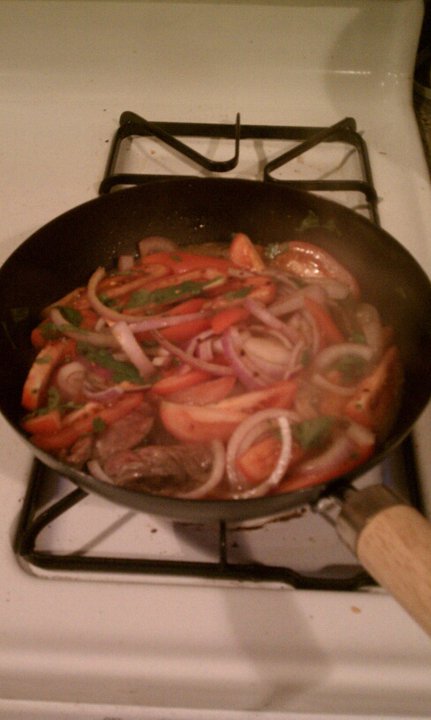
He lured me in with Lomo Saltado, a Peruvian dish consisting of sliced steak, tomatoes and onions marinated in vinegar and spices, then stir fried with a splash of soy sauce and topped with cilantro.  It is served over rice and fried potatoes, and he made a spicy Aji sauce to accompany the rice.  Holy Mary Mother of God!  This homemade hot sauce is quite possibly the best thing to ever happen to me, and I cannot wait to make my own.  I need to learn the proportions, but he told me that it’s easy to make and consists of habanero peppers, garlic, olive oil, salt and pepper.  

Letting someone else take control and do the work in the kitchen is one of the most difficult things I’ve ever done:

        “Can I help with anything?”  “No.” 
        “Can I at least do some dishes?” “No.” 
        “Really?” “Really.” 
        “Are you sure?” “Yes!” 

I literally had to go stand in the other room and watch from afar; standing in a kitchen and doing nothing felt far too odd and awkward.  I thought to myself, “This must be how goalies feel when the puck’s on the other side of the ice.”  I was fidgeting the entire time he cooked the stir fry.  I was relieved once the food was ready, because now I could do something with it, even if that something was simply shoveling it into my mouth. 

Along with our dinner, we shared a bottle of Rioja, which I tried for the first time last night.  I smelled and sipped the wine before I began eating so that the wine's flavor would be pure and would not have to compete with the flavors in the food.  My first thought?  The Rioja smelled exactly like Chianti.  I sipped; it tasted very similar to Chianti as well.  Definitely a variety I’d buy again.  Finally, it was time to taste the food. 

Each bite of Lomo Saltado was better than the last, and I wanted to savor each and every mouthful of the Aji-kissed rice.  I did – I painstakingly scooped up every last grain of rice with my fork until not one remained on my plate.  The meat was well-flavored and tender, the onions retained a slight crunch, and the tomatoes were bursting with flavor. He topped the dish with cilantro, which was the perfect foil for the spicy Aji sauce, and the Rioja was a great match for the dish as it was full-bodied enough to stand up to the bold flavors of Lomo Saltado.  When I commented that I thought the Aji sauce would be great on grilled tuna, he countered with, “It’s great on everything.”  I believe that.

This is definitely a recipe I’ll have to try on my own, but I’d be just as happy hopping in a cab and letting him wear the Chef hat!  I insist that you order this dish if you find it on a menu.  It’s a superstar!


Tuesday, November 9, 2010

Italian "Sushi"

About a week ago, I was giving serious consideration to turning life as I know it upside-down and heading to a cattle call for a chance to be included in the next crop of reality TV cooking show contestants.  After careful consideration (and careful reading of the fine print legalese on the application form),  I decided not to go after a spot on MasterChef, but I did gain something from the decisionmaking process – a new recipe. 

As part of the audition process for MasterChef, each contestant is required to bring a pre-prepared dish to the audition.  Contestants are not permitted to prep or cook any part of the dish at the audition; all work must be be done off site.  Although some leeway is allegedly given in the judging because of the fact that applicants have to wait for hours at a time, I’m sure the judges would wonder about a contestant’s judgment if he/she presented a dish that was only at its peak under specific temperature conditions.  The instructions suggested packing the prepared dish in temperature-controlled containers, such as coolers and ice packs for cold dishes and heat wraps for hot dishes, so I wanted to make something that would be OK in a cooler whose temperature regulation might crap out after six hours of waiting in queue. 

Although the show’s producers wanted contestants to present their signature dishes, my signature dish – linguine with radicchio and cream - would taste like raw sewage if not served piping hot (OK, not raw sewage – but the flavor and texture would be less than ideal).  I challenged myself to come up with something that would be OK served either slightly chilled or at room temperature.  I thought of making the Seared Sesame Tuna and Gingered Pumpkin that I cooked in “Around the World in Eighty Bites – Japan,” but my mom advised against it, her reasoning being that A) seared tuna has been done a thousand times,  and B) it is not the best example of my cooking style. 

Had I decided to audition for the show, I needed a dish that would make me stand out from the crowd and truly shine.  I was less concerned about perfect execution than I was about creativity – perfect execution can be achieved through practice, but creativity and the ability to be inspired are things that can’t be learned.  I also wanted to stay true to my culinary roots, so I was determined to cook something using Italian ingredients and/or techniques.  Something based on risotto, another one of my go-to dishes, seemed like a good starting point.  That’s when it hit me – Italian “sushi!”

My plan was to wrap cold risotto around a filling of sliced roma tomato, then roll each “log” through a layer of very finely chopped fresh basil.  Each roll would be sliced into small cylinders, much like maki rolls, and they would even look like maki sushi – green basil exterior, white risotto base, and the red tomato in the middle would resemble the filling in a tuna or salmon maki roll.  I’d make plain risotto with only a few teaspoons of grated parmesan – no other additions – so that the flavors from the risotto would not overwhelm the other ingredients.  I conducted my experiment last night, and it worked beautifully. 

I made the risotto using Japanese short-grain sushi rice, not because I thought it would work better, but because yours truly didn’t check her pantry before creating a shopping list.  I assumed I had risotto rice…you know what they say about assuming.  Risotto made using sushi rice tastes just like the real thing, but I’ll have to try this recipe again using real risotto rice to assess the texture and determine which rice is more suitable for this recipe.   Also, I made the first roll using only minced basil for the exterior, but I discovered that combining the basil with a few flakes of kosher salt helped the basil better adhere to the rice.  Be sure to use wax paper to make the rolls – the rice will stick to foil or plastic wrap. 

Try this recipe if you’re feeling creative – the result is a delicious cold dish perfect for an antipasto course! 

Italian "Sushi"

3 cups cold plain risotto
1 or 2 firm roma tomatoes, peeled and sliced lengthwise into thin strips
1 bunch fresh basil, very finely minced
Kosher salt flakes


Place about 1/3 cup of the risotto on a sheet of wax paper 4-5 inches wide.  Using the curved back of a large spoon, press the risotto into a rectangle approximately 2.5” X 6” and about 1/3” thick.


In the center of the risotto rectangle, place two of the tomato strips lengthwise. 


Bring the ends of the paper up and together so that the long edges of the risotto rectangle touch, then roll the remaining edges of the wax paper between your thumbs and index fingers so that the rice comes together around the tomato strips and a long cylinder is formed (as shown in photo, left). 


Spread the basil and a pinch of kosher salt in a thin, even layer on a cutting board.  Bring the risotto roll, still wrapped in wax paper, to the edge of the cutting board, then unroll it and guide the risotto roll onto the basil layer, rolling it through the basil so that the minced leaves cling to the rice. 

Once you have rolled the risotto through the basil, place the risotto roll on a clean surface and slice it crosswise into 1-inch cylinders.  Place them cut-side-down on a platter. 

Repeat these instructions until all of the risotto is used, then serve with Garlic and Caper Dipping Sauce, and eat using chopsticks. 

VARIATION:  To make an entire spread of Italian “Sushi” rolls, vary the fillings, the exterior herbs, and the dipping sauces.  For fillings, try strips of roasted red or yellow bell pepper, smoked mozzarella, thinly sliced prosciutto or mortadella, anchovies, preserved lemon peel, or marinated portabella mushrooms.  For the exterior herbs, try minced oregano, parsley, mint, arugula, or tender young chicory leaves.  For dipping sauces, try balsamic vinaigrette or bagna cauda, a hot dip based on butter, olive oil, and anchovy.


Garlic and Caper Dipping Sauce

¼ cup olive oil
2 T. dry white wine
1 T. grated pecorino romano
1 T. finely minced salt-packed capers (do not rinse salt)
1 garlic clove, finely minced

Combine all ingredients in a small bowl.  Whisk well with a fork or small whisk, let stand for at least 15 minutes, whisk again, and serve with Italian “Sushi.” 


Tuesday, October 19, 2010

Spaghetti alla Puttanesca - Pasta for the Working Girl on the Go

Spaghetti alla Puttanesca.  The name sounds pretty, until you realize that its English translation is "Whore's Pasta."

Who are these ladies of the night, what were they cooking, and how did they get a pasta dish named after them?  Legend has it that the "working girls" didn't have much time between "clients," and if they wanted to eat, they had to whip together something quick and simple.  Sorry, ladies, no bolognese for you!  This sauce of garlic, tomatoes, olives, anchovies, and capers was easy to prepare and went together in less time than it took to boil the pasta water, which gave the ladies plenty of time to engage in their economic pursuits. 

Think about our eat-on-the-run culture.  Often, food advertisements lure us in with the promise that so-and-so's new product can be cooked in under two minutes, or its packaging is designed to allow us to eat without utensils so we can get the "food" in our mouths while walking, driving, etc.  We can eat soup while talking on hands-free phones and dodging traffic on the way to work!  Really?  This is supposed to be a good thing? 

Our culture demands that we spend the majority of our waking time auctioning off little pieces of ourselves in exchange for wages, and the process of preparing a meal has been reduced and degraded to "what can I throw in the microwave and inhale on the way to my meeting?"  We rarely make slow-cooked sauces, and we rarely sit down for hours and enjoy a luxurious meal with friends and family.  We're much too busy for that stuff...not so unlike the puttane whose compromised time and desperate lifestyles gave name to this pasta recipe.  Are we all just a bunch of prostitutes?  Are we so busy selling ourselves that we have to multitask during dinner? 

I should mention that at least 1/3 of my posts are written from my cubicle while eating microwaved leftovers and watching the clock.  Trust me, the irony is not lost on me. 

Please try this recipe sometime, and please eat it sitting down at a table with a friend or two and a glass of wine...or three.

Spaghetti alla Puttanesca

1  pound spaghetti or other long pasta (I used fusilli lunghi)
generous splash olive oil
1  2 oz. tin anchovy fillets (do not drain)
1  garlic clove, minced
1  small onion, minced
1  28 oz. can crushed Italian tomatoes (Rienzi, Pastene and Tuttorosso are good brands) 
1/4 c. capers
1 t. dried oregano
1/2 t. crushed red chile flakes
1 cup chopped black olives
salt and pepper to taste
grated parmesan or pecorino romano, to serve (optional) 

Cook the pasta.  In the meantime, heat the olive oil in a heavy-bottomed saucepan over medium heat.  When the oil is heated through, add the anchovy fillets and their oil, the garlic, and the onion.  Cook for about 2 minutes, stirring frequently, until the anchovies have begun to break apart.  Be careful not to let the garlic burn. 

Next, add the tomatoes, capers, oregano, and chile flakes.  Stir well, cover, and cook until the liquid comes to a boil.  Reduce to simmer and cook for about 10 minutes. 

After the sauce has simmered, add the olives, salt and pepper.  Cook for about 2-3 more minutes, stirring frequently.  In the meantime, drain the cooked pasta, toss with a bit of olive oil, and divide into 4 bowls.  Ladle a bit of the sauce over each bowl, serve, and toss with grated cheese if you'd like.

Sunday, September 12, 2010

This Weekend's Meat-Free Menu

This weekend, hundreds of dogs and their owners gathered on Boston Common to raise hundreds of thousands of dollars for the Massachusetts Society for the Prevention of Cruelty to Animals. To honor animals and all the work advocates do on their behalf, I not only volunteered at today’s walk, but everything I’ve cooked this weekend has been either vegetarian or vegan.

So what is the difference between vegetarians and vegans? Vegetarians do not eat meat or fish, but they may choose to eat eggs, dairy products, and other products obtained from live animals. Vegans neither eat nor otherwise use any products derived from animals, including honey and wool.

Because this blog is written to celebrate food - nothing more, nothing less - I do not believe that this is the forum to discuss the plethora of issues surrounding meat consumption. I’ll skip the sociology lesson and let you investigate the economic, political, medical and ethical questions on your own time, but I will highlight a few of the benefits of vegetarian and vegan cooking. I’m not expecting meataholics to put down their steak knives and start mainlining tofu, but consider these facts*:

  • Vegetarian/vegan diets are lower in saturated fat and cholesterol than omnivorous diets
  • Factory-farmed meat products are more likely to contain antibiotic-resistant strains of salmonella, E. coli, etc.
  • No animals have to suffer to make falafel, beans & rice, or quinoa salad
  • Intensive livestock production is one of our country’s greatest sources of environmental pollution
  • Vegetarian dishes are generally easier on the wallet than dishes containing meat and/or fish

Even if you don’t want to give up meat, try cooking a vegetarian or vegan meal once or twice a week - most vegetarian recipes are so delicious that you won’t even miss the meat!


Before I did any real cooking, I had to try vegan bacon. Oxymoron, right?!? The stuff isn’t bad. I am thankful that someone has been able to make such a great substitute. No one should be denied the joys of bacon, butter, and booze.


This stuff cooks up just like real bacon. Grease the frying pan for a more authentic flavor, turn it over a few times, and voila! Vegan goodness.


The flavor is very spot-on, and the texture isn’t an exact match, but it’s pretty darn close. And honestly, people who cook bacon in the microwave probably won’t know the difference. The smell of vegan bacon frying is so alluring that Tessie, my roommate’s pup, joined me in the kitchen, barked to get my attention and showed off her “sit” skills when I picked up a piece!


The first dinner recipe I tried was a vegetarian casserole with whole wheat pasta, Savoy cabbage, fontina cheese, and fresh dill. The cabbage is extremely high in vitamins and minerals, and both cheese and 100% whole wheat pasta contain protein. Choose a high quality Italian brand of whole wheat pasta made with durum wheat, which is naturally higher in protein than other varieties of wheat. This dish is rich, gooey, hearty, and delicious - this one will stick to your bones on a cold day.


The next dinner recipe was more of an experiment, and it turned out to be fantastic! I was inspired to make this after accidentally buying a bag of Roland Sweet Dried Tomatoes - sounds like plain old sun-dried tomatoes, right? Wrong - these are sweetened with sugar, and their flavor and texture remind me of a tomato-tinged prune or raisin. I thought their sweet quality could enhance a recipe much in the way that adding raisins to a savory recipe deepens the flavors. In Sicily, golden raisins are sometimes added to tomato-based sauces; this was a perfect starting point.


I decided that I wanted to give myself a greater challenge than simply creating a vegan dish - I wanted to make one that was both vegan and gluten-free. Flavors? Check. Proteins? I call on my favorite legume, red lentils. Carbohydrates? Herein lies the challenge. Gluten-free pasta? Nah, just ate pasta last night. Rice? That’s for gluten-free amateurs. I chose millet.


Millet is the seed of a grass, and it is commonly used in parts of Asia and Africa. It is readily available in health food stores, co-ops, and better supermarkets. Try and get over the fact that you’ll without a doubt recognize it as a key component in commercially prepared birdseed; it’s inexpensive, nutritious, and has a wonderful, fluffy texture. If you cannot find millet, quinoa or amaranth are also great whole grains suitable for those on gluten-free diets, and they also carry the added perk of being two of the only plant sources of complete proteins.  Check out more gluten-free grains here.


Whole grains are a great substitute for couscous, the preferred starch source in Moroccan cooking. Knowing this, and knowing that my sweet dried tomatoes could work in a Sicilian-inspired dish, I decided to try a dish that blended Sicilian and Moroccan flavors, which was not a difficult task since their cuisines are very similar to begin with due to their proximity.


Now, it’s time to get cooking. Try these recipes and eat up!


Cabbage, Fontina, and Dill Casserole with Whole-Wheat Rotini


8 oz. 100% whole wheat rotini

1 small head Savoy cabbage, quartered and shredded into ¼” strips

1 clove garlic, minced

4 T. chopped fresh dill

Olive oil

2 T. chardonnay (try using an Italian variety, known as Sciardonne, produced in Italy’s Alto Adige region)

5 oz. Fontina cheese, shredded (fontina is soft, so grate it fresh from the fridge or it will melt)

Preheat the oven to 400. Cook the pasta in a large pot of salted boiling water. Whole wheat pasta takes a little bit longer to cook than regular pasta, so be patient.


Meanwhile, combine the cabbage, garlic, 3 T. of the dill, a splash of olive oil, and chardonnay in an ovenproof dish. Place in oven. Check after 5 minutes, if the cabbage has wilted, remove from oven. If not, cook for a few more minutes, no more than 10, and remove from oven. Do not let the cabbage brown.


Once the pasta is cooked, add it to the cabbage in the casserole. Add half the fontina, mix well until all ingredients are blended evenly, adding another splash of olive oil to the mix. Once the pasta, cabbage, and cheese are well-blended, top with the remaining fontina. Place in oven and bake for 8-10 minutes. Remove from oven, let sit for 5 minutes, and serve.


Millet with Sweet Tomato and Lentil Stew


Splash olive oil

1 small onion, chopped

2 tomatoes, chopped

Pinch crushed red chile flakes

Pinch fresh ground black pepper

1 cup chopped sweet dried tomatoes

½ cup red lentils

1 cup white wine

¼ t. ground cumin

¼ t. ground coriander

1 t. smoked paprika

½ cup water or vegetable broth (if necessary)

2 T. fresh parsley, chopped

2 T. fresh mint, chopped

2 T. capers, rinsed and drained

Salt to taste


1 batch cooked millet
Chopped toasted hazelnuts


Heat the olive oil in a heavy-bottomed saucepan over medium heat until the onions become translucent. Do not let them brown. Next, add the chopped tomatoes, chile flakes, and ground pepper. Cook, stirring occasionally, for about 10 minutes or until the tomatoes have cooked down and released some of their liquid.


Add the sweet dried tomatoes, lentils, wine, cumin, coriander, and paprika. Cook for 15 more minutes, stirring occasionally. By this point, the lentils should be cooked but still firm. If the lentils need more cooking time and/or no liquid remains, add the ½ cup water or vegetable broth and simmer for 5-10 more minutes.


The final step is to add the parsley, mint, capers and salt, stirring until well-blended. To serve, spoon over cooked millet and sprinkle with chopped toasted hazelnuts.


* information obtained from www.tryveg.com and www.bostonveg.org