Showing posts with label peppers. Show all posts

Sunday, August 12, 2012

Restaurant Replica Recipe: Gourmet Dumpling House’s Beef with Longhorn Peppers

Longhorn Peppers
Readers, I must apologize for not posting much lately. Before my vacation, I found out that I needed to search for another apartment, so I spent the greater part of July seeing dozens of apartments, subsisting on Chinatown takeaway and frozen toaster waffles. Now that I know where I’ll be living in September, I’m back in the swing of actually cooking meals for myself, but I still find myself craving certain dishes that I fell in love with during my “no time to cook” period. One of those is Gourmet Dumpling House’s Beef with Longhorn Peppers! This is not their exact recipe, but I did my best to duplicate it. I found longhorn peppers at C-Mart in Chinatown, but if you cannot find these, you can substitute poblanos. Try this if you’re looking for something quick and easy!


Gourmet Dumpling House’s Beef with Longhorn Peppers

1 T. toasted sesame oil
1 lb. top round steak, sliced into thin strips
8 long horn peppers
1 T. garlic and ginger paste*
2 T. soy sauce
2 green onions, sliced
Cooked rice, to serve

Heat a large frying pan or wok over high heat. Add the sesame oil, shake the pan to coat. Add the steak, peppers, and garlic and ginger paste. Stir-fry until the beef is cooked through. Finally, add the soy sauce and green onions, stir fry for about 30 seconds until well-blended. Serve over cooked rice.

* Garlic and ginger paste can be found in most Indian or Asian markets
Nutritional information: Serves four. 355 calories, 7.9 g fat, 42.4 g. carbohydrates, 28.5 g protein.


Monday, June 4, 2012

Conch Chowder – The Boston Version

Of all the foods I tried in Key West last week, Conch Chowder was the recipe that struck me as The One – the one I had to duplicate, that is. The intermingled sounds of reggae, country, and Cuban jazz competing with each other from the nearby bars, the scents of cigar smoke, fried seafood, and suntan lotion, and the company of friends that I can only see after I’ve been felt up by TSA may have enhanced the flavors of the warm, mildly spiced tomato broth and the bits of salty, rich shellfish, but I did not want that bowl of soup to end.

The soup ended. The vacation ended. While city lights and potty-mouthed cabbies immediately conjure up a strange sense of home in my brain, my tastebuds still longed for the Keys, so I went on a mission to find conch and duplicate that delicious chowder.

This mission, while not impossible, was not fruitful. Tropical Foods, a Latin American/Caribbean Grocer located near Boston’s Dudley Square neighborhood, sells conch. Unfortunately, $55/pound is just not feasible for me, so I ended up back at square one – yearning for conch chowder, no conch.

Quahog
Fate must have been on my side, because just when I had mentally given up on my conch chowder, I spotted live quahogs at the grocery store. For my non-New Englanders, quahogs are large, hard-shell clams that weigh about a half-pound each in the shell. Once shucked, the meat inside is about the size of a golf ball, with a texture resembling calamari more than New England’s beloved steamer clams. Interestingly, one of our first stops in the Florida Keys was Alabama Jack’s, a roadside bar known for its conch fritters and sassy elderly dancers—where the New Englanders among us tried conch fritters for the first time. One girl compared the flavor and texture of conch to our quahogs.

To me, finding live quahogs was the equivalent of having my cake and eating it too – I could have my conch chowder, with a New England twist!


Conch Chowder – The Boston Version

Quahog, shelled
8 quahogs*
3 slices streaky bacon, chopped
1 onion, diced
1 potato, diced
1 red bell pepper, diced
1 green bell pepper, diced
3-4 leafy celery stalks, chopped
8 allspice berries, crushed
2 large bay leaves, torn
1 t / 5 g dried thyme
5 roma tomatoes, diced
1 canned chile in adobo, minced
2-3 carrots, shredded using the large holes of a box grater
3.5 c / 830 mL shellfish stock
Juice of 1 lime
1 green onion, sliced
Large handful cilantro, chopped

First, prepare the quahogs. Place them in a large pot with a splash of water, and steam for about 6-8 minutes, or until the shells open up a bit. Quahogs will not open like small clams or mussels, they simply gape a bit. Remove from heat, and once the shells are cool enough to touch, pry the shells apart and remove the meat. Chop into small bits and set aside.

In a large stockpot, heat the bacon over medium-high heat. Cook 3-5 minutes or until the bacon is crisp, then add the onion, potato, red and green pepper, and celery. Cook for an additional 5-7 minutes, stirring occasionally, until the vegetables have softened.

Place the crushed allspice, bay leaves, and thyme in a mesh tea ball or in cheesecloth (if using cheesecloth, tie it into a small packet). Add the tea ball or cheesecloth packet to the stockpot, along with the tomatoes, the chile, the carrots, and the shellfish stock. Bring to a boil, then cover and reduce to a simmer. Cook for 20-30 minutes, stirring occasionally.

Now, add the conch meat, lime juice, green onion, and cilantro. Cook for a few minutes, stirring frequently, and serve hot. Note, this tastes much better when served outdoors with cigars burning and reggae on the iPod!


* If you do not live in New England, quahogs may be difficult to locate – the landlocked can substitute a half-pound (500g) regular fresh steamed clams or canned whole clams. For authenticity’s sake, you can also substitute canned conch (available at Amazon.com), but it is quite expensive.

Nutritional information: serves six. 437 calories, 8.2 g fat, 70 g carbohydrates, and 20 g protein per serving.


Friday, November 12, 2010

Peruvian 101

Last night, I had the pleasure of dining on home-cooked Peruvian food.  I’ve neither cooked nor tasted Peruvian food before, and I didn’t cook it last night – I left the hard labor to the expert, my Peruvian friend who has been occupying a lot of my time lately.  Let me tell you something – having a man cook for me was delightful, and what made it more awesome is that the kid’s a great cook!

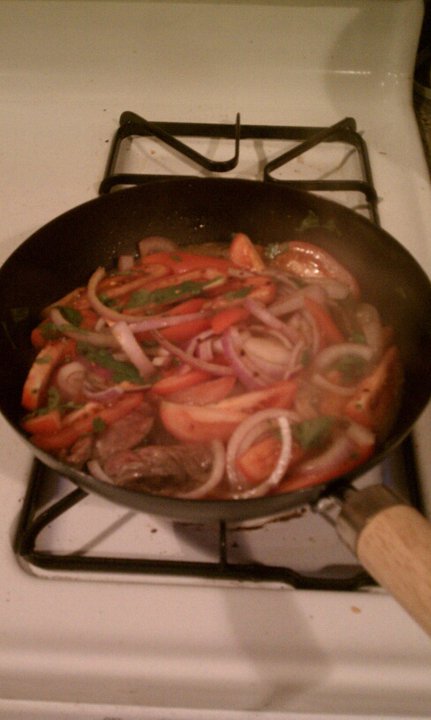
He lured me in with Lomo Saltado, a Peruvian dish consisting of sliced steak, tomatoes and onions marinated in vinegar and spices, then stir fried with a splash of soy sauce and topped with cilantro.  It is served over rice and fried potatoes, and he made a spicy Aji sauce to accompany the rice.  Holy Mary Mother of God!  This homemade hot sauce is quite possibly the best thing to ever happen to me, and I cannot wait to make my own.  I need to learn the proportions, but he told me that it’s easy to make and consists of habanero peppers, garlic, olive oil, salt and pepper.  

Letting someone else take control and do the work in the kitchen is one of the most difficult things I’ve ever done:

        “Can I help with anything?”  “No.” 
        “Can I at least do some dishes?” “No.” 
        “Really?” “Really.” 
        “Are you sure?” “Yes!” 

I literally had to go stand in the other room and watch from afar; standing in a kitchen and doing nothing felt far too odd and awkward.  I thought to myself, “This must be how goalies feel when the puck’s on the other side of the ice.”  I was fidgeting the entire time he cooked the stir fry.  I was relieved once the food was ready, because now I could do something with it, even if that something was simply shoveling it into my mouth. 

Along with our dinner, we shared a bottle of Rioja, which I tried for the first time last night.  I smelled and sipped the wine before I began eating so that the wine's flavor would be pure and would not have to compete with the flavors in the food.  My first thought?  The Rioja smelled exactly like Chianti.  I sipped; it tasted very similar to Chianti as well.  Definitely a variety I’d buy again.  Finally, it was time to taste the food. 

Each bite of Lomo Saltado was better than the last, and I wanted to savor each and every mouthful of the Aji-kissed rice.  I did – I painstakingly scooped up every last grain of rice with my fork until not one remained on my plate.  The meat was well-flavored and tender, the onions retained a slight crunch, and the tomatoes were bursting with flavor. He topped the dish with cilantro, which was the perfect foil for the spicy Aji sauce, and the Rioja was a great match for the dish as it was full-bodied enough to stand up to the bold flavors of Lomo Saltado.  When I commented that I thought the Aji sauce would be great on grilled tuna, he countered with, “It’s great on everything.”  I believe that.

This is definitely a recipe I’ll have to try on my own, but I’d be just as happy hopping in a cab and letting him wear the Chef hat!  I insist that you order this dish if you find it on a menu.  It’s a superstar!


Tuesday, September 21, 2010

Rock Out With Your Wok Out!

Lame title?  Possibly.  Great suggestion?  Definitely. 

So why stir-fry in a wok instead of a ginormous frying pan?  First, it's been done that way for centuries.  The wok's deep sides keep the food in the wok and off your stovetop.  Also, the large surface area allows you to move the ingredients about more freely than in a frying pan.  Last but not least, it's really fun. 

Stir-frying in one of the healthiest ways to cook foods - quick cooking retains nutrients and crunch while using only a small amount of oil, so stir-fried foods tend to be low in fat.  The key to a successful stir fry is to heat the wok thoroughly before adding the cooking oil - foods will not stick to the wok if you adhere to this principle. 

Last night, I made one of my favorite stir-fried recipes - Walnut Chicken, a recipe my mom has been making since 1992, and one of my all-time favorites.  She adapted this recipe from a magazine, and I remember eating this recipe during the Clinton campaign, so feel free to hum "Don't Stop Thinking About Tomorrow" while you cook.  It is generally served over rice, but since I had no rice, I served it over cooked millet instead.  Either way, it's fabulous. 

Walnut Chicken

for the stir-fry sauce:
2.5 T. low-sodium soy sauce
2 T. sherry or rice wine
1.5 T. water
2 t. cornstarch
1 t. sugar or agave syrup
1 t. grated fresh ginger
1/2 t. crushed red pepper flakes

1-2 t. canola oil
1 green bell pepper, sliced into bite-sized chunks
1 red bell pepper, sliced into bite-sized chunks
small bunch green onions, sliced into thick rings
2 chicken breasts, sliced into bite-sized chunks

chopped toasted walnuts, to serve

First, make the stir fry sauce by combining all sauce ingredients in a small bowl and mixing until the cornstarch is dissolved completely. 

Heat the wok thoroughly, and then add a teaspoon or two of cooking oil.  Add the red and green peppers and green onions; stir fry for no longer than two minutes. 

Remove peppers and green onions from wok, and set aside. 


Next, add another teaspoon of canola oil (if necessary) and stir-fry the chicken pieces.  Continue stir-frying the chicken for 4-5 minutes, until no pink remains and the chicken is slightly browned on the outside.


Once the chicken is browned, return the veggies to the wok, along with the stir-fry sauce.  Stir together for a minute or two, then remove from wok and place in a serving container (keeping it in the wok will cause the veggies to continue cooking, and you don't want to cook away all the crunch).


Spoon over cooked rice or millet, and sprinkle with a handful of chopped toasted walnuts.  Enjoy!