Showing posts with label spicy food. Show all posts

Saturday, April 27, 2013

Around the World in Eighty Bites—Peru

My first introduction to Peruvian food came courtesy of a brief fling with a Peruvian guy. We split up quickly, but my love affair with Peruvian cuisine was the beginning of a beautiful friendship.

Peruvian Ingredients

From my first taste—Lomo Saltado with Aji Paste—to future finds such as my favorite, a layered potato dish called Causa, I’ve never tried a Peruvian dish I didn’t like. One of my close friends grew up in Peru, and she knows all the best Peruvian restaurants in and around Boston.

In recent years, Peruvian food has been touted as the next “It” cuisine. While Peruvian food is exotic enough to be a break from the ordinary, most Peruvian food is not so foreign that it cannot be easily made at home. Still, some authentic ingredients may not be easy to find if you do not live in an area with a significant Hispanic/Latino customer presence. Thankfully, we live in an era where anything we want is merely a click away, and there are plenty of online retailers selling authentic Peruvian foods.

I've created versions of several traditional Peruvian recipes that you can try at home!


Margarita Ceviche

2 cloves garlic, quartered
Juice of 2 limes
Juice of ½ orange
1 shot tequila anejo
1 habanero pepper, quartered
2 sprigs parsley, minced (leaves only)
3 sprigs cilantro, minced (leaves and stems)
A few paper-thin slices red onion
1 lb. dry sea scallops, cut into medallions*

Combine all the ingredients in a large glass or ceramic bowl. Cover with plastic film and place in the refrigerator. Let it chill for at least 2 hours (up to 12). Serve immediately in chilled bowls, or in margarita glasses with a salted rim!

* To cut the sea scallops, it helps if you place them in the freezer for about 30 minutes before slicing. When slicing, slice across the grain of the scallop as shown in the photo to the left—the blue lines in the photo represent the “grain” of the scallop, and the red line shows the direction that the knife’s blade should cut. Slice each scallops into 4 medallions of equal thickness.


Aji Sauce

1 thick slice baguette, torn into pieces
5 oz. can evaporated milk
2 aji amarillo chiles (use habaneros or serranos if you cannot find aji amarillos
2 small garlic clove, minced
2 sprigs cilantro, minced
1/3 c. grated cotija cheese
1 T. olive oil
Pinch smoked sea salt

Soak the bread for 10 minutes in the evaporated milk. Place the bread and milk in a blender or food processor with all remaining ingredients. Blend well until smooth. Keep refrigerated and use as a condiment.


Giant Corn with Cotija and Orange


Giant Corn
8 oz. dried giant corn (Goya sells this product)
4 c. cold water
2 dried de arbol or chipotle chiles
2 oz. cotija cheese, grated
Rind of1/2 orange
1 T. minced red onion
2 T. Aji Sauce (recipe above)

Soak the corn in the cold water overnight. Once soaked, drain the corn. Place it in a pot with the 2 dried chiles, cover with water by 2 inches, and bring to a boil. Boil for approximately 45 minutes, adding water if necessary.

Drain the corn and chiles and place in a bowl. When cool enough to touch, remove the chiles, mince them and place in the bowl with the corn. Add the cotija, orange rind, onion, and Aji Sauce. Blend well.

Serve either at room temperature or chilled.


Purple Potato Causa

1 lb. purple potatoes, peeled and diced
¼ c. grated cotija cheese
3 T. Aji Sauce (recipe above)
1 lime, halved
8 oz. canned crabmeat
2 T. mayonnaise
1 ripe avocado
Salt

Aji Sauce, to serve
Cilantro leaves, for garnish

Boil the potatoes in salted water. Drain and mash, incorporating the cotija cheese, Aji Sauce, and the juice from one of the lime halves. Set aside.

Combine the crabmeat and the mayonnaise and set aside. Next, mash the avocado with the juice from the remaining lime half and a pinch of salt.

Assembly will require a ring mold. To assemble the Causa, spoon a tablespoon or two of Aji Sauce onto a small plate. Set aside. Place your ring mold onto a sheet of parchment or waxed paper. Fill the mold with about 2 inches of the mashed potato mixture. Then, add a ½ inch layer of the avocado mixture. Finally, top the avocado with a 1 inch layer of crabmeat. Place the blade of a spatula under the parchment and over the plate containing the Aji Sauce. Slip the parchment out from the bottom, letting the mold slip onto the sauce (this will take practice—I ruined my first few tries!). Top with one or two cilantro leaves. Repeat until all ingredients are used, and serve chilled or at room temperature.

Giant Corn with Cotija and Orange


Margarita Ceviche


Purple Potato Causa


Peruvian Small Plates


Tuesday, February 19, 2013

Lemongrass Shrimp Skewers with Kiwi & Avocado Guacamole

Recently, I was lucky enough to spot U-7 shrimp at Seaport Fish (U-7 indicates that there are 7 or fewer shrimp per pound – these babies are pretty big!). Originally, I planned on cooking them simply with butter and garlic, but when I spotted kiwis at the local market, I decided to try something more exotic.

In addition to my kiwis, I picked up an avocado, some Serrano chiles, and on a whim, a few stalks of lemongrass. While the lemongrass didn’t contribute much flavor-wise, it certainly added to the presentation. Try this next time you’re craving spicy, tropical flavors!


Lemongrass Shrimp Skewers with Kiwi & Avocado Guacamole

4 stalks lemongrass
8 U-7 (jumbo) shrimp
Kiwi & Avocado Guacamole, as prepared below

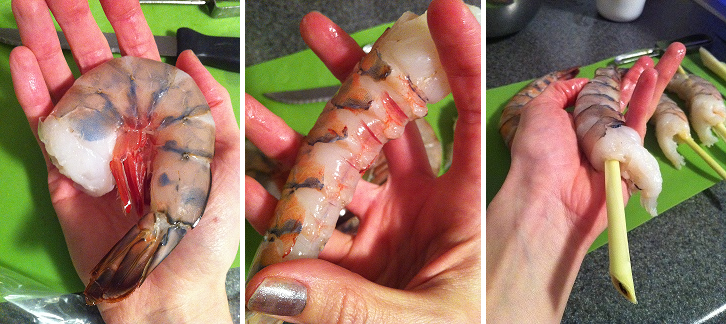
Prepare a grill or preheat your oven’s broiler. In the meantime, remove shells from shrimp, leaving the tail shell intact (this helps prevent the smaller end of the shrimp from drying out while cooking. Cut the lemongrass stalks in half, cutting diagonally so that a sharp point is formed (as shown in photo below right). Use your fingers to straighten the raw shrimp, and using the pointed end of the lemongrass spear, insert the lemongrass into the shrimp lengthwise (see photos below).


If using the broiler, line a baking sheet with foil, and place a wire rack on top of the foil. Place the skewered shrimp on the wire rack, and put the shrimp under the broiler. Cook the shrimp for 3-4 minutes, or until the shrimp are firm and pink. If using the grill, place the shrimp over slow coals and grill for 2-4 minutes, or until the shrimp are firm and pink.

While the shrimp cook, prepare two plates by spreading about ½ cup of the Kiwi & Avocado Guacamole on each plate. Once the shrimp are cooked, arrange four shrimp on each plate in a spoke formation.

* Nutritional info: serves 2. 335 calories, 11 g fat, 17 g carbohydrates, 45 g protein.


Kiwi & Avocado Guacamole

3 cloves garlic, very finely minced
2 serrano chiles, very finely minced*
1 T. finely minced onion
2 kiwis, peeled and minced
1 avocado, chopped

Combine all the ingredients in a large mixing bowl. Using a potato masher or a fork, mash until the guacamole is smooth and well-blended (you can use a food processer, but the texture will be almost too smooth—mashing manually gives a heartier texture). Cover the bowl with plastic film and set aside. This recipe makes about 2 cups.

*You can adjust the heat by using a milder or a hotter chile in place of serranos, or simply adjusting the number of chiles used.

* Nutritional info: serves about 4. 111 calories, 7.5 g fat, 15 g carbohydrates, 1.5 g protein.


Wednesday, October 17, 2012

Ingredient Spotlight – Tripe; Recipe – Tripe and Red Bean Stew

The other day, I had a craving for tripe…I am well aware that that’s a very odd thing for an American to say, but I love tripe. Its flavor is great, similar to a mild chicken liver, and it readily absorbs flavors of accompanying ingredients and sauces. Tripe’s texture is what makes it amazing. If you like the texture of barely-cooked sautéed calamari, you’ll love the texture of tripe! Thinly sliced in Vietnamese Pho, it blends in with the noodles and gives you a lovely, chewy surprise when you sink your teeth into it. In Spanish Callos, it adds a soft and silky counter to chorizo and morcilla, two dense, spicy sausages. In my recipe below, it simply satisfied my craving.

If you are unfamiliar with tripe, it is the lining of a cow’s stomach. If you’re put off by this, don’t be—if you’ve eaten sausage, you’ve eaten tripe. In fact, Wikipedia gives a list of global dishes containing tripe, and this list includes American breakfast sausage, which typically uses tripe as a filler. Most tripe sold in American markets is sold prepared, which means that it has already been dressed and pre-boiled. Even if it has been boiled, tripe benefits from slow cooking, so I boiled mine for an hour before adding it to the stew.

It may be hard to find tripe at your run-of-the-mill supermarket, but if you know of a good Italian or Latino market or butcher shop, you should be able to find good tripe.


Tripe and Red Bean Stew

For the Tripe:
1 lb. / 455 g honeycomb tripe
6 peppercorns
1-2 dried red chiles
Pinch salt
Water to cover

Place all ingredients in a large pot. Bring to a boil, cover, and simmer for about an hour. Drain, set aside until tripe is cool to the touch, then slice into thin strips.

 
For the Stew:
4 strips streaky bacon, chopped
1 small carrot, minced
1 large brown onion, diced
2-3 garlic cloves, minced
2 serrano chiles, minced
2 green peppers, chopped, divided
1 lb. / 455 g. fresh roma tomatoes, chopped
1 28 oz. / 822g can red beans (do not drain)
Tripe, cooked as prepared above
Generous pinch dried chipotle pepper
2 t. / 5 g. dried oregano
1 packet La Flor brand sazon (or another brand without MSG)
Splash water or chicken broth
Drizzle olive oil
Handful chopped cilantro

Heat a large, heavy-bottomed pot over a medium flame and add the bacon. Cook until the bacon begins to crisp, then add the carrot, onion, garlic, Serrano chiles, and one of the chopped green peppers. Cook for 5-7 minutes, or until the onion has softened.

Now, add the tomatoes, red beans, tripe, chipotle pepper, oregano, sazon, and water or chicken broth. Stir, then cover and reduce heat. Cook for 25 minutes, stirring occasionally.

Add the remaining green pepper and cook for 3-5 minutes, stirring regularly. Top with a drizzle of olive oil and chopped cilantro. This dish is delicious on its own, but is also wonderful served over seasoned rice.

* To purchase ingredients used in this recipe, click the link(s) below:

Frontier Herb 61965 Organic Chipotle Chili Peppers (Google Affiliate Ad)

Nutritional information (without rice): serves six. 230 calories, 6g fat, 28g carbohydrates, 19g protein


Sunday, July 22, 2012

Creamed Callaloo with Jerk-Seasoned Chicken

This summer, the local farmers’ harvests have been good to me. I’ve picked up early season green tomatoes, some fantastic golden raspberries, fresh garlic, rainbow carrots, and a bounty of other goodies, and to my surprise, one of the vendors was once again selling Callaloo, a green leafy vegetable that grows in tropical climates and is popular in Caribbean cooking, especially when made into a hearty stew bearing the same name (click here for my Callaloo recipe).

The actual species that gives us Callaloo leaves is the amaranth plant, a powerhouse whose seeds nutrient-packed, gluten-free seeds are cooked like grains. Back to the leaves—Callaloo leaves are full of vitamins A and C, and they taste like milder spinach.


Creamed Callaloo with Jerk-Seasoned Chicken

Callaloo leaves
1 T. / 15 mL coconut oil
1 t. / 4 g grains of paradise (also known as melegueta pepper)
1 large brown onion, sliced
1 serrano chile, minced
1 bunch callaloo leaves, chopped and rinsed
1 c. / 230 mL coconut milk
Juice of 1 lime
Salt and pepper to taste
Cooked rice, to serve
Grilled Jerk-Seasoned Chicken, to serve (recipe below)

Heat the coconut oil over medium heat in a large, heavy-bottomed pot. Add the grains of paradise, onion, and Serrano chile. Cook for about 10 minutes, stirring occasionally, until the onion becomes soft and translucent.

Add the callaloo leaves and a splash of water. Stir, then cover and reduce heat to low. Cook until the leaves have begun to wilt.

Add the coconut milk, lime juice, salt and pepper. Cook, stirring frequently, until heated through. Spoon over cooked rice and serve alongside Grilled Jerk-Seasoned Chicken


Grilled Jerk-Seasoned Chicken

20 allspice berries, ground
½ t. / 3 g grains of paradise (also known as melegueta pepper)
1 t. / 4.5 g. ground ginger
2 t. / 9 g cayenne pepper
2 t. / 9 g garlic powder
2 t. / 9 g dried thyme
2 t. / 9 g salt
Approx. 2 lbs. / 1 kg chicken breast tenders, pounded ultra-thin

Combine all ingredients except the chicken. Blend well, then rub the spice mixture into the chicken. Grill over medium heat, approximately 2 minutes per side. Serve with Creamed Callaloo.

Nutritional info: serves six.  425 calories, 14 g fat, 34.5 g carbohydrates, 39 g protein.


Saturday, June 9, 2012

Blackened Grouper with Tequila Sunrise Slaw

I’ve been back from Florida for over a week, but apparently no one told my tastebuds. Each day since I’ve been back has been filled with citrus fruits, Island-inspired seafood recipes, and a few lovely Cuban-style black bean dishes. When I opened Mercato del Mare’s newsletter on Friday and saw that they had fresh Florida grouper for sale, I began to truly believe that while my brain belongs in Boston, my stomach belongs in Key West.

I wanted to serve something crunchy and cool with a little bit of a kick alongside the grouper, which I immediately knew I’d serve blackened. I’m still a little hazy on how my idea evolved and how I ended up inspired to make a slaw based on the tequila sunrise, a classic cocktail made with tequila, orange juice, and grenadine, a dark red syrup made from pomegranates or black currants. However I landed here, I sure am glad I did—this dish worked so well that it may be my signature summer dish going forward!


Blackened Grouper with Tequila Sunrise Slaw

For the Slaw:
1 large orange- zest in thin strips, segments diced
1 small jicama, grated with the large holes of a box grater
1 fresno chile, minced
1 jalapeno, minced
1 green onion, sliced
½ t. / 3 g dried chipotle flakes
2 T. / 30 mL tequila
2T. / 30 g pure pomegranate juice
1 T. / 15 mL olive oil
Salt and pepper to taste

For the Grouper:
6  2.5 oz. / 70 g portions grouper fillet
olive oil
Cajun seasoning

First, prepare the slaw by mixing all the ingredients in a large bowl. Cover and refrigerate for at least one hour.

Now, prepare the grouper. Heat a large cast-iron frying pan over the highest heat. It is hot enough when a drop of water dances across the surface rather than sizzling. Brush each grouper portion with olive oil, then coat in Cajun seasoning. Add the grouper to the hot frying pan and cook for about 1-2 minutes per side, or until the coating starts to turn black. Note, this process will create smoke – if you don’t want to deal with your smoke alarms, make sure to have your windows open and air circulating.

Divide the slaw into six portions and place on small plates, then place a portion of blackened grouper on top of the slaw on each plate.

Nutritional information: serves 6. 144 calories, 4 g fat, 10 g carbohydrates, 16 g protein.


Tuesday, February 28, 2012

Around the World in Eighty Bites - Uganda

As my loyal readers know, I keep track of the countries around the world that read this blog. While it’s fun to watch my numbers increase, the main reason I track my international readership is because I want to try as many different cuisines as possible, and knowing that I’m reaching real people across the globe keeps me inspired to create many new variations of traditional ethnic and national recipes. I also like being able to share the recipes with people who, like me, travel vicariously through their taste buds.
 
from nationsonline.org
The 97th country to hop on the www.baconbutterbooze.com bandwagon was Uganda. Like many countries that have been prone to invasion, Ugandan food features mainly native ingredients while reflecting the influences of invading countries’ cuisines. European, Arab, and Indian traders and explorers brought with them ingredients that have been incorporated into traditional Ugandan cuisine, but traditional dishes rely on native staples such as bananas, yams, and smoked or dried fish.

Cooking Ugandan food was a bit intimidating to me, because with the exceptions of Morocco and Ethiopia, most African nations’ cuisines haven’t become trendy yet, and I feared that finding enough information about the cuisine and its ingredients and cooking techniques would be difficult. However, when I’m intimidated by a kitchen project, I always accept the challenge and step up to the plate, so with a little bit of web research and a basket of fresh ingredients, I was ready to cook. After browsing through about a dozen Ugandan recipes, I selected Oluwombo. Oluwombo is a traditional Ugandan dish featuring meat and smoked fish cooked with tomatoes, peanuts, and mushrooms. I chose this dish because it was so different from the dishes I’ve cooked in the past.

While researching, I found several variations of the meat used in the dish - some used beef, some used chicken, and pork and goat were also featured in a few recipes. The other ingredients had no significant variation from recipe to recipe. Oluwombo is traditionally steamed in banana leaves for almost two hours, but to save time, I’ve varied the cooking method to create a stew that captures the flavors, but requires less preparation and cooking time. My first reaction? “How did I live without this for 30 years?”

Try this when you’re seeking something different from your typical beef stew!


Oluwombo-Inspired Stew

1 T. coconut oil
12 oz. sirloin, cut into ½” cubes
1 small onion, minced
2 medium tomatoes, chopped
1 c. peanuts, crushed
3 oz. Tomato paste
1 cup beef stock or bouillon
4 oz. Fresh button mushrooms, finely chopped
2 chipotles in adobo, minced, plus 2 T. adobo sauce
½ t. toasted cumin seeds, ground
¼ t. ginger
¼ t. turmeric
6 oz. Smoked whitefish, skin and bones removed and flaked

4 baked plantains (instructions below), sliced
Crushed peanuts, to garnish

In a large, heavy-bottomed saucepan, heat 1 T. of the coconut oil over medium-high heat until it has melted. Add the sirloin and cook for several minutes until the meat has browned. Remove the meat with a slotted spoon and set aside, and if a lot of liquid and fat has been released from the meat, drain it. Add more coconut oil if necessary, then add the onion and cook for 3-5 minutes, or until the onion has softened.

Add all the remaining ingredients and the browned sirloin. Stir, reduce the heat to low, and cook for about 45 minutes, stirring occasionally. Once cooked, serve over slices of baked plantain and garnish with crushed peanuts.

Serves four.  Nutrition facts per serving: 790 calories, 68g carbohydrates, 35g fat, 56 g protein


Baked Plantains

4 plantains

Start with plantains that are in their medium stage of ripeness - beginning to blacken, but with a fair amount of yellow still showing. Preheat the oven to 425, and in the meantime, slice the ends off of each plantain, then halve lengthwise. Place the plantains skin side down on a baking sheet, and bake for 30 minutes. Remove from oven, and once the plantain halves are cool enough to touch, peel the skins off and slice the plantain halves into half-inch chunks.

Serves four.  Nutrition facts per serving: 180 calories, 48g carbohydrates, 0.3g fat, 1.2g protein


Friday, January 13, 2012

Stuffed Plantain Rolls with Callaloo, Bacon and Warm Chipotle Butter

This Christmas, Santa brought me some books on Puerto Rican and Floridian cooking. While I'm familiar with the names of most of the ingredients, I haven't had the experience of cooking with some of them, particularly plantains.  I love plantain - whether it's fried, mashed, or grilled, I've always been a fan of their starchy, semi-sweet flavor. So when I saw plantains in my produce department with a "4 for $1" tag, I threw a few into my basket. Talk about an offer I couldn't refuse! 

semi-ripe plantain
For those of you unfamiliar with plantains, they look almost identical to bananas.  However, they do not taste like bananas, nor can they be eaten raw - plantains must be cooked.  The great thing about plantains is that they can be eaten from their green stage to their fully black stage, each stage of ripeness offering different flavors and textures.  When green, they are starchy and potato-like; when black, they are much sweeter and less firm.  I like them best in the in-between phase, when the skins are starting to turn brown and spotted. 

Unsure of how I wanted to cook my plantains, I reached out to my friends and my Baconbutterbooze.com Facebook followers for input, but in the end, a spark of inspiration (and my compulsion to spike everything with bacon) led me to create the recipe below.  If you can find ripe plantains and callaloo, this recipe is one that I highly recommend! 


Stuffed Plantain Rolls with Callaloo, Bacon and Warm Chipotle Butter

4 c. cooked callaloo leaves*
4 chipotles in adobo, minced
1 T. adobo sauce
2 t. ground ginger
1 t. garlic powder
1/2 t. ground allspice
generous amount finely ground black pepper
1/2 t. salt
2 T. bread crumbs
2 semi-ripe plantains, peeled and cut lengthwise in 4 thin slices
8 slices thick-cut bacon
8 pats butter
Warm Chipotle Butter (recipe below)

Preheat the broiler to high, and soak 16 toothpicks in water.  In the meantime, make the stuffing.  If the cooked callaloo has any moisture, drain it in a colander, pressing any remaining liquid out.  Once drained, place it in a mixing bowl with the minced chipotles, adobo sauce, ginger, garlic powder, allspice, pepper, salt, and bread crumbs.  Mix well and set aside. 

Now, assemble the plantain rolls.  Take each strip of plantain, create a ring, and secure with a toothpick, as shown in the photo to the left.  Stuff the center with the callaloo stuffing, packing it in - it should be packed in tightly.  Next, stretch a slice of bacon around the plantain, and secure with a second toothpick.  Push the toothpicks in so that only the ends of each toothpick are visible - they have a tendency to burn.  Finally, top each roll with a pat of butter. 

Broil 3-4 minutes per side, using barbecue tongs to turn.  Turn them over carefully so that you don't squish the plantains or lose the stuffing mid-turn.  Once both sides are broiled, remove from the oven, turn the broiler to low, and finish under the broiler for about 10-15 more minutes. 

Remove from oven, drizzle with Warm Chipotle Butter, and serve hot.

* If you cannot find fresh callaloo leaves, canned callaloo can be purchased online. 


Warm Chipotle Butter

3 T. butter
1 T. adobo sauce, from can of chipotles in adobo
1 T. malt vinegar

Melt the butter in a small saucepan.  Whisk in the adobo sauce and malt vinegar.  Continue whisking until the vinegar's aroma has dissipated, and drizzle the hot melted butter over the Plantain Rolls.


Tuesday, July 19, 2011

Around the World in Eighty Bites - Jamaica

Perhaps I should have saved this post for wintertime, a time when anything that can point one's thoughts in the direction of a warmer climate is greatly appreciated, but my tastebuds go where my cravings take me - I don't plan this stuff.  This week, they went to Jamaica.  Jamaican food is highly underrated in this country, which is a shame because it is creative, distinct, and perfect for the sweltering heat Boston has been getting for the past few weeks.

Jamaican culture is often parodied in mainstream American media through depictions of dreadlocked Rastafarii smoking ganja, paired with thought bubbles containing the words, "Hey, mon!" or "We jammin!" Yes, some Jamaicans smoke weed - so do some Bostonians, but we don't see cartoons of red-haired, pink-faced guys in Sox hats smoking blunts with the caption, "Yeahhhh, bro! Reefahhhh!" Ohhh, stereotypes. Behind this all-too-popular mockery is an exciting culture stemming from collective resistance to one of mankind's greatest wrongs, and out of that culture came inspired cooking.

The slave trade, that brutal scar on humanity's history, is the greatest factor in the formation of Jamaican cuisine and culture. With the slave trade came ingredients from Africa, as well as those brought to the Island by white people. Once the legal slave trade was ended, Asian-Indian labor was used in Jamaica's sugar plantations, and curries became popular on the Island, taking on a Caribbean flavor.

Prevalence of the Rastafarian image in American media does not reflect Jamaican culture as a whole. Hollywood would have us believe that Jamaican food is centered around pot brownies, which is certainly not the case. However, Rastafarians do have a dietary regimen in place - called Ital - which simply bans processed foods.  Was this an early version of the Slow Food movement? 

For this post, I cooked two traditional Jamaican dishes with ingredients common enough in the States that you should have no problem duplicating them. These recipes go from good to great when combined with rum drinks and Buju Banton!
 
Beans & Rice

1 T. coconut oil (or other vegetable oil)
1 yellow onion, chopped
1 can Goya dry pigeon peas
1 fresno chile or red jalapeno, chopped
3 cups cooked rice, seasoned with Goya Sazon
1 green bell pepper, chopped
1 t. garlic powder
1/2 t. allspice powder
2-3 green onions, sliced
salt & pepper to taste

Heat the coconut oil over medium heat in a large, heavy-bottomed pot. When it has melted, add the yellow onion. Cook for a few minutes, stirring occasionally, until the onion has softened a bit.

Next, add the pigeon peas and fresno chile. Cook for another minute or two, just until the pigeon peas are heated through. Finally, add the cooked rice, green pepper, garlic powder, allspice, green onions, and salt and pepper. Stir until well-blended, then continue stirring until it is heated through. Serve with Jerk Chicken.


Jerk Chicken

1 pound chicken breast strips, pounded thin with a meat mallet
1 batch Jerk marinade (see recipe)

Marinate the chicken strips for 1-4 hours in the jerk marinade. Cook on the grill, 2-3 minutes per side, or until cooked through. If you do not have a grill, bake in a 400-degree oven for approximately 20 minutes, turning once.


Jerk Marinade

This is my adaptation of a recipe found in Bon Appetit's July 2011 issue.

4 T. vegetable oil
1/4 cup fresh lime juice
4 green onions, chopped
4 habanero peppers, chopped*
2 garlic cloves, chopped
1 T. dried thyme (or 2 T. fresh)
1 T. grated fresh ginger
1 T. brown sugar
2 t. ground allspice
1 t. salt
1/2 t. finely ground black pepper
2 T. malt vinegar

Combine all the ingredients in a blender. Process until a consistent puree is achieved.

* If you can't take the heat of habaneros, you can wimp out and use jalapenos.

Wednesday, June 15, 2011

No Leftovers Left Behind

These days, I've been doing a lot of cooking for one.  Not necessarily a bad thing, but solitary cooking does carry with it the drawback of having tons of leftovers, leaving me to ask myself, "Why did I feel it necessary to cook an entire pound of potatoes to make one salade nicoise for myself?" and "Why did I make about two cups of aji paste when I only needed 2 teaspoons?"  My poor roommate is probably asking, "How on God's green earth does one person manage to take up so much fridge space?!?" 

If this sounds all too familiar, it's time to set aside your gripes about logistics and volume because leftovers leave the home cook with endless possibilities.  Me?  I've got nothin' but love for leftovers, so I'll share with you some of my favorite ways to transform leftovers into entirely new and exciting dishes.

If you have leftover aji paste:

Spicy Tuna Salad

2 cans tuna in olive oil
1/4 c. sour cream
1 T. aji paste
1 T.  lemon or lime juice
1/4 c. chopped cilantro
salt and pepper to taste

Combine all ingredients in a bowl and stir until blended.  Serve on tortilla crisps. 


If you have lots of leftovers from making Nicoise Peruvienne:

Aji Potato Salad

2 c. cooked potatoes, chilled
2 T. aji paste
1/4 c. sour cream
steamed green beans, sliced into 1-in lengths
handful chopped cilantro
splash olive oil
splash lemon juice


If you have leftover roast chicken or duck:

(Really?  Who has leftover duck?!?)

Spinach Salad with Roast Poultry

2 c. baby spinach
1/2 c. roast chicken or duck, shredded
1/2 c. soft cheese seasoned with herbs and/or garlic
2 roma tomatoes, seeded and diced
1 hard-cooked egg, chopped
vinaigrette

Combine ingredients in a salad bowl and toss with vinaigrette. 


If you have leftover beef or pork:

(Again, really?!?)

Fried Rice

2 T. soy sauce
2 t. toasted sesame oil
1 t. grated fresh ginger
pinch crushed red chile flakes

sesame oil
1 egg, beaten
1 cup cold cooked rice (must be cold, or it will turn mushy!)
1/2 c. cooked beef or pork
1/2 c. frozen peas
2 green onions, sliced into rings


First, make the stir-fry sauce by combining the soy sauce, sesame oil, ginger and chile flakes in a small bowl.  Set aside.

Heat a wok or large frying pan over medium-high heat.  When hot, add a teaspoon or so of sesame oil.  Add the beaten egg.  Stir-fry the egg until it is firm.  Remove from wok and set aside.  Add more sesame oil if necessary, and add the cold rice.  Stir fry until the rice begins to crisp and is completely coated with the sesame oil.  Remove from wok and set aside (you can combine it with the egg). 

Now, add the beef or pork, peas, and green onions.  Stir fry for a minute or two, then add the stir fry sauce and stir fry for an additional 2-3 minutes.  Finally, add the rice and egg to the mixture, blend until rice is coated with the sauce, and serve hot.


If you have random leftover vegetables:

Soup:
Throw them in a pot with some chicken broth, a small can of tomatoes, and a can of cannelini beans.  Simmer for 20 minutes and woohoo, you made soup!

Pasta:
Throw your veggies in a pot with some Classico brand Alfredo sauce.  Add a little cooked chicken if you'd like.  Heat up the sauce over medium-low heat, add some cooked short pasta (such as rotini), and woohoo, you made veggie alfredo!

Polenta:
Make a batch of polenta following the recipe given here, and add diced veggies along with the butter.

Wednesday, June 8, 2011

Inspiration on 'Roids - New England Nicoise, Nicoise Peruvienne

Yup, this bacon, butter, steak, mayonnaise, sour cream, cheese, and pork rind-loving blogger is writing an entire post about salad.  But I'm not writing about rabbit food; I'm writing about new twists on an old favorite, and I'm writing about a salad that is substantial enough to take center stage.  I'm writing about Salade Nicoise.  No lightweight, this French classic contains potatoes, green beans, hard-cooked eggs, olives, tomatoes, tuna and anchovies, nestled in a bed of rich butter lettuce and dressed with tangy dijon vinaigrette.  This is not a dish that will leave you hungry. 

So what happens when this French salad meets ingredients native to my side of the Atlantic?  Magic.  Pure magic happens.  The two salads I created were not planned; rather, I got a boatload of inspiration during one random food shopping excursion and decided to try something new, and the results may be two of my favorite creations to date. 

It all started with a batch of purple potatoes. 

Purple potato cross-section

We've all seen red and yellow potatoes, but purple ones are far less common, at least here in Northern New England.  However, in Peru, the potato's homeland, potatoes come in a variety of colors spanning the rainbow.  When I saw purple potatoes at the market, I loaded them into my basket.  I had no idea what I'd do with them, but I never worry about that until after I'm home and all my groceries are put away.  I started to think - I could boil them?  I could bake or roast them?  Potato salad?  Boring, boring, boring.  I then started to scan my brain for recipes containing potatoes where the color would really stand out, and I came up with salade nicoise.  I felt wicked smart until I thought, "Purple potatoes in a salad?  So f***ing what?"  I knew color alone wouldn't lift my dish from ordinary to extraordinary, but then it hit me - I could add a little aji.  Aji is a traditional Peruvian condiment made from chiles, garlic, and olive oil, and it turns everything it touches to gold.  OK, maybe that's an exaggeration, but it's really damn good.  Once I had aji on my brain, my ideas started snowballing until I realized that I could replace tuna with ceviche, another Peruvian specialty.  And just like that, I created a recipe. 

I couldn't wait to test my recipe, so I ran to the store to pick up all the ingredients I'd need for the ceviche, the aji sauce, and the salad itself.  Cod?  Check.  Chiles?  Check.  Tomatoes?  Check.  Wait - what's that in that bin over there?  Ohhh Lord...I found fiddleheads. 


Fiddlehead
For those of you who don't live in Northern New England, fiddleheads are the edible fronds of young ostrich ferns.  You cannot visit a market in Maine during late spring without seeing at least one basket of fresh fiddleheads.  When steamed or lightly boiled, they retain their bright grass-green color and crunch, and they taste like a green bean/artichoke hybrid.  And face it - they look wicked awesome! 

Back to my market trip - I saw the fiddleheads and knew I had to have them.  While picking through the basket for the smallest, most tightly coiled fiddleheads, my mental wheels began turning and trying to come up with a plan for the fiddleheads.  They're good with just a little salt, pepper, and butter; they're great with hollandaise, and they can replace green beans in any dish.

Waaaiiittt a minute - green beans are used in salade nicoise...use the fiddleheads instead of green beans, and voila!  New England Nicoise.  Hmm, what other ingredients scream "New England?" and would also work in a salad?  Duhhh, lobster!  I'm sure the other market patrons were quite amused seeing this tiny little girl talking to herself out loud and stopping dead in her tracks to turn around and go pick up another ingredient when the light bulb went off over her head, but that's how I roll when inspiration skyrockets.  I whirled around the store like a madwoman, throwing ingredients into my basket and at the same time writing memos to myself on my iPhone so I wouldn't forget my ideas. 

Getting inspired was the easy part.  The hard part was the prep work, especially for Nicoise Peruvienne, which is a recipe within a recipe within a recipe.  While nothing in these recipes is difficult, the process is time consuming.  The most important part of preparing this dish is your mise en place, which is a fancy-schmancy chef term meaning "having one's $#!t together."  Once all the prep work is out of the way, this salad goes together in under 10 minutes, but if you try to assemble it while boiling potatoes, cooking eggs, making vinaigrette, etc., you'll be making a lot of extra work for yourself, and the process will be needlessly stressful. 

If you come across fiddleheads or purple potatoes, do try these two salads.  They are delicious, fun to make, and both are guaranteed to be great talking points if you serve them to guests. 


New England Nicoise

2-4 cups butter lettuce, torn
1/2 lb. baby potatoes, quartered
2 roma tomatoes, quartered lengthwise
2 hard-cooked eggs, quartered lengthwise
1/2 lb. fiddleheads, steamed
1 lb. cooked lobster meat, chopped
8 black olives, pitted
vinaigrette

Boil the potatoes and steam the fiddleheads in advance.  Let chill for at least two hours. 

Assemble the salads.  Fill 2 large bowls with equal amounts of lettuce, then arrange the potatoes, tomato, and egg in a decorative pattern along the edge of the bowl.  Add the fiddleheads and lobster meat to the center, then dress with desired amount of vinaigrette.


Vinaigrette

1 garlic clove, smashed
1 t. dijon mustard
2 T. tarragon vinegar
1/3 c. olive oil
salt & pepper

Whisk all the ingredients in a bowl.  Cover with plastic wrap and set aside for at least an hour.  Remove the garlic clove, whisk again, then use to dress New England Nicoise. 


Nicoise Peruvienne

2-4 c. butter lettuce, torn into bite-sized pieces
2 roma tomatoes, quartered lengthwise
1 avocado, sliced lengthwise
2 hard-cooked eggs, quartered lengthwise
1/4 lb. green beans, steamed
2-4 purple potatoes, quartered lengthwise
2 cups ceviche
aji vinaigrette

Begin prep at least 4 hours, and up to 24 hours, ahead.  Prepare the ceviche style whitefish, hard-cooked eggs, and the aji vinaigrette (recipes below).  Boil the potatoes and steam the green beans, let both cool to room temperature, then refrigerate until it is time to assemble the salads. 

Assemble the salads.  Fill 2 large bowls with equal amounts of lettuce, then arrange the tomato, avocado, and egg in a decorative pattern along the edge of the bowl.  Add the potatoes, green beans, and ceviche, then dress with desired amount of aji vinaigrette. 


Ceviche

1/2 lb. cod or other firm whitefish, cut into chunks
1 serrano chile, minced
1 clove garlic, minced
1/3 c. freshly squeezed lime juice
salt and pepper

Combine all the ingredients in a nonmetallic bowl.  Cover and let marinate in the fridge, stirring occasionally.  Marinate at least 4 hours; preferably overnight. 


Aji Vinaigrette

1T. aji sauce (recipe below)
1 clove garlic, minced
juice of 2 limes
1/2 c. olive oil.

Combine all ingredients in a bowl and whisk until blended.  Use to dress Nicoise Peruvienne.  Any leftover vinaigrette can be used on chicken, fish, potatoes, vegetables, rice...you name it. 


Aji Sauce

5 habanero peppers (can use a milder pepper if you can't take the heat of habaneros)
2 cloves garlic
1 T. chopped cilantro
salt & pepper
splash olive oil

Combine ingredients in a blender and puree until a thick, consistent paste is formed.  Use in Aji Vinaigrette.

Sunday, April 10, 2011

Make Room for Mexican!

Even since I purchased my Spanish and Mexican cookbooks, I've had culinary tunnel vision.  But when I wind up cooking dinners like the one I made, I can't bring myself to think it's a bad thing!  Using a few simple, fresh ingredients, you can whip up a delicious Mexican feast in next to no time.  Most of the ingredients are easy to find, but you may have to search to find chayotes, which are a squash variety native to central America.  If you cannot locate chayote, substitute yellow summer squash.  Serve with seasoned rice.


Baked Snapper
juice of 1 lime
2 cloves garlic, crushed
1 t. dried oregano
2 whole snapper, cleaned*

Preheat the oven to 350. In a small bowl, combine the lime juice, garlic, and oregano.
Now, make shallow incisions in the bodies of the fish on each side.  Place the fish in a baking dish large enough to accomodate both fish without them touching, then pour the lime juice blend into the fish's cavities and rub into the incisions, as shown in the photo.  Bake for 30 minutes, or until the fish flakes easily with a fork.  Serve with Veracruz salsa.   

* You can also use fillets of firm whitefish, such as cod or tilapia, if you don't want to use whole fish.  If the fillets are less than 1 inch thick, reduce cooking time to 20 minutes. 


Veracruz Salsa
generous splash olive oil
2 fresh serrano chiles
2 cloves garlic, minced
3 bay leaves
2 shallots, sliced into thin strips
4 tomatoes, diced
1/2 c. picked jalapenos
1/2 t. ground cinnamon
1 cup green pimiento-stuffed olives
generous grind fresh black pepper
salt to taste

Heat the olive oil in a saucepan over medium heat.  Add the chiles, garlic, bay leaves, and shallots, and cook until the shallot has softened, stirring intermittently.  Next, add the tomatoes, jalapenos, and cinnamon.  Cook for about 10-15 minutes, or until the tomatoes are no longer firm.  Now, add the olives and salt and pepper, and cook just until the olives are heated through.  Serve over baked fish.  This is also delicious added to rice. 


Chayote Salad
2 chayotes, peeled and halved
2 tomatoes, diced
1 shallot, sliced into thin strips
3 T. olive oil
3 T. white wine vinegar
1 t. dijon mustard
1 t. anise seeds
salt and finely ground black pepper to taste

Boil the chayotes for 5-10 minutes, until the flesh has softened up a bit.  Let cool, then dice.  Combine the diced chayote and all remaining ingredients in a large glass bowl.  Serve cold. 


Stinging Margaritas 
1/2 cup tequila
1 cup Simply Limeade
splash Triple Sec
1 serrano chile, halved
kosher salt mixed with a dusting of cayenne, to rim glasses

Combine all ingredients except salt in a cocktail shaker with a few ice cubes.  Shake for 30 seconds, then pour into margarita glasses rimmed with the spiced salt.  Recipe serves two. 


Wednesday, March 30, 2011

Ingredient Spotlight - Cactus Pads (Nopales)

Artichokes.  Asparagus.  Fresh peas.  I doubt many of my fellow New Englanders would add cactus to this list of veggies we associate with spring, but if we lived in Mexico, we might change our tune.  Cactus pads, or nopales, are grown and sold in Mexico and are at their best in the spring, but they are neither common nor easy to find in the U.S., especially the northern U.S.  This is unfortunate.  If you ever see nopales at the market, do yourself a favor and pick up a few.  Just be careful picking them up - after all, they ARE cactii, and they WILL stab you. 


Preparing nopales is a pain in the you-know-what (and the hands, if you're careless), but I'm willing to put up with a little aggravation in order to experience new tastes and textures.  I found that nopales taste like a cross between a green bean and an artichoke, with the texture of cold Chinese-style jellyfish...wait, what?  OK, I guess I could compare it to just-barely-cooked calamari...but the jellyfish comparison is far more accurate, so if you haven't tried jellyfish, get on that!  Anyway, to prepare fresh nopales, simply trim the edges and slice off the spines using a small, sharp paring knife, then slice into bite-sized pieces, boil in salted water for about 10-15 minutes, and use in recipes of your choice.  I've included two refreshing recipes below!

Nopales Salsa

1 lb. nopales, prepared as described above*
1/2 red onion, minced
1 cup canned tomatillos, drained and chopped
2 fresh serrano chiles, minced
1 t. dried oregano
juice of 1 lime
splash olive oil
handful chopped cilantro
salt and freshly ground black pepper to taste

Combine all the ingredients in a glass bowl.  Chill at least 24 hours to let the flavors blend, then serve as desired.

* If you cannot find fresh nopales, prepared nopales in a jar can be purchased online. 

Individual Rice Bowls with Nopales Salsa

1 cup cooked rice, seasoned with Goya Adobo
1/2 c. shredded grilled chicken (you can also use pork, steak, or shrimp)
1/2 c. nopales salsa
avocado slices, to serve
sour cream, to serve
lime wedges, to serve

In a shallow bowl, place the rice, chicken and nopales salsa alongside each other.  Garnish with the avocado slices, sour cream, and lime wedges.

Tuesday, March 15, 2011

Cooking for a Cause

The food I cook, the posts I write, and the general tone of this site is intended to be a celebration, a gastronomic gala, a tip of the hat to unapologetic hedonism.  And that is fine - this isn't a newspaper, and it isn't a political forum.  However, I would be remiss if I did not mention this week's tragedy in Japan.  We can definitely put down our forks, knives, and wine goblets for a moment and acknowledge that people are suffering.  As human beings, one of our more appealing qualities is our compassion, our instinctive drive to alleviate the suffering of our brothers and sisters.  So I write this post today with a bit more purpose than usual.  Enjoy the photos, enjoy the recipes, but don't stop there.  Starting tonight, for every re-post or re-tweet, I will donate 50 cents to the Red Cross's relief efforts in Japan.* 

tamarind pods
When I came up with this idea, the devastation was still unfolding and nobody knew who would be affected.  Because this site has readers in at least 10 Pacific Rim countries, I decided to make this weekend's recipes using ingredients native to areas that either were, or could have been, affected by this tragedy.  My readers mean the world to me, and if I can cook for a cause and do something to help, I will gladly do so.  With that, I bring you two recipes - Marinated Salmon with Coconut, and Spiced Beef with Tamarind. 

If you live in a city with a great supermarket and/or a large Asian/Pacific Islander population, most of the ingredients I use should be fairly easy to locate.  If you cannot find tamarind pods, you can buy whole tamarind pods online, or you can substitute prepared tamarind pulp.  If you cannot find serrano chiles, 1/2 t. crushed red pepper flakes is pretty close to the heat level of one serrano chile. 


Marinated Salmon with Coconut

1 lb. very fresh salmon, sliced into 1/3" strips
juice of 2 limes
1 T. fresh ginger, grated or very finely minced
1-2 shallots, sliced thin
1 serrano chile, seeded and thinly sliced
2 tomatoes, diced
2/3 c. coconut milk
splash sesame oil
salt and cracked black peppercorns

In a glass or ceramic bowl, combine all ingredients except the coconut milk, sesame oil, salt and pepper.  Mix well, cover, and refrigerate for 2-3 hours, stirring occasionally. 

Once the dish has chilled for at least two hours and the salmon looks "cooked" due to the lime juice, add the coconut milk, sesame oil, salt and pepper.  Toss and serve.  A few extra chile slices or a lime wedge would make a nice garnish. 


Spiced Beef with Tamarind

4 oz. tamarind pods (or substitute 2 T. tamarind paste)
1 T. coconut oil
1 3-inch cinnamon stick
2 shallots, minced
2 serrano chiles (red or green), minced
2 T. fresh ginger, minced
1 lb. beef sirloin, sliced into thin strips
1/4" light rum
1 cup coconut milk
splash sesame oil
salt and pepper to taste
cooked rice (when you cook the rice, add a cinnamon stick to the water for additional flavor)
ground cinnamon, for garnish


If you are using fresh tamarind, the pulp must first be extracted from the pods.  This is not a difficult process, but it does take a bit of time and effort and produces a product far superior to the concentrated paste you'll find in jars. 

In the photo collage below, from left to right, you'll see the result of each of the numbered steps below:


1)  Remove the papery husk from each pod.  This will give you a sticky fruit that bears the shape of what you'd see after walking a 25-35 pound dog. 
2)  Remove the fibrous veins from the pods.  These fibers look frighteningly like centipedes. 
3)  Pour boiling water over the prepared pods.  Let soak for 20-30 minutes, or until the pulp is softened and looks even more like dog crap. 
4)  Using a wide-meshed strainer, drain the soaked tamarind pods.  Discard the water.  Holding the strainer over a bowl, press the pods into the mesh using a large spoon.  The seeds should pop out; they look kind of like black chicklets.  Discard the seeds.
5)  Continue to press the pulp through the mesh until all the soft pulp has been extracted.  Any pulp that comes through the mesh but does not drop into the bowl can be scraped off the outside of the strainer with your spoon. 


Once you've extracted the tamarind pulp, set aside and continue with the recipe. 

Heat the coconut oil over medium-high heat in a large frying pan until it has melted.  Next, add the cinnamon stick, shallots, chiles, and ginger.  Cook for a minute or two, stirring frequently, then add the beef strips.  Cook for a few minutes, stirring frequently, until the beef is mostly brown on the outside. 

Next, add the rum and the reserved tamarind pulp.  Cook, stirring constantly, until the tamarind pulp is completely blended with the rum.  Now, add the coconut milk, sesame oil, salt, and pepper.  Cook, stirring frequently, until the sauce thickens and the coconut milk begins to bubble.  Remove from heat, and remove the cinnamon stick. 

To serve, fill a greased measuring cup with cooked rice.  Invert the cup in the middle of a bowl or plate.  Spoon the beef and its sauce around the inverted rice mold, then sprinkle the rice with a dusting of ground cinnamon. 


*  Because money doesn't grow on trees, this is not without limits - but I'm going to do what I can!