Showing posts with label chili peppers. Show all posts

Saturday, September 22, 2012

Curry Crusted Swordfish With Vegetables and Sriracha Cream

This is the first actual meal that I cooked from scratch in my new kitchen! There’s not much to it – if you can slice, you can cook this dinner. This dish goes together in no time, and the combination of hot jalapeno, bold spices, and cool cucumber is surprisingly refreshing!


Curry Crusted Swordfish with Vegetables and Sriracha Cream

For the spice crust
Pinch kosher salt
1 t. / 5 g coriander
1 t. / 5 g cumin
1 t. / 5 g mustard seed
½ t. / 2.5 g kala jeera*
½ t. / 2.5 g turmeric powder
½ t. / 2.5 g coarsely ground black pepper

16 oz / 455 g swordfish, tuna, or other firm-fleshed fish steaks
2 roma tomatoes, chopped
1 large cucumber, quartered lengthwise and thinly sliced
2-3 jalapeno chiles, chopped

For the sriracha cream
4 T. / 60 g sour cream
1 T. / 15 g sriracha
2 t. / 5 mL mild vinegar (white wine vinegar is a good choice)
2 c. / 450 g cooked rice
 
 
toasting the spices
First, toast the salt, coriander, cumin, mustard seed, and kala jeera in a frying pan until they become fragrant, approximately 3-4 minutes. Place them in a mortar and pestle along with the turmeric and black pepper. Grind coarsely. Rub the spice mixture into the swordfish, set aside.

Preheat your broiler. Line a baking dish with foil, then add the tomato, cucumber, and jalapeno in a single layer. Place the spice-crusted swordfish on top of the veggie layer, and broil for 12-15 minutes, or until the fish is cooked through.

While the fish and vegetables are cooking, make the sriracha cream by whisking together the sour cream, sriracha, and vinegar. If the mixture seems too thick, add a few drops of water to the sauce until it is thin enough to drizzle.

Take the fish and vegetables from the oven; let rest for 3-5 minutes. In the meantime, divide the rice among four individual plates. After the fish has rested, divide the fish and vegetables into four equal portions, serve atop the cooked rice. To finish, drizzle with the sriracha cream.

* Also known as black cumin – if you cannot find kala jeera, you can order it online from Penzey’s.

Nutritional info: serves four. 317 calories, 9 g fat, 29 g carbohydrates, 25 g protein.


Sunday, August 28, 2011

Ingredient Spotlight - Ghost Peppers

"Would you like an atomic pepper, Mr. Mentolino?"


Remember that scene in "Dumb & Dumber?"  I'm pretty sure the atomic peppers consumed by the movie's two lovable losers were bhut jolokia, better known as 'ghost peppers.'  Native to India, these fiery fruits set a record in the Guinness Book of World Records in 2007 for being world's hottest pepper.  At 1,041,427 heat units, ghost peppers are approximately 400 times hotter than tabasco sauce on the Scoville scale, which measures a chili's heat based on how much sugar water is needed to neutralize its heat.  To put into perspective just how hot ghost peppers really are, consider that habaneros register 100,000 - 350,000 heat units, while law-enforcement grade pepper spray falls in the 500,000 - 5,000,000 heat unit range.  Rumor has it that biting into a ghost pepper can trigger a heart attack, but according to web sources, it isn't the heat of the pepper that could kill you, it's the potential that the concentration of capsaicin could cause anaphylaxis in some individuals and lead to suffocation. 

That was small comfort as I paid for a 50g carton of ghost peppers at Savenor's Market on Beacon Hill.  Operation "Woman vs. Food" had officially commenced. 

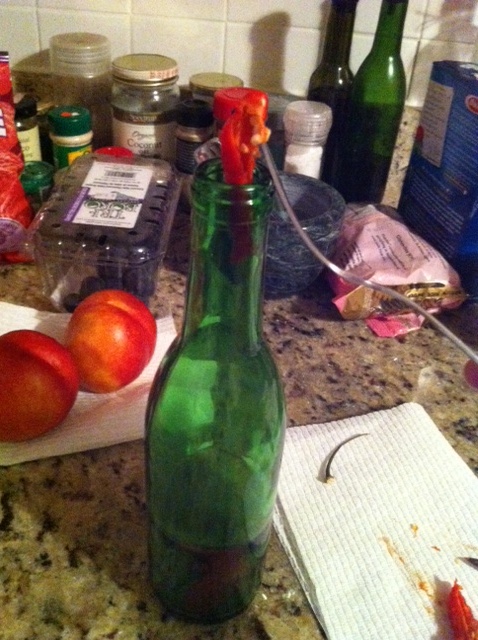
With a tall glass of sugared milk by my side, wearing my large-lensed sunglasses to protect my eyes in case any bits of chili went flying, my heart pounding with nervous anticipation, I pierced a ghost pepper's thick, slightly tough flesh with the blade of my paring knife, then held the cold metal blade against my tongue.  "That's not so bad," I thought.  The pepper tasted bright, almost citrusy, whereas I did not expect to be able to experience any discernible flavor through the fire.  That's when I learned why they're called ghost peppers - boy, do these babies sneak up on you!  The heat hit, but it didn't deliver a burn so much as a tingle.  The heat resonated throughout my mouth, spreading from the point of contact where I'd licked the blade of my knife, and a slight sting crept across my lips.  I sipped some sugared milk to snuff out the heat, then decided I should to try the ghost pepper again, only for real this time.  I sliced off a piece of pepper about the size of a grain of risotto rice, placed it on my tongue, bit into it, and sloshed it around in my mouth, letting the fire spread.

These peppers make "Dave's Insanity" look like "Dave's mild, completely manageable neuroses." 

The ghost pepper's effect was not nearly as devastating as I imagined - after all, I'd pictured myself screaming and scrambling for ketchup and mustard bottles, just like Harry and Lloyd in Dumb & Dumber - but keep in mind that I only consumed a minuscule amount.  If you can get your hands on ghost peppers, try them if you dare, even if only to satisfy your curiosity.

Not knowing if I could handle the heat if I chopped them and added them directly to a dish, I decided to use my ghost peppers to make a batch of hot pepper oil.  With the kind of heat ghost peppers pack, only a few drops will add a spicy kick to any food! 


Ghost Pepper Oil

2 ghost peppers, quartered*
2 cups olive oil

Add the peppers and the oil to a clean, resealable glass bottle.  Shake and allow to sit for 24 hours.  Use sparingly, adding drop-by-drop to any dish that could use some heat.  Great for bloody marys! 


* Be very careful when working with chiles.  If possible, wear gloves, and do not let the chiles, or anything the chiles have touched, come into contact with your eyes.

Wednesday, June 8, 2011

Inspiration on 'Roids - New England Nicoise, Nicoise Peruvienne

Yup, this bacon, butter, steak, mayonnaise, sour cream, cheese, and pork rind-loving blogger is writing an entire post about salad.  But I'm not writing about rabbit food; I'm writing about new twists on an old favorite, and I'm writing about a salad that is substantial enough to take center stage.  I'm writing about Salade Nicoise.  No lightweight, this French classic contains potatoes, green beans, hard-cooked eggs, olives, tomatoes, tuna and anchovies, nestled in a bed of rich butter lettuce and dressed with tangy dijon vinaigrette.  This is not a dish that will leave you hungry. 

So what happens when this French salad meets ingredients native to my side of the Atlantic?  Magic.  Pure magic happens.  The two salads I created were not planned; rather, I got a boatload of inspiration during one random food shopping excursion and decided to try something new, and the results may be two of my favorite creations to date. 

It all started with a batch of purple potatoes. 

Purple potato cross-section

We've all seen red and yellow potatoes, but purple ones are far less common, at least here in Northern New England.  However, in Peru, the potato's homeland, potatoes come in a variety of colors spanning the rainbow.  When I saw purple potatoes at the market, I loaded them into my basket.  I had no idea what I'd do with them, but I never worry about that until after I'm home and all my groceries are put away.  I started to think - I could boil them?  I could bake or roast them?  Potato salad?  Boring, boring, boring.  I then started to scan my brain for recipes containing potatoes where the color would really stand out, and I came up with salade nicoise.  I felt wicked smart until I thought, "Purple potatoes in a salad?  So f***ing what?"  I knew color alone wouldn't lift my dish from ordinary to extraordinary, but then it hit me - I could add a little aji.  Aji is a traditional Peruvian condiment made from chiles, garlic, and olive oil, and it turns everything it touches to gold.  OK, maybe that's an exaggeration, but it's really damn good.  Once I had aji on my brain, my ideas started snowballing until I realized that I could replace tuna with ceviche, another Peruvian specialty.  And just like that, I created a recipe. 

I couldn't wait to test my recipe, so I ran to the store to pick up all the ingredients I'd need for the ceviche, the aji sauce, and the salad itself.  Cod?  Check.  Chiles?  Check.  Tomatoes?  Check.  Wait - what's that in that bin over there?  Ohhh Lord...I found fiddleheads. 


Fiddlehead
For those of you who don't live in Northern New England, fiddleheads are the edible fronds of young ostrich ferns.  You cannot visit a market in Maine during late spring without seeing at least one basket of fresh fiddleheads.  When steamed or lightly boiled, they retain their bright grass-green color and crunch, and they taste like a green bean/artichoke hybrid.  And face it - they look wicked awesome! 

Back to my market trip - I saw the fiddleheads and knew I had to have them.  While picking through the basket for the smallest, most tightly coiled fiddleheads, my mental wheels began turning and trying to come up with a plan for the fiddleheads.  They're good with just a little salt, pepper, and butter; they're great with hollandaise, and they can replace green beans in any dish.

Waaaiiittt a minute - green beans are used in salade nicoise...use the fiddleheads instead of green beans, and voila!  New England Nicoise.  Hmm, what other ingredients scream "New England?" and would also work in a salad?  Duhhh, lobster!  I'm sure the other market patrons were quite amused seeing this tiny little girl talking to herself out loud and stopping dead in her tracks to turn around and go pick up another ingredient when the light bulb went off over her head, but that's how I roll when inspiration skyrockets.  I whirled around the store like a madwoman, throwing ingredients into my basket and at the same time writing memos to myself on my iPhone so I wouldn't forget my ideas. 

Getting inspired was the easy part.  The hard part was the prep work, especially for Nicoise Peruvienne, which is a recipe within a recipe within a recipe.  While nothing in these recipes is difficult, the process is time consuming.  The most important part of preparing this dish is your mise en place, which is a fancy-schmancy chef term meaning "having one's $#!t together."  Once all the prep work is out of the way, this salad goes together in under 10 minutes, but if you try to assemble it while boiling potatoes, cooking eggs, making vinaigrette, etc., you'll be making a lot of extra work for yourself, and the process will be needlessly stressful. 

If you come across fiddleheads or purple potatoes, do try these two salads.  They are delicious, fun to make, and both are guaranteed to be great talking points if you serve them to guests. 


New England Nicoise

2-4 cups butter lettuce, torn
1/2 lb. baby potatoes, quartered
2 roma tomatoes, quartered lengthwise
2 hard-cooked eggs, quartered lengthwise
1/2 lb. fiddleheads, steamed
1 lb. cooked lobster meat, chopped
8 black olives, pitted
vinaigrette

Boil the potatoes and steam the fiddleheads in advance.  Let chill for at least two hours. 

Assemble the salads.  Fill 2 large bowls with equal amounts of lettuce, then arrange the potatoes, tomato, and egg in a decorative pattern along the edge of the bowl.  Add the fiddleheads and lobster meat to the center, then dress with desired amount of vinaigrette.


Vinaigrette

1 garlic clove, smashed
1 t. dijon mustard
2 T. tarragon vinegar
1/3 c. olive oil
salt & pepper

Whisk all the ingredients in a bowl.  Cover with plastic wrap and set aside for at least an hour.  Remove the garlic clove, whisk again, then use to dress New England Nicoise. 


Nicoise Peruvienne

2-4 c. butter lettuce, torn into bite-sized pieces
2 roma tomatoes, quartered lengthwise
1 avocado, sliced lengthwise
2 hard-cooked eggs, quartered lengthwise
1/4 lb. green beans, steamed
2-4 purple potatoes, quartered lengthwise
2 cups ceviche
aji vinaigrette

Begin prep at least 4 hours, and up to 24 hours, ahead.  Prepare the ceviche style whitefish, hard-cooked eggs, and the aji vinaigrette (recipes below).  Boil the potatoes and steam the green beans, let both cool to room temperature, then refrigerate until it is time to assemble the salads. 

Assemble the salads.  Fill 2 large bowls with equal amounts of lettuce, then arrange the tomato, avocado, and egg in a decorative pattern along the edge of the bowl.  Add the potatoes, green beans, and ceviche, then dress with desired amount of aji vinaigrette. 


Ceviche

1/2 lb. cod or other firm whitefish, cut into chunks
1 serrano chile, minced
1 clove garlic, minced
1/3 c. freshly squeezed lime juice
salt and pepper

Combine all the ingredients in a nonmetallic bowl.  Cover and let marinate in the fridge, stirring occasionally.  Marinate at least 4 hours; preferably overnight. 


Aji Vinaigrette

1T. aji sauce (recipe below)
1 clove garlic, minced
juice of 2 limes
1/2 c. olive oil.

Combine all ingredients in a bowl and whisk until blended.  Use to dress Nicoise Peruvienne.  Any leftover vinaigrette can be used on chicken, fish, potatoes, vegetables, rice...you name it. 


Aji Sauce

5 habanero peppers (can use a milder pepper if you can't take the heat of habaneros)
2 cloves garlic
1 T. chopped cilantro
salt & pepper
splash olive oil

Combine ingredients in a blender and puree until a thick, consistent paste is formed.  Use in Aji Vinaigrette.

Sunday, January 30, 2011

Taste of the Tropics Stir Fry - A Vacation For Your Tastebuds

I like snow.  I think it's pretty, I think it makes the air smell fresh, and I love making snow angels and snow sculptures.  One of my favorite things to do is walk around the city during a gentle snowfall, and I smile like a doofy kid every time I see fluffy white flakes outside my window.  But after four major snowstorms in the past 30 days and another one on deck for Wednesday, even I am a little burned out on snow.  I've found myself longing for the beach, sunshine, and fresh summer vegetables.  Since I can't bring the feeling of the Cape's sand, the scent of sunscreen, the energy of Fenway Park, or the taste of a burger or hot dog fresh off the grill to this dismal January day, I decided to transport myself to a tropical paradise - well, I transported my tastebuds at least. 

There's not much that tastes more tropical than coconuts, rum, lime juice, and shrimp.  If you could use a sensory break from the winter doldrums, stop into your grocery store and buy what you'll need for this recipe before the milk/toilet paper/batteries crowd shows up, download some Jimmy Buffett or Bob Marley, and use your snow day to whip up this virtual vacation!

Taste of the Tropics Stir Fry

For the stir-fry sauce:
1/4 cup fresh lime juice
1/2 cup spiced rum
1 T. red chile flakes
1 t. grated fresh ginger
1 t. Goya Adobo seasoning
generous grind black pepper
1 habanero pepper, quartered (optional)

1 T. coconut oil (can substitute butter or vegetable oil)
1 large shallot, minced
1 pound raw shrimp, peeled
1 jicama, diced
1 green bell pepper, chopped
1 cup fresh coconut, cut into 1/4" strips

Cooked white rice, to serve


Make the stir fry sauce.  If using the habanero, let sit for approximately 30 minutes, then remove the habanero and discard. 

In a large wok or frying pan, heat the coconut oil over medium-high heat until it melts.  Saute the shallot until it begins to soften.  Now, add the remaining ingredients.  Stir-fry until the shrimp just begin to curl and are firmed up - do not overcook.  Add the stir-fry sauce, toss several times until all the vegetables and shrimp are coated, then remove from heat and serve hot over cooked rice. 


Friday, November 12, 2010

Peruvian 101

Last night, I had the pleasure of dining on home-cooked Peruvian food.  I’ve neither cooked nor tasted Peruvian food before, and I didn’t cook it last night – I left the hard labor to the expert, my Peruvian friend who has been occupying a lot of my time lately.  Let me tell you something – having a man cook for me was delightful, and what made it more awesome is that the kid’s a great cook!

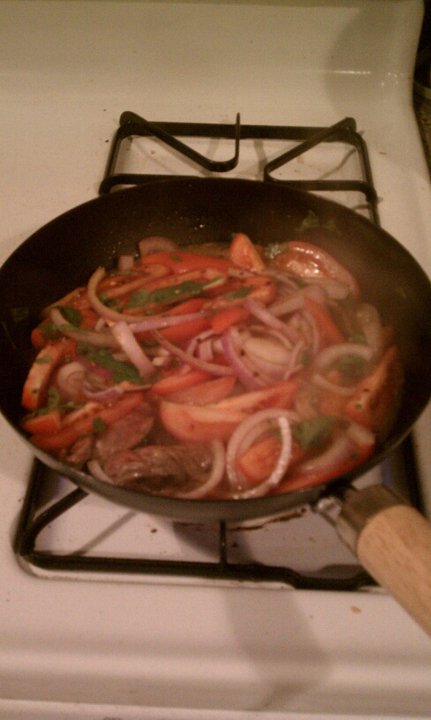
He lured me in with Lomo Saltado, a Peruvian dish consisting of sliced steak, tomatoes and onions marinated in vinegar and spices, then stir fried with a splash of soy sauce and topped with cilantro.  It is served over rice and fried potatoes, and he made a spicy Aji sauce to accompany the rice.  Holy Mary Mother of God!  This homemade hot sauce is quite possibly the best thing to ever happen to me, and I cannot wait to make my own.  I need to learn the proportions, but he told me that it’s easy to make and consists of habanero peppers, garlic, olive oil, salt and pepper.  

Letting someone else take control and do the work in the kitchen is one of the most difficult things I’ve ever done:

        “Can I help with anything?”  “No.” 
        “Can I at least do some dishes?” “No.” 
        “Really?” “Really.” 
        “Are you sure?” “Yes!” 

I literally had to go stand in the other room and watch from afar; standing in a kitchen and doing nothing felt far too odd and awkward.  I thought to myself, “This must be how goalies feel when the puck’s on the other side of the ice.”  I was fidgeting the entire time he cooked the stir fry.  I was relieved once the food was ready, because now I could do something with it, even if that something was simply shoveling it into my mouth. 

Along with our dinner, we shared a bottle of Rioja, which I tried for the first time last night.  I smelled and sipped the wine before I began eating so that the wine's flavor would be pure and would not have to compete with the flavors in the food.  My first thought?  The Rioja smelled exactly like Chianti.  I sipped; it tasted very similar to Chianti as well.  Definitely a variety I’d buy again.  Finally, it was time to taste the food. 

Each bite of Lomo Saltado was better than the last, and I wanted to savor each and every mouthful of the Aji-kissed rice.  I did – I painstakingly scooped up every last grain of rice with my fork until not one remained on my plate.  The meat was well-flavored and tender, the onions retained a slight crunch, and the tomatoes were bursting with flavor. He topped the dish with cilantro, which was the perfect foil for the spicy Aji sauce, and the Rioja was a great match for the dish as it was full-bodied enough to stand up to the bold flavors of Lomo Saltado.  When I commented that I thought the Aji sauce would be great on grilled tuna, he countered with, “It’s great on everything.”  I believe that.

This is definitely a recipe I’ll have to try on my own, but I’d be just as happy hopping in a cab and letting him wear the Chef hat!  I insist that you order this dish if you find it on a menu.  It’s a superstar!


Saturday, November 6, 2010

Around the World in Eighty Bites - Portugal

When I discovered that Bacon, Butter & Booze has readers in Portugal, I could not have been more thrilled - not only did one of my co-workers just turn me on to Portugal’s wondrous Vinho Verde, which Bon Appetit featured several months ago, but I also got the excuse I needed to try Cataplana, a Portuguese recipe I’ve always paused on while reading one of my favorite cookbooks, Jeff Smith‘s “The Frugal Gourmet on Our Immigrant Ancestors: Recipes You Should Have Gotten From Your Grandmother.”

I am not very familiar with Portuguese cuisine, which is surprising, considering that Coastal New England, especially Massachusetts’ South Shore, is home to a large concentration of Portuguese Americans. Here’s what I know about Portuguese food: Linguica sausage, seafood, and kale. Thanks to Wikipedia, I learned that salt cod (bacalhao), olive oil, garlic, and chiles are very popular. Portuguese cuisine is very similar to Italian cooking, especially southern Italian. Apparently, great minds really do think alike.

I’ll start with the wine, which I’m drinking while I write. The other day at work, one of my co-workers raved about Vinho Verde. Never having tried this variety before, she brought in a bottle for me, and did I ever enjoy it! My friends and I killed the bottle the other night, and I bought a new one of the same variety tonight. I’d try to give you some information about the winery, but their website is in Portuguese! The wine is very fresh, slightly effervescent, not very aromatic, acidic, and light (thank you, Wine 101!).

Onto the recipe - Cataplana is a dish of pork shoulder and clams cooked in a spicy wine broth. I picked up the pork from DiPaolo & Rossi and my clams from Mercato del Mare. Originally, I was going to buy cockles, but Liz and Keri, the shop’s owners, were familiar with my recipe and suggested that I use littlenecks. Their tip was right on the money - had I used cockles, the delicate clams would have gotten lost among the other flavors and textures, but littlenecks are larger, meatier and more substantial, so they worked wonderfully. And the pork - superb! It seems like it’s getting more and more difficult to find pork with a lot of flavor, but the meat they sold me actually tasted like pork! The recipe called for dry white wine, so I used Vinho Verde, and instead of the plain paprika called for in the recipe, I used smoked paprika from Penzey’s spices, a spice company that ships all over the country and sells some amazing spice blends. My final alteration was a sprinkling of crushed red pepper flakes.

While researching, I discovered that some versions of this recipe use several other ingredients, including tomatoes and red and green peppers. While I’d like to try those additions in the future, I’m glad I stuck with the basic version, because I got a great sense of the flavor of the sauce without it being overwhelmed by other flavors. I’d also like to make my own piri piri sauce, which I did not do for this recipe - instead, I used some red chile and garlic paste, thinned down with a bit of olive oil. I’ll reprint Jeff Smith’s recipe for Piri Piri, taken from the cookbook referenced above. I’d love to try this recipe with the real thing!!!


Cataplana (Portuguese Pork & Clams)

Based on Jeff Smith’s recipe in “The Frugal Gourmet on our Immigrant Ancestors”

1 lb. Boneless pork shoulder, cut into chunks
1 ¼ cup Vinho Verde
2 small cloves garlic, minced
2 t. Piri Piri (or another non-vinegar red chile sauce thinned with olive oil)
½ t. each salt and freshly ground black pepper
2 bay leaves
Olive oil
2 t. smoked paprika
1 onion, thinly sliced
1 lb. Littleneck clams, in their shells (scrubbed)

In a large bowl, combine the pork, Vinho Verde, garlic, Piri Piri, salt, pepper, and bay leaves. Marinate for two hours.
 
After the meat has marinated, remove the cubes and reserve the marinade. Heat a heavy-bottomed dutch oven or frying pan with high sides over high heat, add a generous splash of olive oil, and cook the pork until it begins to brown.


Once the pork has browned, reduce the heat to low. After about a minute, add the reserved marinade and the smoked paprika. Simmer the meat in the marinade, uncovered, until the liquid has almost evaporated (approx 45 minutes).


In the meantime, heat another heavy frying pan with a lid (preferably a transparent lid) over high heat, and add another generous splash of olive oil, and then add the onions. Cook the onions until they are soft but have not changed colors. Now, add the clams and cover with the lid. Cook for about 5 minutes, or until the clams have opened. You may want to shake the pan a few times during the cooking process, but do not remove the lid until the clams have opened.

Finally, once the clams are cooked, add the clams and the onions to the pork mixture, stirring well. Serve over cooked potato cubes or boiled rice.


Piri Piri

By Jeff Smith, “The Frugal Gourmet on our Immigrant Ancestors”

2/3 cup hot red peppers (tiny Thai peppers work well)
½ cup whiskey
1 cup olive oil

Combine in a jar and shake well. Cap the jar and let sit for a month before using, shaking frequently during the curing process.


Thursday, October 28, 2010

New Cocktail Recipe - The Velvet Rope

Oops, I did it again…I have been extremely busy this week with trainings at the MSPCA animal shelter and preparing baked goods for their Halloween bake sale, which has turned out to be a more ambitious undertaking than I had imagined.  I’m making some treats for humans – Roasted Garlic Focaccia, Pumpkin Pecan Biscotti, and Chestnut Raisin Cookies – but most of my goodies are for the pups.  Last night, I made enough dough to make at least 300 “Canine Crumpets.”  Each time I’ve glanced at my to-do list, I’ve asked myself, “Sweetie, what were you thinking?!?”  I’ve realized that I’m no Martha Stewart – I’m more like her Black Sheep kid sister who says semi-questionable things at the dinner table and makes the drinks a little too strong.  But to all the rescue dogs who will be sampling my Canine Crumpets, I’m a domestic goddess, and their opinions are the only ones that truly matter this weekend.

Because I’ve been busy baking, I haven’t posted in a few days.  I don’t want to leave my readers hanging, so I’ll give you a great cocktail recipe that I created this summer.  Named "The Velvet Rope" because of its color, this vodka-based cocktail was inspired by the cover of Vogue’s July issue (right) featuring French actress Marion Cotillard.  The rich color of her dress, the hint of lace peeking out at her neckline, the dark lipstick – sweet, strong, and mysterious, with a spicy edge – just like the following drink.

The Velvet Rope

1 ½ oz. premium vodka, such as Ketel One
3 oz. organic 100% black cherry juice
½ t. bitter dark chocolate syrup*
1 thin slice habanero pepper

Combine in a shaker with ice, serve in a stemless martini glass, and wait for the hint of pepper to fire up your lips! 

VARIATION:  For a unique and artistic presentation, garnish by skewering one whole habanero pepper between two cherries. 


*  To make bitter dark chocolate syrup, combine 1 T. boiling water with 1 T. premium cocoa powder in a small bowl.  Whisk until the cocoa powder is completely blended and no lumps remain.  Let cool.

Sunday, August 29, 2010

Beach Blogging, Yesterday's Recipes

This post comes to you from the beach, where I'm sipping lemon water and watching seagulls pick apart crabs and clams that have washed up in the surf.  It's a damn shame birds aren't sophisticated enough to figure out how to melt butter.

Knowing that this could potentially be my last beach day until next year makes me a little sad, but it helps to know that once summer fades away there's plenty of fall food for me to cook.  Grilled steaks, steamed clams, cucumber salads, and frozen drinks will soon give way to pork chops braised in Magners, baked cod, butternut squash, and Sam Adams Oktoberfest.  When you love food, there is something to look forward to every season, every day of the year. 

Today would be the perfect day to throw together a great end-of-summer meal, but since I'd rather soak up the last of the summer's rays, I offer you yesterday's recipes.

Last night's dinner consisted of broiled grouper with grapefruit & mint salsa, risotto with fennel and pecorino romano, and a glass of my heavenly new white wine.  Really, who serves a citrus-y, warm-water fish with a dish like creamy risotto?  Answer:  Someone who doesn't have the patience to conduct only one culinary experiment at a time.  Friday, I yearned to try a mild risotto with my new wine.  That same day, I got my Daily Catch e-mail from Mercato del Mare alerting me that grouper would be available Saturday.  I've never tried grouper...the wine was open, and it needed to be finished...the grouper would not be available forever...  This culinary conundrum led to my mismatched multitasking.  Sure, the two dishes don't go together, but neither do army pants and a satin halter top, and that never stopped me from combining them!  Here are yesterday's recipes:

Grouper with grapefruit & mint salsa
1 grapefruit
handful chopped mint
1 habanero pepper, sliced into 1/4" rings
splash olive oil
salt & pepper
1/2lb. grouper fillets

To make the salsa:  Peel the skin from the grapefruit like you would from an orange.  Divide the segments, scoop the grapefruit pulp from the white pith, and place in a shallow baking dish (left).  Add the chopped mint and habanero slices to the grapefruit (right).


Add a splash of olive oil, salt, and pepper to taste.  Stir until blended, then add the fish fillets to the dish, covering them with the grapefruit salsa.  Marinate for 30 minutes to one hour. 

Preheat the broiler.  After the fish has marinated, remove the habanero slices and discard.  Place pan in broiler with salsa still covering fish, and broil until the fish is flaky, about 7-10 minutes depending on the thickness of the fish fillets.  Serve hot.


Risotto with fennel and pecorino romano 
splash olive oil
2 shallots, finely minced
1.5 cups arborio rice
1 cup dry white wine
4 cups chicken broth, simmering (more if necessary)
1 fennel bulb, sliced into 1/8" thick strips
3/4c. grated pecorino romano cheese
3T. butter
salt & pepper
fennel fronds, for garnish


Heat the olive oil in a large, heavy-bottomed pot over medium heat.  Add the shallots and saute until they begin to soften.  Do not let them brown.  Add the rice and stir until each grain is coated with oil, then add the wine.  Cook, stirring constantly so that rice doesn't stick to the bottom of the pan, until the rice has absorbed the wine, as shown.

The chicken broth should be kept in a small saucepan next to the risotto pot.  As soon as the rice has absorbed the wine, add 1 cup of the chicken broth.  Stir constantly until the rice has absorbed the broth.  Repeat this step several times, adding 1/2 cup at a time.

Once 3 out of the 4 cups of broth have been added and absorbed, add the sliced fennel with the remaining broth.  Stir constantly, letting the rice absorb all the broth. 


Once all the broth has been absorbed, the rice should be cooked through and have a slightly creamy texture.  The rice should not stick to the bottom of the pan, but it should stay firm and not "run" when you scrape to the side, as shown in the photo to the left.  If this texture has not been achieved yet, you can add more broth.  Once the rice is fully cooked, add the grated pecorino, butter, salt, and pepper.  Stir until the butter and cheese are melted and fully incorporated with the rice. 


If you care about presentation, grease the inside of a measuring cup with olive oil, pack the risotto into the greased cup, and turn out onto a plate.  The risotto will keep the basic shape of the mold, budging ever so slightly.  Garnish with several small fennel fronds. 

Thursday, August 12, 2010

My Favorite Things

Bacon and butter and whiskey and vino
Indian and Polish and most things Latino
Fresh fettucine and fried onion rings
These are a few of my favorite things

Boiled Maine Lobsters and hot Texas chili
Stacked Philly cheese steaks and Long Island iced tea
Real New York Pizza and Buffalo wings
These are a few of my favorite things

When my day sucks
When my friends bail
When I'm feeling sad
I cook up a few of my favorite things
And then I don't feel so bad!

Rodgers & Hammerstein bastardizations aside, there are several ingredients that make their way into 90% of my recipes.  Without further ado, here is my list of foods for which I'd sell a vital organ before giving them up:
  • Bacon - I'm not that different from the dog on the "Beggin' Strips" commercial.
  • Butter - Not going to lie, I eat it plain.  Two pats for the pan, one for my mouth.
  • Pasta - I'd be a pretty half-arsed Italian if pasta didn't make it in my top 10.  Pasta is one of the most versatile basic ingredients available, and using it allows the cook a tremendous amount of creativity.  It's the culinary version of a blank canvas.
  • Sushi - from plain old California maki rolls to more exotic sushi and sashimi choices like eel, flying fish roe, and sea urchin, there's something for everyone.
  • Oysters - stay tuned, I'm learning how to shuck oysters on Saturday!  Although I generally prefer mine with nothing but a squirt of fresh lemon and a quick grind of black pepper, I have an interesting twist on a mignonette on deck. 
  • Scotch - Johnnie Black was my gateway scotch.  I graduated to single malt after buying a bottle of Ardbeg 10-year, which I diligently hunted down simply because Bon Appetit referred to it as "liquid bacon."
  • Lemons - when life gives me lemons, I believe it's God's way of dropping a subtle hint that he's craving chicken piccata. 
  • Extra Virgin Olive Oil - cooking with anything else is like funneling O'Douls.
  • Chiles - chile flakes?  Always.  Chipotles?  Yes, please.  Habaneros?  Thank you for making my vodka sting and my bloody marys kick.
  • Anchovies - don't say "eew!"  They're fantastic.  I dare you to find flavor in a a Puttanesca or Caesar dressing made without them. 
Honorable mentions:  hardneck garlic, bottarga, lacinato kale, heirloom tomatoes, basil, heavy cream, jicama, and roasted red peppers. 


What are your favorite foods and ingredients?  Leave a comment!