Showing posts with label shrimp. Show all posts

Tuesday, February 19, 2013

Lemongrass Shrimp Skewers with Kiwi & Avocado Guacamole

Recently, I was lucky enough to spot U-7 shrimp at Seaport Fish (U-7 indicates that there are 7 or fewer shrimp per pound – these babies are pretty big!). Originally, I planned on cooking them simply with butter and garlic, but when I spotted kiwis at the local market, I decided to try something more exotic.

In addition to my kiwis, I picked up an avocado, some Serrano chiles, and on a whim, a few stalks of lemongrass. While the lemongrass didn’t contribute much flavor-wise, it certainly added to the presentation. Try this next time you’re craving spicy, tropical flavors!


Lemongrass Shrimp Skewers with Kiwi & Avocado Guacamole

4 stalks lemongrass
8 U-7 (jumbo) shrimp
Kiwi & Avocado Guacamole, as prepared below

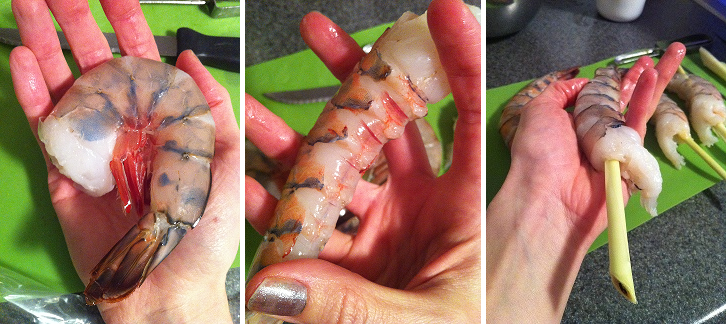
Prepare a grill or preheat your oven’s broiler. In the meantime, remove shells from shrimp, leaving the tail shell intact (this helps prevent the smaller end of the shrimp from drying out while cooking. Cut the lemongrass stalks in half, cutting diagonally so that a sharp point is formed (as shown in photo below right). Use your fingers to straighten the raw shrimp, and using the pointed end of the lemongrass spear, insert the lemongrass into the shrimp lengthwise (see photos below).


If using the broiler, line a baking sheet with foil, and place a wire rack on top of the foil. Place the skewered shrimp on the wire rack, and put the shrimp under the broiler. Cook the shrimp for 3-4 minutes, or until the shrimp are firm and pink. If using the grill, place the shrimp over slow coals and grill for 2-4 minutes, or until the shrimp are firm and pink.

While the shrimp cook, prepare two plates by spreading about ½ cup of the Kiwi & Avocado Guacamole on each plate. Once the shrimp are cooked, arrange four shrimp on each plate in a spoke formation.

* Nutritional info: serves 2. 335 calories, 11 g fat, 17 g carbohydrates, 45 g protein.


Kiwi & Avocado Guacamole

3 cloves garlic, very finely minced
2 serrano chiles, very finely minced*
1 T. finely minced onion
2 kiwis, peeled and minced
1 avocado, chopped

Combine all the ingredients in a large mixing bowl. Using a potato masher or a fork, mash until the guacamole is smooth and well-blended (you can use a food processer, but the texture will be almost too smooth—mashing manually gives a heartier texture). Cover the bowl with plastic film and set aside. This recipe makes about 2 cups.

*You can adjust the heat by using a milder or a hotter chile in place of serranos, or simply adjusting the number of chiles used.

* Nutritional info: serves about 4. 111 calories, 7.5 g fat, 15 g carbohydrates, 1.5 g protein.


Sunday, June 10, 2012

Straight Outta Cajun: Gator Gumbo

To fully appreciate this post, you must know that I’ve spent this beautiful, sunny day not parked in a beach chair, but hard at work. That being said, hard work doesn’t seem so hard when it involves sitting on a warm porch with a cold drink, wearing the staples of any good Southern gal's wardrobe (white cotton tank paired with tiny shorts that used to be jeans) Skynyrd and Allman Brothers pumping out of the iPod as I scribble down my thoughts on my latest culinary creations inspired by my recent vacation. Folks, you’ll need to bear with me—I am still in my Floridian food phase, and in addition to Caribbean and Latin-tinged flavors, the third major influence I noticed in the Sunshine State's cuisine is the flavor of the Bayou—Cajun and Creole.

 
Braising gator legs
While South Florida is not at all rural like the locales featured on the History Channel's Swamp People, many of the culinary traditions are one in the same. Several of the bars and restaurants I visited over vacation featured gumbos, jambalayas, and fried alligator (better known as gator) on their menus. Yes, they really do eat alligators down there. And if you’ve never tried alligator meat, that is your loss—gator meat is similar in texture to dark meat chicken, and its flavor is a rich blend of game meat and mild freshwater fish. Alligator meat is high in protein and low in fat, which has increased its popularity in areas of the U.S. north of the Mason-Dixon Line as well as west of the Mississippi.

I managed to find gator legs at Savenor’s Market, and due to the ever-growing market for its meat, alligator is now easily available via mail order from many online retailers.

Alligator Gumbo

Stirring the gumbo
2 T / 30 g butter
1 green pepper, diced
1 medium brown onion, diced
½ lb. / 230 g Andouille sausage, diced
12 oz. / 340 g cooked alligator meat (recipe below)
2 large tomatoes, diced
½ lb. / 230 g fresh okra, sliced crosswise
3 c. / 690 g seafood stock
1 t. / 15 g chipotle flakes
2 large bay leaves
1 t. / 15 g dried thyme
1 t. / 15 g smoked sea salt
½ lb. / 230 g raw shrimp, shelled
1  3 oz. / 185 g tin smoked oysters in olive oil, drained
Generous amount coarsely ground black pepper
Cooked quinoa, to serve (recipe below)

Melt the butter in a large stockpot over medium heat. Add the green pepper, onion, and Andouille sausage. Cook for 8-10 minutes, stirring occasionally, or until the onion and pepper have softened.

Next, add the cooked alligator meat, tomatoes, okra, seafood stock, chipotle flakes, bay leaves, thyme, and smoked sea salt. Cook for 25-30 minutes, uncovered, stirring frequently.

Finally, add the shrimp, smoked oysters, and a very generous amount of coarsely ground black pepper. Cook for 3-5 minutes so that the shrimp is cooked through, stirring frequently. Remove the bay leaves before serving, and spoon over cooked quinoa.

Nutritional information: serves eight.  310 calories, 11.5 g fat, 29.5 g carbohydrates, 30.5 g protein.


Braised Alligator Legs

1 lb. bone-in alligator legs
½ c. chicken broth or dry white wine
1 bay leaf
1/2 t. thyme
Freshly ground black pepper

Heat a frying pan over medium-high heat, then add the alligator legs. Brown on all sides, 8-10 minutes, or until the outside turns a pale golden brown.

Add the chicken broth or wine, bay leaf, thyme, and a few grinds of black pepper. Bring to a boil, then cover and lower the heat to a simmer. Cook for 25-30 minutes.

Remove the alligator legs and discard the broth. If using the meat for the Alligator Gumbo recipe, allow the legs to cool, then use your fingers to remove the meat from the bone and shred into bite-sized pieces.

NOTE: 1 lb. bone-in alligator legs yields about 12 oz. cooked meat.


Cooked Quinoa

2 cups water
Pinch sea salt
1 cup quinoa

In a large, heavy-bottomed saucepan, bring the water to a boil. Add the sea salt and the quinoa and cook for a minute, stirring constantly. Cover, lower the heat to a simmer, and cook for 15-20 minutes or until all the water is absorbed. Uncover, let stand for 5 minutes, then fluff with a fork.


Thursday, October 6, 2011

In the Mood for a Quickie?

We've all had those days. You know the type - the days when crawling out of bed and getting dressed seems only slightly less horrific than being waterboarded with Clorox, or the days when your schedule is packed so full that you have to deliberately schedule time to use the bathroom. 

These are the days when I rely on a few quick and easy recipes that don't require many ingredients, don't require much time, and are so simple that I can prepare them in full-on zombie mode. These are the days when I'm in the mood for a quickie (that's what she said). 

The beauty of these recipes is that they're not only delicious, but they look and taste like they required a good deal of time and effort to prepare, so they're great to keep up your sleeves for those instances when you have unexpected houseguests!


Garlic and Chile Shrimp

Splash olive oil
Bay leaf
2 cloves garlic, minced
2 red chili peppers, sliced (Fresno chilis work well in this dish)
1 pound raw medium-sized shrimp, peeled (16/20s work best)

Heat the olive oil in a frying pan over low-medium heat. Add the bay leaf, garlic, and chilis, and saute for 2-3 minutes, or until the garlic and chilis become fragrant.

While the garlic and chilis are cooking, pat the shrimp dry on paper towels. Once the garlic and chilis become fragrant, increase the heat to medium-high, then add the shrimps. Stir-fry the shrimp for 3-4 minutes, or until they’ve curled and turned opaque.

Serve hot with a bit of the cooking oil drizzled over them.


Pate-Stuffed Apples with Leeks and Cider

4 apples, cored and halved lengthwise, with a bit scooped out of the middle
1 cup hard cider*, plus more to thin the pate
1 cup chicken liver pate, brought to room temperature
Crushed potato crisps

Preheat the oven to 400. Place the sliced leek in a shallow baking dish, then place the apples skin-side down in the dish. Carefully pour in the hard cider, making sure that it doesn’t splash into the hollowed part of the apples. Bake for approximately 15 minutes.

While the apples are baking, thin the pate with a splash of hard cider until it reaches the consistency of frosting. Use the thinned pate to fill a pastry bag, or alternatively, a plastic baggie. If using the plastic baggie method, simply snip off the corner seam, as shown below:


After the apples have baked, use the pastry bag/plastic baggie to fill the apples with the pate. Once the apples are equally filled, sprinkle each with a pinch or two of the crushed potato crisps, then slice with a sharp knife and layer on individual plates. Spoon a bit of the cooked leeks on the plate next to the stuffed apple slices, and serve with glasses of hard cider.


* Magners is a popular and easy to find hard cider brand, but many small breweries are beginning to produce hard ciders - these are often worth the search!


Grilled Nectarines with Lemongrass Mint Balsamic Glaze

2 nectarines, halved
¼ c. Boston Olive Oil Co. Lemongrass & Mint White Balsamic Vinegar
3 T. powdered sugar, plus more to garnish.

Heat a grill or grill pan. Place the nectarine halves, cut side down, on the grill, and cook until lines have formed on the flesh. Set aside to cool.

In the meantime, whisk the vinegar and powdered sugar together to make the glaze. Set aside.

Once the grilled nectarines are cool enough to touch, slice lengthwise and arrange on individual plates. Drizzle with the glaze, then sprinkle with powdered sugar.


Baked Haddock

4 haddock fillets, approx 8 oz. each
2 oz. butter (approx half a stick), sliced into pats
Juice of 1 lemon
1 T. salt-packed capers, rinsed and drained
Chive- or shallot-based seasoning, such as Penzey’s Fox Point
Salt & pepper

Preheat the oven to 375. In the meantime, place the haddock fillets skin-side down in a baking dish lined with tinfoil. Place a few pats of butter on each fillet, then squeeze the lemon juice over the fillets. Bake for 15-20 minutes or until the fish flakes easily with a fork.

Once the fish is cooked, place each fillet on a plate, drizzle with a few spoonfuls of the liquid, sprinkle with the seasonings, and serve.


Blistered Poblano Peppers

2 poblano peppers, sliced into strips*
1 T. lime juice
Kosher salt or sea salt
Lime wedges, to garnish

Heat a large, preferably cast-iron pan over high heat.  The pan is hot enough when a drop of water dances across the surface of the pan rather than sizzling.  Once the pan is hot enough, add the peppers in an even layer (depending on the size of your pan, you may have to do this in batches, as each pepper slice should touch the bottom of the pan). 

Cook the peppers for a minute or two – you’ll hear the peppers begin to “pop,” and there may be a bit of smoke.  Toss the peppers – you should see dark blisters on the skin.  Once these blisters form, stir-fry them for another 2-3 minutes, or until they are softened, but retain a crunch. 

Immediately after cooking the peppers, transfer them to a large bowl.  Sprinkle the lime juice and a few pinches of salt over the peppers, and toss a few times.  Serve on individual plates with lime wedges. 


*Poblanos are one of the milder chili peppers, but they’re still hot enough to sting like hell if you stick your fingers in your eyes.  I learned that the hard way when I took my contacts out after making these.  Don’t be an idiot like me and assume that because they don’t taste hot, they won’t burn you.

Sunday, January 30, 2011

Taste of the Tropics Stir Fry - A Vacation For Your Tastebuds

I like snow.  I think it's pretty, I think it makes the air smell fresh, and I love making snow angels and snow sculptures.  One of my favorite things to do is walk around the city during a gentle snowfall, and I smile like a doofy kid every time I see fluffy white flakes outside my window.  But after four major snowstorms in the past 30 days and another one on deck for Wednesday, even I am a little burned out on snow.  I've found myself longing for the beach, sunshine, and fresh summer vegetables.  Since I can't bring the feeling of the Cape's sand, the scent of sunscreen, the energy of Fenway Park, or the taste of a burger or hot dog fresh off the grill to this dismal January day, I decided to transport myself to a tropical paradise - well, I transported my tastebuds at least. 

There's not much that tastes more tropical than coconuts, rum, lime juice, and shrimp.  If you could use a sensory break from the winter doldrums, stop into your grocery store and buy what you'll need for this recipe before the milk/toilet paper/batteries crowd shows up, download some Jimmy Buffett or Bob Marley, and use your snow day to whip up this virtual vacation!

Taste of the Tropics Stir Fry

For the stir-fry sauce:
1/4 cup fresh lime juice
1/2 cup spiced rum
1 T. red chile flakes
1 t. grated fresh ginger
1 t. Goya Adobo seasoning
generous grind black pepper
1 habanero pepper, quartered (optional)

1 T. coconut oil (can substitute butter or vegetable oil)
1 large shallot, minced
1 pound raw shrimp, peeled
1 jicama, diced
1 green bell pepper, chopped
1 cup fresh coconut, cut into 1/4" strips

Cooked white rice, to serve


Make the stir fry sauce.  If using the habanero, let sit for approximately 30 minutes, then remove the habanero and discard. 

In a large wok or frying pan, heat the coconut oil over medium-high heat until it melts.  Saute the shallot until it begins to soften.  Now, add the remaining ingredients.  Stir-fry until the shrimp just begin to curl and are firmed up - do not overcook.  Add the stir-fry sauce, toss several times until all the vegetables and shrimp are coated, then remove from heat and serve hot over cooked rice.