This recipe came about when I wanted to use a bunch of fresh, young carrots that I picked up at the farmers’ market. It goes together quickly, uses easy-to-find ingredients, and it’s loaded with vitamins, minerals, and crunch. Depending on the chiles you use, this can be made hot or mild. Give this recipe a try when you have limited cooking time but want to create something healthy.
Chicken, Carrot, and Bok Choy Coconut Curry
1 T. coconut oil
2 chicken breasts, cut into bite-sized pieces
1 bunch young carrots, sliced into thin rounds
1-3 chiles, chopped*
2 cloves garlic, minced
1 15-oz can coconut milk
1 T. freshly grated ginger
1 T. coriander seeds, toasted and ground
1 t. cumin seeds, toasted and ground
2 t. coarsely ground black pepper
1 bunch bok choy, chopped
Sea salt to taste
Sesame oil
Heat the coconut oil over high heat in a large pan. Once it has melted, add the chicken pieces and begin to cook, stirring occasionally. When the chicken pieces are barely showing any pink, add the carrots and chiles. Keep stirring until no more pink shows in the chicken.
Next, add the coconut milk, ginger, coriander, cumin, and black pepper. Reduce heat to medium-low and cook for 8-12 minutes, stirring occasionally, until the chicken is cooked through and the carrots have lost their crunch but are still firm.
Add the bok choy. Cover and cook until the green tops are barely wilted. Add sea salt to taste and blend, then serve over cooked rice with a drizzle of sesame oil.
* You can make this as mild or as hot as you prefer. If you like it mild, use chiles such as cubanelles or poblanos; if you prefer hot, use a cayenne, Serrano, or even a habanero or scotch bonnet.
Showing posts with label chiles. Show all posts
Monday, September 9, 2013
Saturday, April 27, 2013
Around the World in Eighty Bites—Peru
My first introduction to Peruvian food came courtesy of a brief fling with a Peruvian guy. We split up quickly, but my love affair with Peruvian cuisine was the beginning of a beautiful friendship.
From my first taste—Lomo Saltado with Aji Paste—to future finds such as my favorite, a layered potato dish called Causa, I’ve never tried a Peruvian dish I didn’t like. One of my close friends grew up in Peru, and she knows all the best Peruvian restaurants in and around Boston.
In recent years, Peruvian food has been touted as the next “It” cuisine. While Peruvian food is exotic enough to be a break from the ordinary, most Peruvian food is not so foreign that it cannot be easily made at home. Still, some authentic ingredients may not be easy to find if you do not live in an area with a significant Hispanic/Latino customer presence. Thankfully, we live in an era where anything we want is merely a click away, and there are plenty of online retailers selling authentic Peruvian foods.
I've created versions of several traditional Peruvian recipes that you can try at home!
Margarita Ceviche
2 cloves garlic, quartered
Juice of 2 limes
Juice of ½ orange
1 shot tequila anejo
1 habanero pepper, quartered
2 sprigs parsley, minced (leaves only)
3 sprigs cilantro, minced (leaves and stems)
A few paper-thin slices red onion
1 lb. dry sea scallops, cut into medallions*
Combine all the ingredients in a large glass or ceramic bowl. Cover with plastic film and place in the refrigerator. Let it chill for at least 2 hours (up to 12). Serve immediately in chilled bowls, or in margarita glasses with a salted rim!
* To cut the sea scallops, it helps if you place them in the freezer for about 30 minutes before slicing. When slicing, slice across the grain of the scallop as shown in the photo to the left—the blue lines in the photo represent the “grain” of the scallop, and the red line shows the direction that the knife’s blade should cut. Slice each scallops into 4 medallions of equal thickness.
Aji Sauce
1 thick slice baguette, torn into pieces
5 oz. can evaporated milk
2 aji amarillo chiles (use habaneros or serranos if you cannot find aji amarillos
2 small garlic clove, minced
2 sprigs cilantro, minced
1/3 c. grated cotija cheese
1 T. olive oil
Pinch smoked sea salt
Soak the bread for 10 minutes in the evaporated milk. Place the bread and milk in a blender or food processor with all remaining ingredients. Blend well until smooth. Keep refrigerated and use as a condiment.
Giant Corn with Cotija and Orange
8 oz. dried giant corn (Goya sells this product)
4 c. cold water
2 dried de arbol or chipotle chiles
2 oz. cotija cheese, grated
Rind of1/2 orange
1 T. minced red onion
2 T. Aji Sauce (recipe above)
Soak the corn in the cold water overnight. Once soaked, drain the corn. Place it in a pot with the 2 dried chiles, cover with water by 2 inches, and bring to a boil. Boil for approximately 45 minutes, adding water if necessary.
Drain the corn and chiles and place in a bowl. When cool enough to touch, remove the chiles, mince them and place in the bowl with the corn. Add the cotija, orange rind, onion, and Aji Sauce. Blend well.
Serve either at room temperature or chilled.
Purple Potato Causa
1 lb. purple potatoes, peeled and diced
¼ c. grated cotija cheese
3 T. Aji Sauce (recipe above)
1 lime, halved
8 oz. canned crabmeat
2 T. mayonnaise
1 ripe avocado
Salt
Aji Sauce, to serve
Cilantro leaves, for garnish
Boil the potatoes in salted water. Drain and mash, incorporating the cotija cheese, Aji Sauce, and the juice from one of the lime halves. Set aside.
Combine the crabmeat and the mayonnaise and set aside. Next, mash the avocado with the juice from the remaining lime half and a pinch of salt.
Assembly will require a ring mold. To assemble the Causa, spoon a tablespoon or two of Aji Sauce onto a small plate. Set aside. Place your ring mold onto a sheet of parchment or waxed paper. Fill the mold with about 2 inches of the mashed potato mixture. Then, add a ½ inch layer of the avocado mixture. Finally, top the avocado with a 1 inch layer of crabmeat. Place the blade of a spatula under the parchment and over the plate containing the Aji Sauce. Slip the parchment out from the bottom, letting the mold slip onto the sauce (this will take practice—I ruined my first few tries!). Top with one or two cilantro leaves. Repeat until all ingredients are used, and serve chilled or at room temperature.
![]() |
| Peruvian Ingredients |
From my first taste—Lomo Saltado with Aji Paste—to future finds such as my favorite, a layered potato dish called Causa, I’ve never tried a Peruvian dish I didn’t like. One of my close friends grew up in Peru, and she knows all the best Peruvian restaurants in and around Boston.
In recent years, Peruvian food has been touted as the next “It” cuisine. While Peruvian food is exotic enough to be a break from the ordinary, most Peruvian food is not so foreign that it cannot be easily made at home. Still, some authentic ingredients may not be easy to find if you do not live in an area with a significant Hispanic/Latino customer presence. Thankfully, we live in an era where anything we want is merely a click away, and there are plenty of online retailers selling authentic Peruvian foods.
I've created versions of several traditional Peruvian recipes that you can try at home!
Margarita Ceviche
Juice of 2 limes
Juice of ½ orange
1 shot tequila anejo
1 habanero pepper, quartered
2 sprigs parsley, minced (leaves only)
3 sprigs cilantro, minced (leaves and stems)
A few paper-thin slices red onion
1 lb. dry sea scallops, cut into medallions*
Combine all the ingredients in a large glass or ceramic bowl. Cover with plastic film and place in the refrigerator. Let it chill for at least 2 hours (up to 12). Serve immediately in chilled bowls, or in margarita glasses with a salted rim!
* To cut the sea scallops, it helps if you place them in the freezer for about 30 minutes before slicing. When slicing, slice across the grain of the scallop as shown in the photo to the left—the blue lines in the photo represent the “grain” of the scallop, and the red line shows the direction that the knife’s blade should cut. Slice each scallops into 4 medallions of equal thickness.
Aji Sauce
1 thick slice baguette, torn into pieces
5 oz. can evaporated milk
2 aji amarillo chiles (use habaneros or serranos if you cannot find aji amarillos
2 small garlic clove, minced
2 sprigs cilantro, minced
1/3 c. grated cotija cheese
1 T. olive oil
Pinch smoked sea salt
Soak the bread for 10 minutes in the evaporated milk. Place the bread and milk in a blender or food processor with all remaining ingredients. Blend well until smooth. Keep refrigerated and use as a condiment.
Giant Corn with Cotija and Orange
| Giant Corn |
4 c. cold water
2 dried de arbol or chipotle chiles
2 oz. cotija cheese, grated
Rind of1/2 orange
1 T. minced red onion
2 T. Aji Sauce (recipe above)
Soak the corn in the cold water overnight. Once soaked, drain the corn. Place it in a pot with the 2 dried chiles, cover with water by 2 inches, and bring to a boil. Boil for approximately 45 minutes, adding water if necessary.
Drain the corn and chiles and place in a bowl. When cool enough to touch, remove the chiles, mince them and place in the bowl with the corn. Add the cotija, orange rind, onion, and Aji Sauce. Blend well.
Serve either at room temperature or chilled.
Purple Potato Causa
1 lb. purple potatoes, peeled and diced
¼ c. grated cotija cheese
3 T. Aji Sauce (recipe above)
1 lime, halved
8 oz. canned crabmeat
2 T. mayonnaise
1 ripe avocado
Salt
Aji Sauce, to serve
Cilantro leaves, for garnish
Boil the potatoes in salted water. Drain and mash, incorporating the cotija cheese, Aji Sauce, and the juice from one of the lime halves. Set aside.
Combine the crabmeat and the mayonnaise and set aside. Next, mash the avocado with the juice from the remaining lime half and a pinch of salt.
Assembly will require a ring mold. To assemble the Causa, spoon a tablespoon or two of Aji Sauce onto a small plate. Set aside. Place your ring mold onto a sheet of parchment or waxed paper. Fill the mold with about 2 inches of the mashed potato mixture. Then, add a ½ inch layer of the avocado mixture. Finally, top the avocado with a 1 inch layer of crabmeat. Place the blade of a spatula under the parchment and over the plate containing the Aji Sauce. Slip the parchment out from the bottom, letting the mold slip onto the sauce (this will take practice—I ruined my first few tries!). Top with one or two cilantro leaves. Repeat until all ingredients are used, and serve chilled or at room temperature.
| Giant Corn with Cotija and Orange |
| Margarita Ceviche |
| Purple Potato Causa |
| Peruvian Small Plates |
Labels:
aji,
aji sauce,
appetizers,
avocado,
causa,
ceviche,
chiles,
cotija,
crab,
easy recipes,
giant corn,
Peru,
Peruvian food,
potatoes,
purple potatoes,
scallops,
side dish,
spicy food,
tequila,
warm weather recipes
Tuesday, February 19, 2013
Lemongrass Shrimp Skewers with Kiwi & Avocado Guacamole
In addition to my kiwis, I picked up an avocado, some Serrano chiles, and on a whim, a few stalks of lemongrass. While the lemongrass didn’t contribute much flavor-wise, it certainly added to the presentation. Try this next time you’re craving spicy, tropical flavors!
Lemongrass Shrimp Skewers with Kiwi & Avocado Guacamole
4 stalks lemongrass
8 U-7 (jumbo) shrimp
Kiwi & Avocado Guacamole, as prepared below
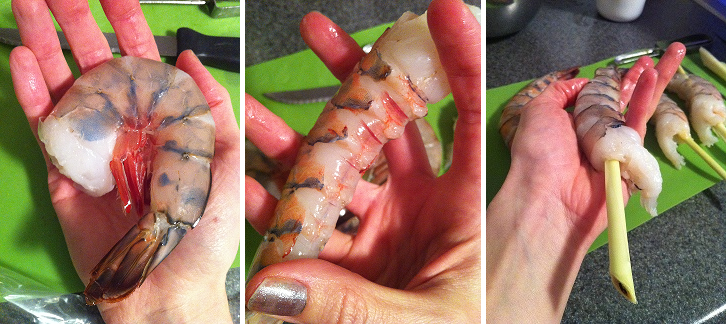
Prepare a grill or preheat your oven’s broiler. In the meantime, remove shells from shrimp, leaving the tail shell intact (this helps prevent the smaller end of the shrimp from drying out while cooking. Cut the lemongrass stalks in half, cutting diagonally so that a sharp point is formed (as shown in photo below right). Use your fingers to straighten the raw shrimp, and using the pointed end of the lemongrass spear, insert the lemongrass into the shrimp lengthwise (see photos below).
If using the broiler, line a baking sheet with foil, and place a wire rack on top of the foil. Place the skewered shrimp on the wire rack, and put the shrimp under the broiler. Cook the shrimp for 3-4 minutes, or until the shrimp are firm and pink. If using the grill, place the shrimp over slow coals and grill for 2-4 minutes, or until the shrimp are firm and pink.
While the shrimp cook, prepare two plates by spreading about ½ cup of the Kiwi & Avocado Guacamole on each plate. Once the shrimp are cooked, arrange four shrimp on each plate in a spoke formation.
* Nutritional info: serves 2. 335 calories, 11 g fat, 17 g carbohydrates, 45 g protein.
Kiwi & Avocado Guacamole
3 cloves garlic, very finely minced
2 serrano chiles, very finely minced*
1 T. finely minced onion
2 kiwis, peeled and minced
1 avocado, chopped
Combine all the ingredients in a large mixing bowl. Using a potato masher or a fork, mash until the guacamole is smooth and well-blended (you can use a food processer, but the texture will be almost too smooth—mashing manually gives a heartier texture). Cover the bowl with plastic film and set aside. This recipe makes about 2 cups.
*You can adjust the heat by using a milder or a hotter chile in place of serranos, or simply adjusting the number of chiles used.
* Nutritional info: serves about 4. 111 calories, 7.5 g fat, 15 g carbohydrates, 1.5 g protein.
Monday, February 4, 2013
Chicken and Sweet Potato Curry with Tropical Fruits
This recipe was an accident—a happy accident. I’d originally purchased the tropical fruits and Thai seasonings to create what turned out to be painfully underwhelming Tropical Fruit Spring Rolls. By rethinking the ingredients and adding chicken, rice, and vitamin-packed sweet potatoes, I turned my failure into a delectable Thai-inspired curry.
While most large supermarkets sell papayas and mangos (if not fresh, you’ll probably be able to find them in jars or frozen), dragon fruits may be more difficult to track down. Try a Latino or Chinese grocer; if you still can’t find dragon fruit, simply add the diced flesh of 2-3 peeled kiwis.
Chicken and Sweet Potato Curry with Tropical Fruits
2 T. coconut oil
12 oz. chicken breast, cut into bite-sized pieces
2 medium sweet potatoes, peeled and diced
3-4 Thai chiles, minced
1 mango, peeled and cut into small dice
1 ripe papaya, seeded and cut into small dice
1 dragon fruit, peeled and cut into small dice*
8 oz. can sliced water chestnuts, drained
15 oz. can coconut milk
Juice and grated zest of 1 lime
¼ c. rum
2 T. soy sauce
2 t. cardamom, ground
1 t. grains of paradise, ground
1 t. grated ginger
½ t. ground cinnamon
¼ t. freshly ground black pepper
Handful Thai basil, chopped
Handful fresh mint, chopped
Cooked rice, to serve
Small sprigs of basil and/or mint, for garnish
Thai chiles, for garnish
In a large, heavy-bottomed pot, melt the coconut oil over medium-high heat, then add the chicken, sweet potatoes and chiles. Cook for 5-7 minutes, stirring frequently, until the chicken has mostly browned.
Next, add all remaining ingredients except the Thai basil, mint, and rice. Stir to combine, lower the heat to medium-low, cover, and cook for another 20-25 minutes, stirring occasionally.
When the dish is finished cooking, stir in the chopped Thai basil and the chopped mint. Blend well, spoon over rice in individual serving bowls, and top with a small sprig of basil or mint and a single Thai chile.
*If you cannot locate dragon fruit, substitute 2-3 peeled kiwis.
* Nutritional info: serves 6-8. 406 calories, 16 g fat, 48 g carbohydrates, 22 g protein.
* To purchase ingredients used in this recipe, click the link(s) below:
While most large supermarkets sell papayas and mangos (if not fresh, you’ll probably be able to find them in jars or frozen), dragon fruits may be more difficult to track down. Try a Latino or Chinese grocer; if you still can’t find dragon fruit, simply add the diced flesh of 2-3 peeled kiwis.
![]() |
| Dragon Fruit, Cross-Section |
2 T. coconut oil
12 oz. chicken breast, cut into bite-sized pieces
2 medium sweet potatoes, peeled and diced
3-4 Thai chiles, minced
1 mango, peeled and cut into small dice
1 ripe papaya, seeded and cut into small dice
1 dragon fruit, peeled and cut into small dice*
8 oz. can sliced water chestnuts, drained
15 oz. can coconut milk
Juice and grated zest of 1 lime
¼ c. rum
2 T. soy sauce
2 t. cardamom, ground
1 t. grains of paradise, ground
1 t. grated ginger
½ t. ground cinnamon
¼ t. freshly ground black pepper
Handful Thai basil, chopped
Handful fresh mint, chopped
Cooked rice, to serve
Small sprigs of basil and/or mint, for garnish
Thai chiles, for garnish
In a large, heavy-bottomed pot, melt the coconut oil over medium-high heat, then add the chicken, sweet potatoes and chiles. Cook for 5-7 minutes, stirring frequently, until the chicken has mostly browned.
Next, add all remaining ingredients except the Thai basil, mint, and rice. Stir to combine, lower the heat to medium-low, cover, and cook for another 20-25 minutes, stirring occasionally.
When the dish is finished cooking, stir in the chopped Thai basil and the chopped mint. Blend well, spoon over rice in individual serving bowls, and top with a small sprig of basil or mint and a single Thai chile.
*If you cannot locate dragon fruit, substitute 2-3 peeled kiwis.
* Nutritional info: serves 6-8. 406 calories, 16 g fat, 48 g carbohydrates, 22 g protein.
* To purchase ingredients used in this recipe, click the link(s) below:
Tuesday, December 18, 2012
Feast of the Seven Fishes: Vodka-Braised Calamari with Celery and Tomatoes
It’s almost time for the Feast of the Seven Fishes! Stemming from the Catholic tradition of abstaining from meat on Christmas Eve, many Italians create elaborate meals featuring seven seafood dishes. If you’re in the mood for a less-traditional preparation, try this calamari dish that I created this weekend.
My inspiration for this recipe arrived while I wrestled with whether or not to make a bottle of chile-infused vodka—I wondered what I could do with the spicy booze other than pour it into bloody marys, and I decided to try cooking calamari in vodka with some chiles. The result? A fantastic, fresh-tasting sauce that would be a delight on any Christmas Eve table! If you’re bored with the same old calamari recipes, give this one a shot!
Vodka-Braised Calamari with Celery and Tomatoes
16 oz. / 455 g dry linguine
3 slices streaky bacon (optional)
1 T. butter (if omitting bacon, increase to 2 T. butter)
2 leafy stalks celery, minced (reserve minced leaves)
2 shallots, minced
2 serrano chiles, minced
2 bay leaves
3 medium tomatoes, chopped
1/3 c. golden raisins
1 T. capers in salt
1 c. vodka
1.5 lb. calamari (I prefer a 50/50 mix of tubes and tentacles)
Generous splash olive oil
First, cook the pasta in heavily salted water. In the meantime, if using the bacon, cook the bacon slices in a large, heavy-bottomed pot over medium-high heat until crisp, then remove and place on paper towels. Do not drain the bacon fat from the pot. Add the butter and let it melt (if not using the bacon, simply add the butter to the pot and let it melt), then add the minced celery stalk (keep the minced celery leaves set aside for later), shallot, chiles, and bay leaves. Cook, stirring frequently, for 3-5 minutes or until the shallot and celery are translucent.
Next, add the tomatoes, raisins, capers and vodka. Stir, scraping up any browned bits of bacon from the bottom of the pot. Lower heat to simmer and cook for 8-10 minutes.
When the pasta is just about ready and the tomatoes have simmered in the vodka, add the calamari to the pot with the vodka and tomatoes and raise the heat to medium-high. Cook, stirring frequently, for 1-2 minutes.
Drain the pasta from the cooking water and add the cooked pasta to the pot with the vodka and calamari. Add a generous splash of olive oil, and stir gently until blended. Serve the pasta in individual bowls, and garnish by sprinkling with the minced celery leaves.
* To purchase ingredients used in this recipe, click the picture below:
My inspiration for this recipe arrived while I wrestled with whether or not to make a bottle of chile-infused vodka—I wondered what I could do with the spicy booze other than pour it into bloody marys, and I decided to try cooking calamari in vodka with some chiles. The result? A fantastic, fresh-tasting sauce that would be a delight on any Christmas Eve table! If you’re bored with the same old calamari recipes, give this one a shot!
Vodka-Braised Calamari with Celery and Tomatoes
16 oz. / 455 g dry linguine
3 slices streaky bacon (optional)
1 T. butter (if omitting bacon, increase to 2 T. butter)
2 leafy stalks celery, minced (reserve minced leaves)
2 shallots, minced
2 serrano chiles, minced
2 bay leaves
3 medium tomatoes, chopped
1/3 c. golden raisins
1 T. capers in salt
1 c. vodka
1.5 lb. calamari (I prefer a 50/50 mix of tubes and tentacles)
Generous splash olive oil
First, cook the pasta in heavily salted water. In the meantime, if using the bacon, cook the bacon slices in a large, heavy-bottomed pot over medium-high heat until crisp, then remove and place on paper towels. Do not drain the bacon fat from the pot. Add the butter and let it melt (if not using the bacon, simply add the butter to the pot and let it melt), then add the minced celery stalk (keep the minced celery leaves set aside for later), shallot, chiles, and bay leaves. Cook, stirring frequently, for 3-5 minutes or until the shallot and celery are translucent.
Next, add the tomatoes, raisins, capers and vodka. Stir, scraping up any browned bits of bacon from the bottom of the pot. Lower heat to simmer and cook for 8-10 minutes.
When the pasta is just about ready and the tomatoes have simmered in the vodka, add the calamari to the pot with the vodka and tomatoes and raise the heat to medium-high. Cook, stirring frequently, for 1-2 minutes.
Drain the pasta from the cooking water and add the cooked pasta to the pot with the vodka and calamari. Add a generous splash of olive oil, and stir gently until blended. Serve the pasta in individual bowls, and garnish by sprinkling with the minced celery leaves.
* To purchase ingredients used in this recipe, click the picture below: