Showing posts with label linguine. Show all posts

Monday, November 11, 2013

Linguine with Seafood and Citrus

I swear I’m not going to get emotional…I swear I’m not. Not gonna do it! Why am I getting all sentimental? Because I haven’t been inspired to write for a long time. But this weekend, I got the chance to hang out with some amazing friends, some old and some new, and throughout the day when the conversation turned to food, I began to miss cooking for the purposes of sharing recipes.

I don’t often get to share the actual dishes I create—but I can always share my recipes, and I love sharing food with others, even if it’s just through typed words on a page. It’s time to get back to what I love. So here goes. I don’t know how often I’ll get to post, I don’t know if anyone will read my recipes, and I don’t know if anyone will try to cook them…but I get to do what I love—cook, write, and share. Mangia, bitches!


Linguine with Seafood and Citrus

16 oz. linguine
2 oz. butter (1/2 a standard stick)
3-4 cloves garlic, pressed
1 bulb fennel, sliced
2 T. capers
1 t. dried oregano
½ t. crushed chile flakes
Rind and juice of 1 large lemon
Rind and juice of 1 orange
½ c. dry white wine
1 lb. calamari, tubes sliced into rings*
½ lb. large scallops, sliced into bite-sized pieces**
2 cups roughly chopped parsley
2 large handfuls arugula
Salt and pepper to taste
Splash extra virgin olive oil

Cook the linguine in heavily salted water. In the meantime, melt the butter in a large pot over medium heat. Add the garlic, being careful not to let it burn. When the garlic starts to become fragrant, add the fennel, capers, oregano, chile flakes, and lemon and orange rind (save the juice for the next step). Stir gently, stirring every few minutes, until the fennel slices have softened but are still firm.


Timing is important for these next few steps – when the pasta is about 2-3 minutes away from being cooked, add the lemon and orange juice and the wine to the pot with the fennel and seasonings. Turn the heat to high, and stir until the mixture is bubbling.  Add the calamari and the scallops, and cook for about a minute, stirring constantly. Add the parsley and arugula to the pot, stirring just until it is blended in.  Add the salt and pepper to taste.

Immediately after adding the parsley and arugula, drain the pasta and add the cooked pasta to the pot. Add a splash of olive oil, then toss to coat the pasta. Serve piping hot preferably with wine.


* If tentacles give you the willies you can use all tubes, but tentacles add texture and make for a more interesting presentation.

** Always use “dry” scallops—the texture and flavor are superior. They’re more expensive, but you get what you pay for, and you won’t be ingesting a chemistry project.


Sunday, September 11, 2011

Linguine with Sausage, Tomatoes, and Broccoli Rabe

It's been quite some time since I've posted a recipe that didn't highlight an ingredient or feature a culinary backstory rivaling the Old Testament in word count, so today I offer you a basic, straightforward recipe that is both easy and fun to prepare.  All of the ingredients used are simple and easy to find, but if for some reason you cannot find broccoli rabe, kale, escarole, or collard greens would be acceptable substitutes. 

Linguine with Sausage, Tomatoes, and Broccoli Rabe

1 lb. dried linguine
splash olive oil
1 lb. hot Italian sausage, removed from casings
1 onion, quartered lengthwise, then sliced
small bunch broccoli rabe, chopped into bite-sized bits (approx. 4 cups)
1 28oz. can whole tomatoes, or 2 lbs. fresh tomatoes
2 t. fennel seeds
2 t. dried oregano
1 T. butter
salt and pepper
grated pecorino, to serve


Cook the pasta.  In the meantime, heat a generous splash of olive oil in a large pot over medium-high heat.  Add the sausage and brown it, separating it into bite-sized chunks with a wooden spoon as it cooks.  Cook for a minute or two, then add the sliced onion.  Cook for approximately 5 minutes, or until the onion is soft. 


Next, add the chopped broccoli rabe and saute for about 5 more minutes, stirring occasionally, until the leafy bits of the broccoli rabe have wilted. 

Now, add the liquid from the canned tomatoes to the pot.  Take each whole tomato and crush it in your hand over the pot, as shown in the photo to the right.  I like to think about the person(s) at the top of my shit list when I complete this step - it's mildly therapeutic.  Alternatively (but not nearly as emotionally satisfying), if you are using fresh tomatoes, simply chop them and add them to the pot along with a splash of the pasta cooking water. 


Once the sausage, broccoli rabe, and tomato sauce has cooked for at least 10-15 minutes, the cooked pasta can be added.  The trick is to add the pasta when it is cooked but still slightly firm, as it will continue to cook after you add it to the sauce - nobody likes mushy linguine. 

Once you've added the pasta to the pot with the sauce, toss gently so that each strand is coated.  Add the butter, salt, and pepper, and toss again until the butter has melted.  Serve in individual bowls, topped with freshly grated pecorino romano.


Monday, July 25, 2011

Linguine with New England Clam Sauce

Lovers of Italian food and shellfish have probably tried dozens of variations on the classic Linguine con Vongole, better known as Linguine with Clam Sauce.  I've tried several styles of this perennial favorite, but after an on-the-fly experiment, my method of choice is to prepare it using New England's famous steamers.  I like to call it "Linguine with New England Clam Sauce."


Soft-shell clams steaming
For my readers who have never visited New England, "steamers" are our colloquial term for soft-shell clams, which are traditionally steamed in their shells, then served with clam broth and melted butter.  Diners pull the clams from their shells, dunk them in the broth to rinse away any leftover sand, then slosh them in the butter, which is sometimes seasoned with garlic or wine. 

I would have never thought to use steamers in linguine and clam sauce until my old roommate, who loves clams so much I'm surprised she doesn't grind them up and snort them, came home with a plastic container full of steamers that were left over after a BBQ she had attended.  Instead of letting the host throw them away, she packed them up and said, "My roommate will be able to do something with these."  So she gave me the cooked clams and said, "Feed me."  (I'm paraphrasing - the conversation wasn't that brief)


Cooked steamers
Having just made a batch of fresh pasta, the first thing I thought of was to turn the steamers into clam sauce.  I poured the broth through a strainer and into a pot and reduced it, adding lots of garlic and some chile flakes.  Realizing that I had no parsley, which is the herb traditionally used in Linguine with Clam Sauce, I decided to experiment with the fresh tarragon I had on hand.  I minced up about a tablespoon and added it to the reduced clam broth, and I was pleased with the spicy depth that it added.  I served the sauce over the fresh pasta, and the end result is one of my most memorable creations. 

In more recent versions, I've added fresh parsley as well - I find that it brightens up the flavor a bit.  Pair this with a crisp, acidic white wine, and enjoy it outdoors while the sun is still shining - it's New England pasta perfection! 


Linguine with New England Clam Sauce

2 lbs. live steamer clams
1 T. fresh tarragon (or 1 t. dried)
2 cups dry white wine
1/4 - 1/2 t. red chile flakes
1 large or 2 small cloves garlic, smashed
1 lb. linguine
1 T. minced parsley
generous splash olive oil
1/4 stick butter

Place the wine, tarragon, and chile flakes in a large pot.  Heat to a boil, then add the clams.  Cover, then cook until all of the clams have opened.  Discard any that do not open. 

Using a slotted spoon, remove the clams from the broth.  Reserve the broth and set both the broth and the clams aside to cool.  Once the clams are cook enough to touch, clean them by removing the clam from its shell, then peel the wrinkly black membrane from the "neck" of the clam.  Discard the membrane and return the cleaned clams, along with the smashed garlic clove(s), to the cooled broth (don't add the clams while the broth is still hot, or the clams will continue to cook and become tough).  Refrigerate the clams in broth for at least 2 hours, preferably overnight - this allows for the garlic flavor to penetrate the clams. 

After the clams have marinated in the broth, remove them from the broth again.  Set the clams aside, and in a large, heavy-bottomed pot, heat the broth until it has almost reached a boil.  Add the parsley, olive oil, and butter, then reduce heat to medium-low and cook until the broth is reduced by about half.  In the meantime, cook the pasta. 

Once the sauce has reduced, add the cooked pasta and the reserved clams to the pot.  Cook for another minute or so, stirring until each strand of pasta is coated.  Because the clam broth is naturally salty, you will probably not need to add any additional salt, but you may want to add a grind or two of black pepper.  Serve hot, topped with a drizzle of olive oil.

Friday, December 3, 2010

Linguine with Tomato, Pancetta, and Capers

It's Arrabiata!  It's Amatriciana!  No, it's - damn, I don't even have a catchy name for this tasty tomato-based sauce that marries the flavors of penne all'arrabiata and bucatini all'amatriciana.   

It all started yesterday at approximately 4:45pm.  I received a text from a friend:  "What should I make for dinner?"  He explained that he had no discernable food cravings.  I started to think about what I was going to make for dinner after I ran my errands and went to the gym.  After a long, tiring day at work, I was barely motivated to pour milk into a bowl of cereal.  The longer I thought about it, the more I realized that what I really wanted wasn't to complete my "To-Do list," but to sit down with a large bowl of pasta and a glass of Chianti.  Library books can be returned late; I don't mind paying a small late fee.  The world won't end if someone else buys the last purple corduroy 3/4 sleeve jacket at Ralph Lauren.  Living on a 2nd floor walk-up on the top of a massive hill guarantees that my glutes won't atrophy if I skip the gym for a day (OK, week...).  I can ignore anything except a food craving, and I'm not opposed to procrastinating except when doing so delays dinner. 

My decision was final.  I picked up the ingredients at the store, headed back to my apartment, uncorked the Chianti, cranked up the Frank, and got down to business slicing and stirring to create this savory, spicy tomato sauce with a perfectly balanced piquancy achieved by throwing in a few salt-packed capers just before adding the pasta to the pot.  Try this one sometime, and make sure to sing along with Sinatra while you cook!

Linguine with Tomato, Pancetta, and Capers

1 pound dry linguine
splash olive oil
1/2 pound pancetta, sliced into 1/2" x 1" strips
1 large or 2 small shallots, minced
1 garlic clove, halved
2 pounds fresh tomatoes, diced
1/2 cup dry white wine
generous amount coarsely ground black pepper
1/4 - 1/2 t. crushed red chile flakes
2-3 T. salt-packed capers (do not rinse)
1 teaspoon chopped fresh oregano

Cook the pasta.  In the meantime, heat the olive oil over medium-high heat in a large, heavy-bottomed pot.  Add the pancetta and cook until it begins to crisp, approx. 6-8 minutes.  During the last minute of cooking, add the minced shallots and the garlic clove halves.  Cook until the shallots become translucent, 1-2 minutes.  Do not let them burn. 


Add the tomatoes, wine, pepper, and crushed red chile flakes.  Cook for approximately 10-15 minutes, stirring frequently, until tomatoes have softened and just barely hold their shape.


Now, remove the garlic clove halves and add the capers and oregano to the tomato sauce.  Cook for 1-2 more minutes, stirring once or twice.  Next, reduce the tomato sauce to low heat and add the hot cooked pasta to the tomato blend, stirring until each strand of pasta is coated with sauce. 


Serve immediately, garnishing with a few fresh oregano leaves. 


Monday, November 1, 2010

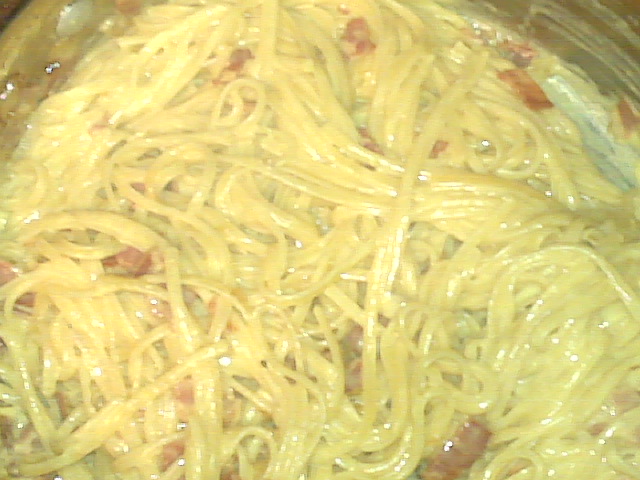
Linguine Carbonara with Bacon, Butter and Booze

Before I begin the discussion of my latest recipe, let me explain why I’m not profiling Italy in my Around the World in Eighty Bites project – definitely not because I don’t want to honor my Italian readers, but it seems redundant, considering that 90% of my culinary knowledge centers around Italian food and 80% of my recipes are either Italian or Italian-inspired.  I wouldn’t even know where to begin!  Making me choose one recipe to represent Italy would be like making me choose between The Rolling Stones and Led Zeppelin, so instead of cooking one representative dish, I’ll just give one big grazie to my Italian readers and express my envy that they get to live where pecorino and prosciutto are made! 


This weekend, I made biscotti, which requires egg whites.  In turn, I had egg yolks left over.  Not one to waste food, I needed to come up with a recipe using those egg yolks, and I decided on Linguine Carbonara.    


Carbonara is a very popular, very rich dish characterized by the presence of cured pork, eggs, cheese, and lots and lots of black pepper.  It is traditionally made with spaghetti, but any long pasta can be used.  Some versions use cream, some do not.  The type of pork used varies; some cooks use pancetta, some use guanciale, and some use plain old all-purpose bacon.  Americanized versions of the dish tend to feature other ingredients, such as grilled chicken, mushrooms, or peas, but these are not used in the Italian version.  My version stays closer to the traditional Italian recipe, and it includes Italian bacon (pancetta), butter, and booze!  Where I stray is in the addition of the egg at the end – in the traditional version, the raw egg is added at the last minute and cooked no further, letting the heat from the pasta cook the egg.  In my version, the egg and wine are added together, which requires an extra minute of cooking to guarantee that the egg cooks through.  You do not have to use only the eggs’ yolks for this recipe; I did so because I had them.  Whole eggs also work fine, and using whole eggs will result in a lighter texture than using mainly yolks.  Because this dish is extremely rich, a small serving goes a long way. 


Linguine Carbonara

1 pound linguine
½ stick butter
4 oz. pancetta, sliced into small strips
1 small onion, minced
1 whole egg + 2 egg yolks (you can substitute two whole eggs)
2 T. dry white wine
2 T. coarsely ground black pepper
½ cup grated parmesan cheese
Salt to taste


Cook the pasta.  In the meantime, melt the butter over medium-high heat in a large, heavy bottomed pan large enough to accommodate all the cooked pasta.  Once the butter has melted, add the pancetta and cook, stirring frequently, for about 2-4 minutes.  Once the edges begin to crisp, lower the heat, and add the onion and cook for another minute or so until the onion turns translucent. 


While the pancetta and onion cook, place the egg and yolk in a small bowl.  Add the wine and pepper, and beat with a fork or a small whisk until the ingredients are completely blended.  Set aside. 


Once the pasta has cooked, drain it and add it to the pan with the pancetta and onion.  Add the cheese and salt, and stir until the cheese is melted.  Now, slowly add the egg/wine mixture, constantly tossing the pasta, until each strand is coated with the mixture.  Cook for 1-2 minutes, or until the egg begins to firm up and adhere to the pasta.  Serve immediately.

Friday, September 24, 2010

Bacon and Butter and Booze, Oh My!

Bacon and butter and booze, oh my! Don’t forget cream, olive oil, and radicchio, one of my favorite vegetables. Yes, this recipe contains a lot of dieting no-nos, but calories are not a valid reason to miss out on something this delicious. Deprivation is not the key to anything, except maybe bingeing and unhappiness. If you’re really concerned about calories, keep in mind that this recipe makes four servings, so each portion only contains a teaspoon or so of the high-fat ingredients. Also keep in mind that our bodies need fat to function, and it’s much better to get your fat from a beautiful, flavorful pasta dish than from some chopped, formed deep-fried by-product garbage procured from a drive-thru. This dish is not one to miss!

The bacon, butter, cream, and wine make this a very, very rich dish, but the richness is balanced out by the bitterness of the radicchio. When choosing radicchio, select firm heads with white stems and tightly packed leaves. This tasty and versatile vegetable can be eaten raw or cooked, and is delicious quartered, grilled, and dressed with olive oil and lemon juice.


Linguine with Radicchio and Cream

12 oz. linguine
Splash olive oil
6 oz. Uncured bacon or pancetta, sliced
1 small onion, minced
1 head radicchio, quartered and shredded into ¼” strips
¼ c dry white wine
½ c grated pecorino romano
½ c heavy cream
2 T butter
Salt & pepper
Chopped parsley

Cook the pasta. In the meantime, prepare the sauce.

In a heavy-bottomed pan, heat the olive oil over medium-high heat. Add the bacon and the onion, cook until the bacon is starting to crisp and the onion is translucent, stirring occasionally.
Next, add the radicchio and the wine. Reduce the heat to low, cover, and cook until the radicchio is wilted. Stir once or twice.


Add all the remaining ingredients, stirring constantly until the butter an cheese have melted. When the pasta is cooked, drain it and add it to the pan with the radicchio, stir, and cook for 1-2 minutes more. Divide among 4 plates and serve.


Friday, September 10, 2010

Linguine al Limone

Boys and girls, pasta doesn’t get much simpler than this. Next time you’re looking for something quick, refreshing and satisfying, give this simple pasta recipe a try! Because it makes use of basic pantry ingredients, this is the perfect dish to make when you have to work late or when it’s raining like crazy outside and you don’t want to run to the store.


Linguine al Limone

½ box linguine
Splash olive oil *
Juice and zest of 1 lemon
½ - 1 cup grated pecorino romano
½ t. cracked black peppercorns
Pinch crushed red chile flakes
Pinch salt

Cook and drain the pasta. Add the olive oil and stir so that each strand of pasta is coated and pasta does not stick. Add the remaining ingredients, mix well, and serve.

* For a richer flavor, use half olive oil and half butter!