After picking up a bunch of Thai basil in Chinatown for a recipe that only required a few leaves, I needed to come up with something to do with the rest of the bunch. “Why not make pesto with a Thai twist?” I thought. I threw my experiment in the blender and was happy with the result, and my first instinct was to add the Thai pesto to cold Asian noodles, which is what I did in the recipe below.
While the noodle dish is excellent, you can also use Thai pesto on stir-fried or grilled vegetables, meats, and seafood, and thinned with a bit of sesame oil and rice vinegar, it would make an excellent dressing for Asian greens.
Soba Noodles with Thai Pesto
12 oz. buckwheat soba noodles
1 T. coconut oil
Splash sesame oil
½ c. Thai pesto (see recipe below)
1 cup cooked shelled edamame
Handful shredded cabbage
Cook the noodles in boiling water according to package instructions. Drain and place in a large mixing bowl with the coconut oil, sesame oil, Thai pesto, edamame, and cabbage. Toss until the noodles are coated with the pesto and the oil. Place the bowl in your refrigerator. Serve cold, garnishing with extra basil or sesame seeds if desired.
Thai Pesto
¼ c. peanuts, coarsely chopped
Leaves from 1 large bunch Thai basil
Leaves from 1 small bunch mint
2-3 Thai or Serrano chiles (use as many or as few as you’d like)
1 t. grated ginger
1 T. soy sauce
1 T. sesame oil
¼ c. canola oil (plus more if needed)
Place all ingredients in a blender or food processor. Blend until it forms a thick, smooth paste, adding more oil if necessary. Store in an airtight container for up to two weeks.
* Nutritional info: serves 4. 391 calories, 45 g fat, 67 g carbohydrates, 24 g protein.
Tuesday, April 2, 2013
Monday, March 4, 2013
Salmon with Ginger Chutney & Blueberries
This recipe was born from Things Whole Foods Had On Sale This Week. No restaurant replica, no convoluted tale of inspiration, just a girl trying to save a few bucks on sustainable seafood and produce that wasn’t sprayed with Big Ag’s latest science fair project.
Salmon with Ginger Chutney & Blueberries
¼ c. ginger chutney
1 cup water
4 4-oz portions wild salmon fillet
1 cup organic blueberries
Cooked basmati rice, to serve
Braised Escarole, to serve (recipe below)
Nigella seeds, for garnish
Blend the ginger chutney and the water together in a shallow baking dish, whisking with a fork to remove any lumps from the chutney. Place the salmon fillets in the baking dish, skin side up, and marinate for 30 minutes up to 4 hours.
Preheat the oven’s broiler to high. Line another large, shallow baking dish with foil and place the salmon fillets skin side up, with plenty of room between each fillet and room between the salmon and the edges of the dish. Pour the ginger chutney marinade into the dish alongside the salmon. Add the blueberries.
Broil for 4-6 minutes, or until the salmon skin starts becomes crispy and develops a slight char. Remove from heat.
Place about ½ c. cooked basmati rice in the center of a dinner plate, creating a round bed. Place braised escarole around the rice like a ring, and place one of the cooked salmon fillets, skin side down, on top of the basmati rice. Spoon some of the cooking liquid and the blueberries on top of the salmon, and sprinkle with the nigella seeds. Prepare three additional plates in the same manner and serve piping hot.
Braised Escarole
2 heads escarole, chopped
1 clove garlic, smashed with the side of a knife
1 allspice berry, smashed with the side of a knife
Pinch salt
Escarole grows best in sandy soil, so it must be thoroughly washed before using or you may end up with gritty greens. To wash the escarole, place the chopped leaves in a large bowl and cover with water. Using your hands, slosh the escarole around in the bowl for a minute or so, wiggling the leaves through your fingers so that any sand falls to the bottom of the bowl.
Place the crushed garlic clove and allspice berry in a large pot with a lid. Without draining, lift the escarole out of the water-filled bowl and place directly into the pot. Sprinkle with a pinch of salt, place the lid on the pot, and cook over medium heat, stirring occasionally, until the escarole has wilted but still retains a firm texture. Pay close attention during cooking—the water that clings to the leaves after washing isn’t always enough; the pot should never be dry, so you may need to add a tablespoon or two of extra water while cooking.
Remove the garlic clove and serve with a slotted spoon to drain away any excess moisture.
* Nutritional info: serves four. 537 calories, 11.5 g fat, 63 g carbohydrates, 32 g protein.
![]() |
Tuesday, February 19, 2013
Lemongrass Shrimp Skewers with Kiwi & Avocado Guacamole
In addition to my kiwis, I picked up an avocado, some Serrano chiles, and on a whim, a few stalks of lemongrass. While the lemongrass didn’t contribute much flavor-wise, it certainly added to the presentation. Try this next time you’re craving spicy, tropical flavors!
Lemongrass Shrimp Skewers with Kiwi & Avocado Guacamole
4 stalks lemongrass
8 U-7 (jumbo) shrimp
Kiwi & Avocado Guacamole, as prepared below
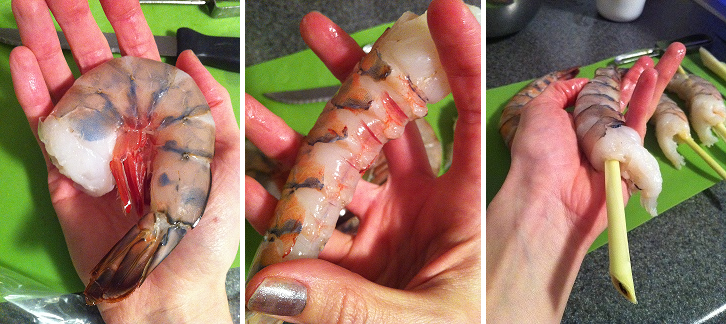
Prepare a grill or preheat your oven’s broiler. In the meantime, remove shells from shrimp, leaving the tail shell intact (this helps prevent the smaller end of the shrimp from drying out while cooking. Cut the lemongrass stalks in half, cutting diagonally so that a sharp point is formed (as shown in photo below right). Use your fingers to straighten the raw shrimp, and using the pointed end of the lemongrass spear, insert the lemongrass into the shrimp lengthwise (see photos below).
If using the broiler, line a baking sheet with foil, and place a wire rack on top of the foil. Place the skewered shrimp on the wire rack, and put the shrimp under the broiler. Cook the shrimp for 3-4 minutes, or until the shrimp are firm and pink. If using the grill, place the shrimp over slow coals and grill for 2-4 minutes, or until the shrimp are firm and pink.
While the shrimp cook, prepare two plates by spreading about ½ cup of the Kiwi & Avocado Guacamole on each plate. Once the shrimp are cooked, arrange four shrimp on each plate in a spoke formation.
* Nutritional info: serves 2. 335 calories, 11 g fat, 17 g carbohydrates, 45 g protein.
Kiwi & Avocado Guacamole
3 cloves garlic, very finely minced
2 serrano chiles, very finely minced*
1 T. finely minced onion
2 kiwis, peeled and minced
1 avocado, chopped
Combine all the ingredients in a large mixing bowl. Using a potato masher or a fork, mash until the guacamole is smooth and well-blended (you can use a food processer, but the texture will be almost too smooth—mashing manually gives a heartier texture). Cover the bowl with plastic film and set aside. This recipe makes about 2 cups.
*You can adjust the heat by using a milder or a hotter chile in place of serranos, or simply adjusting the number of chiles used.
* Nutritional info: serves about 4. 111 calories, 7.5 g fat, 15 g carbohydrates, 1.5 g protein.
Monday, February 4, 2013
Chicken and Sweet Potato Curry with Tropical Fruits
This recipe was an accident—a happy accident. I’d originally purchased the tropical fruits and Thai seasonings to create what turned out to be painfully underwhelming Tropical Fruit Spring Rolls. By rethinking the ingredients and adding chicken, rice, and vitamin-packed sweet potatoes, I turned my failure into a delectable Thai-inspired curry.
While most large supermarkets sell papayas and mangos (if not fresh, you’ll probably be able to find them in jars or frozen), dragon fruits may be more difficult to track down. Try a Latino or Chinese grocer; if you still can’t find dragon fruit, simply add the diced flesh of 2-3 peeled kiwis.
Chicken and Sweet Potato Curry with Tropical Fruits
2 T. coconut oil
12 oz. chicken breast, cut into bite-sized pieces
2 medium sweet potatoes, peeled and diced
3-4 Thai chiles, minced
1 mango, peeled and cut into small dice
1 ripe papaya, seeded and cut into small dice
1 dragon fruit, peeled and cut into small dice*
8 oz. can sliced water chestnuts, drained
15 oz. can coconut milk
Juice and grated zest of 1 lime
¼ c. rum
2 T. soy sauce
2 t. cardamom, ground
1 t. grains of paradise, ground
1 t. grated ginger
½ t. ground cinnamon
¼ t. freshly ground black pepper
Handful Thai basil, chopped
Handful fresh mint, chopped
Cooked rice, to serve
Small sprigs of basil and/or mint, for garnish
Thai chiles, for garnish
In a large, heavy-bottomed pot, melt the coconut oil over medium-high heat, then add the chicken, sweet potatoes and chiles. Cook for 5-7 minutes, stirring frequently, until the chicken has mostly browned.
Next, add all remaining ingredients except the Thai basil, mint, and rice. Stir to combine, lower the heat to medium-low, cover, and cook for another 20-25 minutes, stirring occasionally.
When the dish is finished cooking, stir in the chopped Thai basil and the chopped mint. Blend well, spoon over rice in individual serving bowls, and top with a small sprig of basil or mint and a single Thai chile.
*If you cannot locate dragon fruit, substitute 2-3 peeled kiwis.
* Nutritional info: serves 6-8. 406 calories, 16 g fat, 48 g carbohydrates, 22 g protein.
* To purchase ingredients used in this recipe, click the link(s) below:
While most large supermarkets sell papayas and mangos (if not fresh, you’ll probably be able to find them in jars or frozen), dragon fruits may be more difficult to track down. Try a Latino or Chinese grocer; if you still can’t find dragon fruit, simply add the diced flesh of 2-3 peeled kiwis.
![]() |
| Dragon Fruit, Cross-Section |
2 T. coconut oil
12 oz. chicken breast, cut into bite-sized pieces
2 medium sweet potatoes, peeled and diced
3-4 Thai chiles, minced
1 mango, peeled and cut into small dice
1 ripe papaya, seeded and cut into small dice
1 dragon fruit, peeled and cut into small dice*
8 oz. can sliced water chestnuts, drained
15 oz. can coconut milk
Juice and grated zest of 1 lime
¼ c. rum
2 T. soy sauce
2 t. cardamom, ground
1 t. grains of paradise, ground
1 t. grated ginger
½ t. ground cinnamon
¼ t. freshly ground black pepper
Handful Thai basil, chopped
Handful fresh mint, chopped
Cooked rice, to serve
Small sprigs of basil and/or mint, for garnish
Thai chiles, for garnish
In a large, heavy-bottomed pot, melt the coconut oil over medium-high heat, then add the chicken, sweet potatoes and chiles. Cook for 5-7 minutes, stirring frequently, until the chicken has mostly browned.
Next, add all remaining ingredients except the Thai basil, mint, and rice. Stir to combine, lower the heat to medium-low, cover, and cook for another 20-25 minutes, stirring occasionally.
When the dish is finished cooking, stir in the chopped Thai basil and the chopped mint. Blend well, spoon over rice in individual serving bowls, and top with a small sprig of basil or mint and a single Thai chile.
*If you cannot locate dragon fruit, substitute 2-3 peeled kiwis.
* Nutritional info: serves 6-8. 406 calories, 16 g fat, 48 g carbohydrates, 22 g protein.
* To purchase ingredients used in this recipe, click the link(s) below:
Sunday, January 27, 2013
Cold-Weather Cooking: Farfalle with Chicken, Mushrooms, and Roasted Red Peppers
When temperatures drop down to single digits, it’s only natural to be inclined to cook hearty dishes with rich, buttery sauces! This recipe, which uses dark meat chicken, roasted red peppers, meaty Portobello mushrooms, and fiber-packed chickpeas, is simple to prepare and immensely satisfying. Bundle up, head to the market and pick up these easy-to-find ingredients, and once you've thawed out, put this on the stove. Serve with lots of Chardonnay!
Farfalle with Chicken, Mushrooms, and Roasted Red Peppers
16 oz. / 455 g. dry farfalle
Splash olive oil
4 boneless, skinless chicken thighs
1-2 large shallots, sliced
1 head garlic, roasted*
4-5 large Portobello mushrooms, diced
2-3 large red peppers, roasted and minced*
1 15-oz.can chickpeas (do not drain)
2 bay leaves
3 whole cloves
Pinch dried rosemary
½ c. Chardonnay
½ c. light cream
Pat butter
Salt and pepper, to taste
Cayenne pepper, to taste (optional)
Cook the pasta in heavily salted water. In the meantime, heat the olive oil over medium-high heat in a large, heavy-bottomed pot. Add the chicken and brown for a few minutes, then add the shallot and garlic and continue to cook for another 3-5 minutes.
Next, add the mushrooms, red peppers, chickpeas, bay leaves, cloves, rosemary, and wine. Cook for 15-20 minutes, stirring occasionally.
When the chicken is fully cooked, add the cream, butter, salt and pepper, and cayenne (if using). Blend well, then add the cooked pasta. Mix well, and serve piping hot.
*Note: For instructions on roasting garlic and peppers, click here. When selecting peppers for roasting, choose peppers that are long rather than round and boxy. I don’t know why, but they seem to yield a more flavorful roasted pepper!
* Nutritional info: serves six. 624 calories, 16 g fat, 75 g carbohydrates, 47 g protein.
Sunday, January 13, 2013
Barley-Stuffed Chicken Rolls with Rose and Whiskey Sauce
Recently, I found a jar of rose preserves—rose petals preserved with sugar and pectin—at a Russian market. Never having tried rose preserves, I obviously needed to buy it! I opened the jar and sniffed the marmalade-like preserves, then tried a spoonful and realized how wonderful it would taste when combined with whiskey. That was all the inspiration I needed for this recipe! Here, I’ve combined traditional Scottish flavors with the sweet, fragrant rose jam. Serve this alongside bitter greens, such as kale or broccoli rabe, which will complement the sugary jam. This is even better when served with a glass of scotch!
Barley-Stuffed Chicken Rolls with Rose and Whiskey Sauce
For the stuffing:
1 T. butter
½ medium brown onion, minced
1 large clove garlic, smashed with the side of a knife blade
3 whole cloves
1 bay leaf
1 small pinch cinnamon
½ c. pearl barley
1.5 c. low-sodium chicken broth
For the sauce:
¼ c. butter
½ medium brown onion, minced
¼ t. dried thyme
1 bay leaf
1 pinch cinnamon
1/3 c. scotch
¼ c. rose preserves*
¼ c. low-sodium chicken broth
For the chicken rolls:
6 slices chicken breasts (approx. 1.5 pounds), pounded ultra-thin
1 batch stuffing
1 batch sauce
First, make the stuffing. Melt the butter over medium-low heat, then add the onion, garlic, cloves, cinnamon, and bay leaf. Cook for 5-7 minutes, or until the onion has softened.
Add the barley, stir until each grain is coated with butter, then add the chicken broth. Stir, bring to a boil, reduce to a simmer and cover, and cook for about 30 minutes.
While the barley is cooking, make the sauce. Melt the butter over low heat. Add the onion, thyme, bay leaf, and cinnamon. Cook for about 10 minutes or until the onion is soft and translucent. Once the onion has cooked, add the scotch, rose preserves, and chicken broth. Cook, stirring constantly, until the rose preserves have completely blended in.
Once the stuffing is done cooking, let it cool a bit, and then prepare the chicken. Lay the pounded chicken on a flat surface, and spread each piece with 1-2 heaping spoonfuls of stuffing. Roll up, starting with the largest end, and secure with kitchen string or silicone ties. Place each roll seam-side down in an ovenproof baking dish.
Pour the sauce over the chicken roll. Bake for 30 minutes, basting every 5 minutes. When done baking, let rest for 5 minutes, then slice, spoon the sauce over the slices, and serve alongside a green vegetable.
* Rose preserves can be found at Russian or Eastern European markets, at specialty retailers, and online. I used Kafkas brand. If you cannot find rose preserves, simply substitute an equal amount of orange marmalade along with1-2 teaspoons rose water.
* Nutritional info: serves six. 350 calories, 12 g fat, 24 g carbohydrates, 31 g protein.
| Spreading the barley stuffing on the chicken |
| Basting the chicken rolls as they bake |
| Sliced and ready to serve |
Sunday, December 30, 2012
It’s Nigiri! It’s Maki! No, it’s…Antipasti?!?
Try my twist on the traditional antipasti platter, where rich cheese, prosciutto, and roasted red peppers and eggplant are shaped and formed into Roasted Eggplant and Prosciutto "Maki" rolls and Roasted Red Pepper "Nigiri." Perfect for a festive occasion, these delightful nibbles will certainly surprise your guests!
To save time on party day, prepare the cheese blend and roast the peppers and the eggplants in advance.
Cheese Blend for Antipasti “Sushi”
15 oz. / 425 g. whole milk ricotta, drained
8 oz. / 225 g. mozzarella, finely diced (pieces should be about the size of rice grains)
1 small clove garlic, pressed
1 t. salt
Freshly ground black pepper
Pinch dried oregano
Combine all the ingredients in a large bowl. Mix well so that the garlic is evenly blended throughout. Cover with plastic film and refrigerate until ready to use.
Roasted Eggplant
1 t. salt
1 t. dried oregano
½ t. freshly ground black pepper, fine grind
1 small eggplant, sliced lengthwise into ½” slices
Combine the salt, dried oregano, and pepper in a small bowl and set aside. Lay the eggplant on a wire rack, and sprinkle with the seasoning. Rub the seasoning into the eggplant slices.
Preheat the oven’s broiler. In the meantime, line a baking sheet with foil and place the wire rack with the eggplant on top of the foil. When the oven is ready, place the eggplant under the broiler and broil for 5-7 minutes. Remove and set aside to cool until ready to use.
Roasted Red Peppers
2 red bell peppers*, cored and sliced lengthwise at natural rib
Preheat the broiler on high. Arrange the peppers on a baking sheet covered in foil (this makes clean-up much easier). Put the peppers under the broiler for 5-10 minutes, or until the peppers' skins have turned black and charred.
Remove the baking sheet from the oven. Using tongs, place the roasted peppers in a bowl. Cover the bowl and let the peppers cool.
Once peppers have cooled, gently peel off the charred skin and discard skin. The peppers are now ready to use.
* For this recipe, use the boxiest, most evenly square-shaped peppers you can find
Roasted Eggplant and Prosciutto “Maki”
Roasted eggplant, as prepared above
4 oz. / 115 g. prosciutto, very thinly sliced
Cheese blend, as prepared above
Prepare the eggplant by slicing lengthwise into thin batons, then slicing in half crosswise so that the batons are about as long as the prosciutto’s width. Set aside.
Lay a slice of prosciutto on your work surface. Heap a spoonful or two of the cheese blend onto about half of the prosciutto and spread until it is about ¼” thick. Place 2-3 eggplant batons about an inch in (see photo below), and roll up.
Using a sharp knife, slice each roll in half (see photo below), then trim the ends so that they will lay flat on a serving tray.
Repeat with the remaining eggplant, prosciutto, and cheese.
* Nutritional info per piece: 58 calories, 4 g fat, 2.7 g carbohydrates, 4.7 g protein.
Roasted Red Pepper “Nigiri”
Roasted red peppers, as prepared above
Cheese blend, as prepared above
Slice the roasted red peppers into rectangles, approximately 1 x 2.5 inches.
Place 2 heaping spoonfuls of the cheese blend into your hands and shape into pieces that are about an inch thick, and inch wide, and 2 inches long. Handle the cheese as little as possible, as the warmth of your hands will cause the cheese to soften.
Place a red pepper slice on the shaped cheese piece. Repeat with the remaining peppers and cheese.
* Nutritional info per piece: 97 calories, 7 g fat, 1.7 g carbohydrates, 6 g protein.
Tuesday, December 18, 2012
Feast of the Seven Fishes: Vodka-Braised Calamari with Celery and Tomatoes
It’s almost time for the Feast of the Seven Fishes! Stemming from the Catholic tradition of abstaining from meat on Christmas Eve, many Italians create elaborate meals featuring seven seafood dishes. If you’re in the mood for a less-traditional preparation, try this calamari dish that I created this weekend.
My inspiration for this recipe arrived while I wrestled with whether or not to make a bottle of chile-infused vodka—I wondered what I could do with the spicy booze other than pour it into bloody marys, and I decided to try cooking calamari in vodka with some chiles. The result? A fantastic, fresh-tasting sauce that would be a delight on any Christmas Eve table! If you’re bored with the same old calamari recipes, give this one a shot!
Vodka-Braised Calamari with Celery and Tomatoes
16 oz. / 455 g dry linguine
3 slices streaky bacon (optional)
1 T. butter (if omitting bacon, increase to 2 T. butter)
2 leafy stalks celery, minced (reserve minced leaves)
2 shallots, minced
2 serrano chiles, minced
2 bay leaves
3 medium tomatoes, chopped
1/3 c. golden raisins
1 T. capers in salt
1 c. vodka
1.5 lb. calamari (I prefer a 50/50 mix of tubes and tentacles)
Generous splash olive oil
First, cook the pasta in heavily salted water. In the meantime, if using the bacon, cook the bacon slices in a large, heavy-bottomed pot over medium-high heat until crisp, then remove and place on paper towels. Do not drain the bacon fat from the pot. Add the butter and let it melt (if not using the bacon, simply add the butter to the pot and let it melt), then add the minced celery stalk (keep the minced celery leaves set aside for later), shallot, chiles, and bay leaves. Cook, stirring frequently, for 3-5 minutes or until the shallot and celery are translucent.
Next, add the tomatoes, raisins, capers and vodka. Stir, scraping up any browned bits of bacon from the bottom of the pot. Lower heat to simmer and cook for 8-10 minutes.
When the pasta is just about ready and the tomatoes have simmered in the vodka, add the calamari to the pot with the vodka and tomatoes and raise the heat to medium-high. Cook, stirring frequently, for 1-2 minutes.
Drain the pasta from the cooking water and add the cooked pasta to the pot with the vodka and calamari. Add a generous splash of olive oil, and stir gently until blended. Serve the pasta in individual bowls, and garnish by sprinkling with the minced celery leaves.
* To purchase ingredients used in this recipe, click the picture below: