Showing posts with label radicchio. Show all posts

Tuesday, March 20, 2012

Chestnut Flour Pasta with Sautéed Radicchio, Chicken Livers, and Grapefruit

chestnut honey, chestnut flour pasta,
parsley, radicchio
This is one of those recipes that snowballs from a basic idea until I have no choice but to give into my curiosity and try a recipe that sounds like a long shot flavor-wise. First, I wondered if chestnut honey and grapefruit juice would taste good together. They did. I wanted to carry the chestnut theme through the dish, and I had about a cup of chestnut flour in my pantry, so that got thrown in a bowl with some eggs and I turned it into pasta. Chestnut flour is a bit gritty and earthy tasting, so I needed ingredients that would not be overpowered by the chestnut flavor. Radicchio and chicken livers seemed perfect. Would it work?

It worked! It would have been more appropriate in autumn, but it tasted great! This dish is not for everyone - you have to be a true lover of intensely earthy, woodsy, bitter flavor combinations in order to appreciate this one, but if you’re anything like me and you can’t bear to not try something, take a chance on this recipe!


Chestnut Flour Pasta with Sautéed Radicchio, Chicken Livers, and Grapefruit

1 batch cooked chestnut flour pasta (recipe below)
Splash olive oil
1 large shallot, minced
12 oz. Chicken livers, chopped into bite-sized pieces
2 T. chestnut honey
1/3 c. grapefruit juice
½ c. coarsely grated pecorino romano
2 heads radicchio, shredded
Salt and coarsely ground pepper
Handful coarsely chopped parsley
Pecorino romano shavings, to garnish

In a large, heavy-bottomed pan, heat the olive oil over medium-high heat. Add the shallot and chicken livers and saute for about 5-7 minutes, stirring frequently, until the shallots are softened and the chicken livers have browned.

Add the chestnut honey, grapefruit juice, and pecorino romano, stirring gently a few more times until the mixture is well-blended. Add the radicchio, cover, and reduce heat to low. Cook for 5-7 minutes, stirring once or twice, until the radicchio is wilted.

Add the salt and parsley to the mixture, stir until blended, and spoon over the cooked chestnut flour pasta. Garnish with extra chopped parsley and shaved pecorino romano.


Chestnut Flour Pasta

¾ c. chestnut flour
¾ c. unbleached white flour
1 t. salt
1 t. olive oil
2 eggs

Combine the ingredients in a bowl and blend, using your hands. Work the ingredients together until you have a stiff dough, and knead for 6-8 minutes. Wrap the dough in plastic and refrigerate for at least one hour, if not overnight.

After the dough has refrigerated, use a pasta machine to roll out the dough. Don’t use the thinnest setting; chestnut flour pasta tends to be more brittle than wheat flour pasta. I recommend the 2nd or 3rd thinnest setting. Cut the dough into 1/3” wide noodles, and let dry for at least 30 minutes.

When you are ready to cook the chestnut flour pasta, cook it in heavily salted water and stir as little as possible, as it has a tendency to break easily. Serve with the recipe above.


Wednesday, February 1, 2012

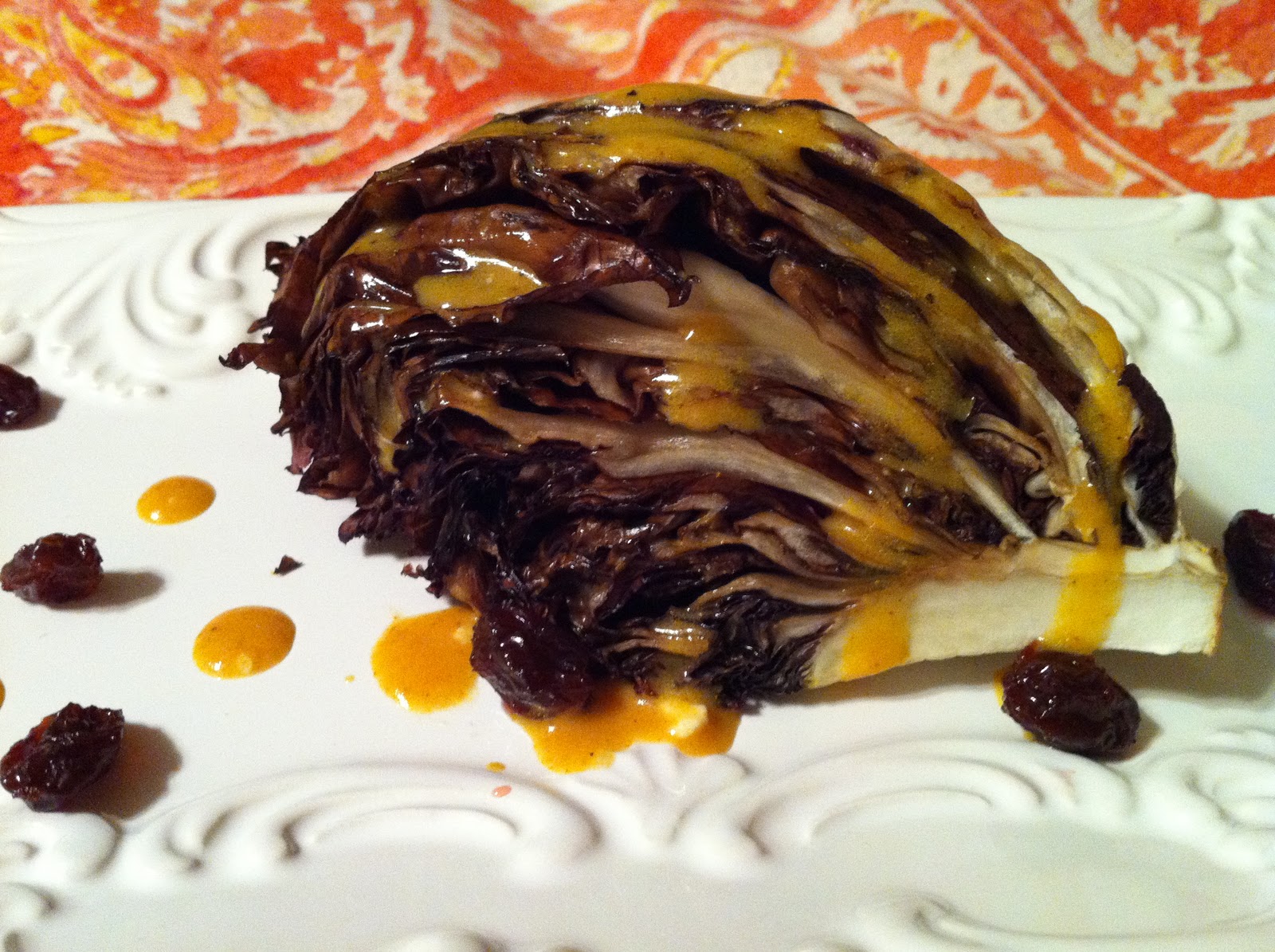
Radicchio Wedge Salad with Curried Blue Cheese Dressing and Campari Raisins

The iceberg wedge salad. Now a common steakhouse and “New American” restaurant menu staple, the iceberg wedge wasn’t always so readily accepted by the hungry public. In fact, yours truly was waiting tables during the iceberg wedge’s rise to popularity, and I recall many a diner shooting me a barbed, “What the hell is this?” or “Um, did someone forget to chop the lettuce? Send it back.” I could feel my tips dwindling. But like hybrid cars, the Internet, and casual Fridays, the iceberg wedge went from shunned to tolerated to embraced. However, as eaters’ palates have become more adventurous, the iceberg wedge is now playing second fiddle to salads that use darker, more exotic greens, innovative dressings, and interesting touches like candied walnuts, pickled shallot, and marketable “superfoods” such as goji berries and pomegranate seeds.

Rather than burn out or fade away, perhaps the wedge salad simply needs a makeover!

Last night, I created a modern twist on the classic wedge salad, using radicchio instead of traditional iceberg lettuce. I originally planned on dressing it in a garlicky aioli, but I decided to at least stay parallel to tradition, so I concocted a runny blue cheese dressing with a punch of curry. The richness of the creamy blue cheese paired delightfully with the warm, bitter radicchio. Still, the plate needed something else, but what? Perhaps something sweet to counter the bitterness of the radicchio and the kick of heat in the curry? Raisins! But I’d have to plump them first; otherwise I’d risk having my plate look like it had been sprinkled with rabbit poo. I didn’t have any open wine, and I feared that whiskey or grappa would be far too strong, so I chose Campari. Campari is an Italian liqueur with a bitter, yet sweet and almost citrusy flavor; it seemed like a logical choice for this dish. I soaked the raising in warmed Campari to speed up the plumping process, and then I sprinkled the raisings on the plate with my radicchio wedge.

The result? Sheer perfection! If your palate is not accustomed to bitter ingredients, you may not appreciate the complexity of this dish, but if you like bold, unique flavors, you’ll surely fall in love with this modern twist on the classic iceberg wedge salad!


Radicchio Wedge Salad with Curried Blue Cheese Dressing and Campari Raisins

For the Campari Raisins:
2 T. raisins
3 T. Campari, warmed but not boiling

For the dressing:
3-4 T. high-quality blue cheese dressing
2 T. olive oil
2 t. Campari (use the liquid left after the raisins have soaked)
2 t. turmeric
1 t. garlic powder
¼ t. cayenne, or to taste
Dash finely ground black pepper

2 heads radicchio, quartered
1 T. olive oil

Soak the raisins in the warmed Campari for at least 20 minutes.

Preheat your oven’s broiler over a low setting, and if you can’t control the setting, simply use the rack farthest away from the heat source. In the meantime, make the dressing by whisking all the ingredients together until they are completely blended. Set aside until ready to use.

Now, it is time to broil the radicchio. Brush each cut surface of the radicchio quarters with the olive oil, lay the curved side on a baking sheet lined with tinfoil, and broil for 5-7 minutes. Do not let the radicchio burn.

Once the radicchio has broiled, place a quarter or two on individual serving plates, drizzle the dressing over the radicchio, and sprinkle each plate with a few raisins. Serve immediately. 


Friday, September 24, 2010

Bacon and Butter and Booze, Oh My!

Bacon and butter and booze, oh my! Don’t forget cream, olive oil, and radicchio, one of my favorite vegetables. Yes, this recipe contains a lot of dieting no-nos, but calories are not a valid reason to miss out on something this delicious. Deprivation is not the key to anything, except maybe bingeing and unhappiness. If you’re really concerned about calories, keep in mind that this recipe makes four servings, so each portion only contains a teaspoon or so of the high-fat ingredients. Also keep in mind that our bodies need fat to function, and it’s much better to get your fat from a beautiful, flavorful pasta dish than from some chopped, formed deep-fried by-product garbage procured from a drive-thru. This dish is not one to miss!

The bacon, butter, cream, and wine make this a very, very rich dish, but the richness is balanced out by the bitterness of the radicchio. When choosing radicchio, select firm heads with white stems and tightly packed leaves. This tasty and versatile vegetable can be eaten raw or cooked, and is delicious quartered, grilled, and dressed with olive oil and lemon juice.


Linguine with Radicchio and Cream

12 oz. linguine
Splash olive oil
6 oz. Uncured bacon or pancetta, sliced
1 small onion, minced
1 head radicchio, quartered and shredded into ¼” strips
¼ c dry white wine
½ c grated pecorino romano
½ c heavy cream
2 T butter
Salt & pepper
Chopped parsley

Cook the pasta. In the meantime, prepare the sauce.

In a heavy-bottomed pan, heat the olive oil over medium-high heat. Add the bacon and the onion, cook until the bacon is starting to crisp and the onion is translucent, stirring occasionally.
Next, add the radicchio and the wine. Reduce the heat to low, cover, and cook until the radicchio is wilted. Stir once or twice.


Add all the remaining ingredients, stirring constantly until the butter an cheese have melted. When the pasta is cooked, drain it and add it to the pan with the radicchio, stir, and cook for 1-2 minutes more. Divide among 4 plates and serve.