Showing posts with label curry. Show all posts

Wednesday, February 1, 2012

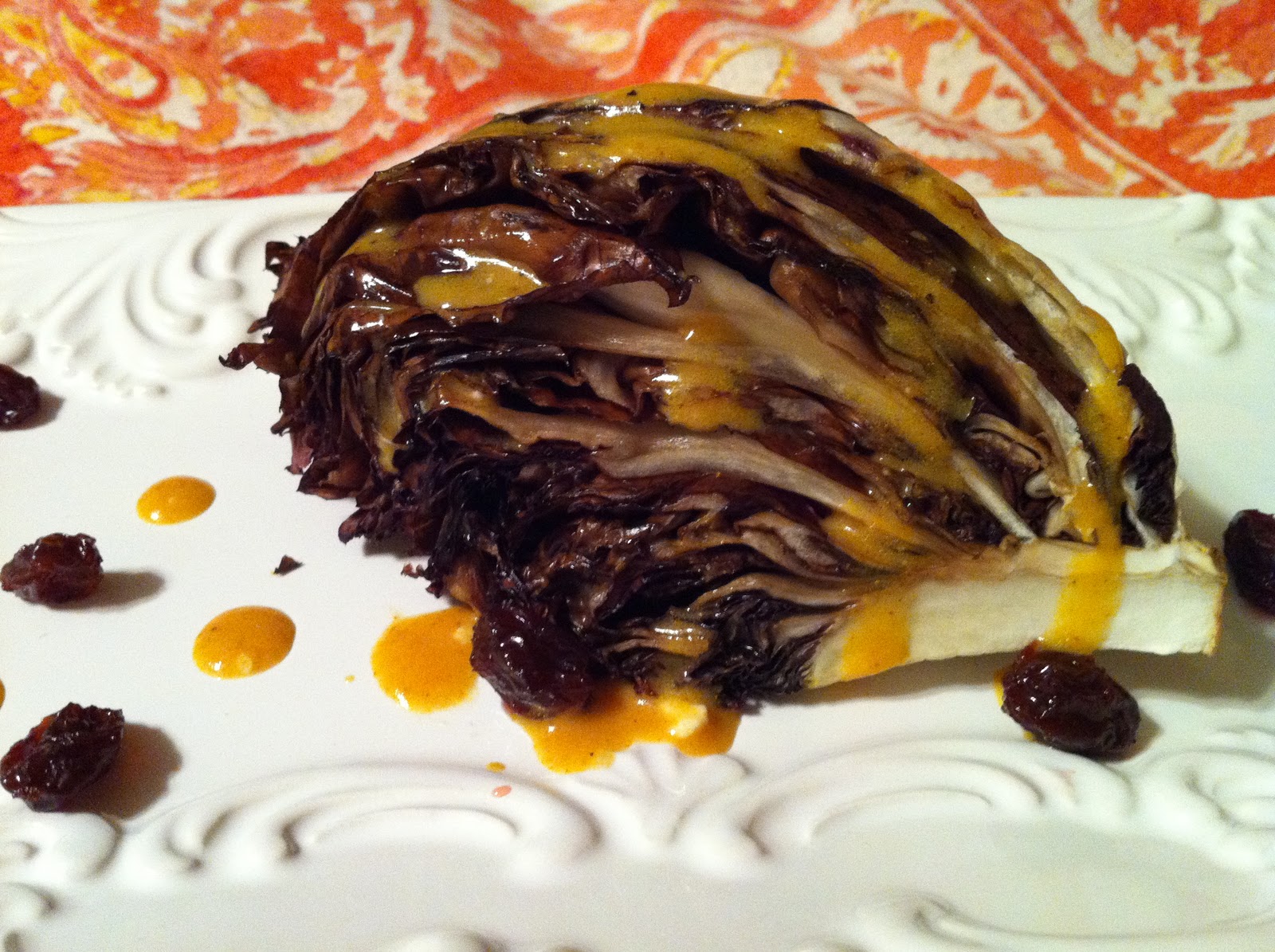
Radicchio Wedge Salad with Curried Blue Cheese Dressing and Campari Raisins

The iceberg wedge salad. Now a common steakhouse and “New American” restaurant menu staple, the iceberg wedge wasn’t always so readily accepted by the hungry public. In fact, yours truly was waiting tables during the iceberg wedge’s rise to popularity, and I recall many a diner shooting me a barbed, “What the hell is this?” or “Um, did someone forget to chop the lettuce? Send it back.” I could feel my tips dwindling. But like hybrid cars, the Internet, and casual Fridays, the iceberg wedge went from shunned to tolerated to embraced. However, as eaters’ palates have become more adventurous, the iceberg wedge is now playing second fiddle to salads that use darker, more exotic greens, innovative dressings, and interesting touches like candied walnuts, pickled shallot, and marketable “superfoods” such as goji berries and pomegranate seeds.

Rather than burn out or fade away, perhaps the wedge salad simply needs a makeover!

Last night, I created a modern twist on the classic wedge salad, using radicchio instead of traditional iceberg lettuce. I originally planned on dressing it in a garlicky aioli, but I decided to at least stay parallel to tradition, so I concocted a runny blue cheese dressing with a punch of curry. The richness of the creamy blue cheese paired delightfully with the warm, bitter radicchio. Still, the plate needed something else, but what? Perhaps something sweet to counter the bitterness of the radicchio and the kick of heat in the curry? Raisins! But I’d have to plump them first; otherwise I’d risk having my plate look like it had been sprinkled with rabbit poo. I didn’t have any open wine, and I feared that whiskey or grappa would be far too strong, so I chose Campari. Campari is an Italian liqueur with a bitter, yet sweet and almost citrusy flavor; it seemed like a logical choice for this dish. I soaked the raising in warmed Campari to speed up the plumping process, and then I sprinkled the raisings on the plate with my radicchio wedge.

The result? Sheer perfection! If your palate is not accustomed to bitter ingredients, you may not appreciate the complexity of this dish, but if you like bold, unique flavors, you’ll surely fall in love with this modern twist on the classic iceberg wedge salad!


Radicchio Wedge Salad with Curried Blue Cheese Dressing and Campari Raisins

For the Campari Raisins:
2 T. raisins
3 T. Campari, warmed but not boiling

For the dressing:
3-4 T. high-quality blue cheese dressing
2 T. olive oil
2 t. Campari (use the liquid left after the raisins have soaked)
2 t. turmeric
1 t. garlic powder
¼ t. cayenne, or to taste
Dash finely ground black pepper

2 heads radicchio, quartered
1 T. olive oil

Soak the raisins in the warmed Campari for at least 20 minutes.

Preheat your oven’s broiler over a low setting, and if you can’t control the setting, simply use the rack farthest away from the heat source. In the meantime, make the dressing by whisking all the ingredients together until they are completely blended. Set aside until ready to use.

Now, it is time to broil the radicchio. Brush each cut surface of the radicchio quarters with the olive oil, lay the curved side on a baking sheet lined with tinfoil, and broil for 5-7 minutes. Do not let the radicchio burn.

Once the radicchio has broiled, place a quarter or two on individual serving plates, drizzle the dressing over the radicchio, and sprinkle each plate with a few raisins. Serve immediately. 


Friday, January 7, 2011

Ingredient Spotlight - Thai Eggplant

What is Thai Eggplant?  From what I determined, it's a cuter version of common purple eggplant!

I stumbled across a bag of Thai Eggplant in the produce department of my grocery store. Each no larger than a tangerine, some as small as a golf ball, these shamrock green spheres speckled with white aroused my curiosity. Do they they taste any different from regular eggplant? Is their texture the same? What color is the flesh inside?  I stopped staring at them and threw them into my basket, mentally shuffling my shopping list to include the ingredients for a traditional Thai green curry with beef.

While slicing the Thai Eggplant, I noticed that they contained more seeds than regular purple eggplant. This could be due to their small size. The flavor is exactly the same as purple eggplant, and so is the texture. My conclusion? Unless you want to add visual interest to a dish, there is no need to seek out these eggplants when you could simply use the easier to locate and easier to prepare common purple eggplant. That being said, here is the recipe I created with my Thai Eggplant.

Thai Eggplants in Beef Curry

1 T. coconut oil (can substitute vegetable oil)
1 lb. beef sirloin, sliced into 1/4" strips (also known as "stir-fry beef")
1 shallot or small onion, minced
2 lb. Thai eggplants, quartered or cut into eighths (or substitute diced purple eggplant)
1 can coconut milk
1t - 2T. Thai green curry paste (depends on how spicy you like it)
1t. grated fresh ginger
2 T. soy sauce
1 T. fish sauce
black pepper to taste
generous handful shredded basil leaves
red chile flakes (optional)

cooked rice noodles

Heat the coconut oil over medium-high heat in a large, heavy-bottomed pan. When heated through, add the beef strips and brown for 2-3 minutes. Add the shallot or onion and saute for another minute or so, or until the shallot is translucent. Now, add the eggplant and stir a few times to combine.

Add the coconut milk, curry paste, ginger, soy sauce, fish sauce, and pepper. Stir to combine, reduce heat to low, and simmer for about 10 minutes, or until the eggplant has softened and the sauce has thickened up a bit.

Spoon the curry over cooked rice noodles, and garnish each dish with shredded basil, and chile flakes if you prefer a little extra heat.

Monday, November 22, 2010

Around the World in Eighty Bites - Thailand

The next leg of my “Around the World in Eighty Bites” journey stops in Thailand.  Thai food is known for being spicy, but many Westerners don’t seem to be as apprehensive about trying Thai food as they do about trying Indian or Japanese dishes.  Thai food is definitely exotic, but in an approachable manner. 

My first foray into international cooking was over 10 years ago when I experimented with a Thai squid salad recipe I found in Jeff Smith’s “The Frugal Gourmet on Our Immigrant Ancestors.”  Never before had I used unfamiliar ingredients such as Thai curry paste (an ingredient made from chiles, garlic, ginger, and spices), lemongrass, or fish sauce, but I fell in love with Thai flavors and wanted to try as many Thai recipes as I could get my hands on.  Once I headed off to Northeastern University and lived in my first off-campus apartment, my mom bought me a Thai cookbook.  I still use that cookbook today, despite the fact that entire sections are peeling away from the binding and some of the pages are glued together by splashes of coconut milk or soy sauce.  The book features write-ups about each ingredient common in Thai cooking, many of which are available in the States, either in cities with large Asian populations or via mail order.  My curiosity was aroused by some of these hard-to-find foreign ingredients.  Thankfully, I live in a city with a sizable Chinatown, and I’ve been able to locate imported items like tamarind, shrimp paste, and fresh lychees. 

My Thai cookbook also gives a detailed history of Thai cooking and culinary traditions.  I loved learning about the philosophy of the Five Flavors – hot, salty, sweet, sour, and bitter – and how these five flavors are incorporated into each dish.  I like that kind of playful balance that creates a party in one’s mouth!  It was also interesting to learn that traditionally, Thai women were sent to live in temples for years at a time.  In these temples, they learned the art of food preparation, including not only cooking, but garnishing.  The women learned to carve fruits and vegetables into elaborate edible figurines for presentation at formal meals.  These temples still exist in modern Thailand, but they are open to the public for tours, and cooking lessons are now available to men as well! 

Although I’ve tried many Thai recipes, I still have not made Pad Thai, Thailand’s most famous dish. I will someday.  My all-time favorite Thai recipe (so far) is a quick coconut-based curry with chopped pineapple.  Traditionally made with pork, this recipe can also be made using chicken or seafood, as I have done in the recipe below.  If you like it a little spicier, add some crushed red chile flakes or fresh minced chiles.  This recipe is light, yet rich, and like most Thai food, it pairs well with an ice-cold lager or ale. 


Seafood Curry with Pineapple

1 T. coconut or vegetable oil
1 shallot, minced
2 cups fresh pineapple, chopped into bite-sized pieces
1 can coconut milk
2 T. Thai green curry paste (Thai Kitchen is a good brand)
2 T. soy sauce
1 T. fish sauce
1 T. lime juice
1 T. grated fresh ginger
½ t. freshly ground black pepper
1 can sliced water chestnuts, drained
1 can baby corn, drained and sliced into bite-sized pieces
½ pound squid, sliced (see note)
½ pound firm whitefish, such as cod, sliced into bite-sized pieces
½ cup green onions, sliced into thin rings
½ cup shredded basil
½ cup chopped cilantro


Heat a large pot over medium-high heat, and add the coconut or vegetable oil.  When oil is heated, add the shallot and cook for 1-2 minutes, or until it has started to soften.  Do not let the shallot burn.  Next, add the pineapple to the pan and cook for 1-2 more minutes, stirring frequently. 

Add the coconut milk, green curry paste, soy sauce, fish sauce, lime juice, ginger, black pepper, water chestnuts, and baby corn to the pan.  Cook for 8-10 minutes, stirring frequently, until the curry paste is fully dissolved and the liquid has reached a low boil. 


Now, turn the heat up to high.  Once liquid is boiling, add the squid, fish, green onions, basil, and cilantro.  Cook for 1-3 minutes, or until the fish has firmed up and the squid begins to curl up.  Serve immediately over cooked jasmine rice. 


Note:  In traditional Thai cooking, squid is not cut into rings as is common in Mediterranean cooking.  Rather, it is cut into squares, and the inside of the squid’s tube is scored with a knife so that the pieces curl up into bite-sized cylinders when cooked.  To prepare squid in this fashion, cut each tube in half lengthwise, then cut each piece in half crosswise.  Using a sharp knife, make shallow slits in criss-cross pattern across the inside of the squid’s tube, being careful not to cut all the way through.  It is now ready to be cooked using a quick, high heat method, such as boiling or stir-frying.