Recently, during a trip to Central Square in Cambridge, I passed what I thought was a cafĂ© called Life Alive. I didn’t stop in, but I looked it up on my train ride back to the city and discovered that Life Alive is a vegetarian/vegan restaurant. I checked out the menu and a few Yelp reviews, and I wished I’d stopped in! Instead, I did what I thought was the next best thing—I cooked a vegetarian dish full of nutrient-rich vegetables and whole grains, seasoning it with a sauce made from soy sauce, sake, miso, and pungent ginger & garlic paste, a condiment that can be purchased at Indian markets or grocery stores with a good selection of ethnic foods.
Next time you feel the need to clean up your diet, give this recipe a try!
Sweet Potato, Kale, and Shiitake Mushrooms with Miso Sauce over Millet
For the millet:
2 ½ c. / 550 mL water
1 t. / 15 g salt
1 c. / 230 g millet
For the vegetables:
2 sweet potatoes, peeled and diced
12 shiitake mushrooms, halved
1 bunch kale, mid-ribs removed, chopped
2 cloves garlic, minced
1 t. / 15 g salt
2/3 c. / 150 mL water
For the sauce:
½ c. / 115 mL sake
¼ c. / 60 mL low-sodium soy sauce
¼ c. / 60 g miso
2 T. / 30 g ginger & garlic paste
1-2 sliced green onions, to garnish
Butter or vegan butter substitute
First, cook the millet by bringing the water to a boil. Add the millet, reduce heat to low, and simmer for 20 minutes, covered. Let stand for 5 minutes, then fluff with a fork.
In the meantime, add the sweet potatoes, kale, garlic, salt and water to a large stockpot with a lid. Cook over medium heat, stirring occasionally, until the kale has wilted and the sweet potatoes are fork-tender.
While the vegetables and millet are cooking, make the sauce by combining the sake, soy sauce, miso, and ginger & garlic paste in a small saucepan over high heat. Whisk until the miso and the garlic & ginger paste have dissolved completely.
Once all the components are cooked, serve in individual bowls by adding the millet, then the vegetables, then the sauce, and finally, finish with a few sprinkled green onions and a pat of butter or vegan butter substitute.
Nutritional information: serves four. 340 calories, 2.2 g fat, 65.8 g carbohydrates, and 11 g protein per serving.
Showing posts with label vegetarian. Show all posts
Tuesday, May 8, 2012
Tuesday, February 7, 2012
Farro Tagliatelle with Zucchini, White Beans, and Pink Peppercorns
For weeks, I've been planning to write a post about what to do with game day leftovers, but instead I’m choosing to be petty―there will be no mention of Sunday's main event. Game or no game, post or no post, I still had to eat last night. Although I was tired and had spent the greater part of the morning battling a hangover, ordering take-out was not an option, as my stomach could not handle any more salty, greasy, fatty food. I decided to suck it up and prepare something quick and light.
What ended up on my plate was an unintentionally vegetarian pasta dish using my favorite brand of farro tagliatelle, lots of garlic and butter, fresh zucchini, canned beans, and flavorful seasonings, including pink peppercorns. Try this recipe when you’re feeling lazy but still craving something nutritious!
Farro Tagliatelle with Zucchini, White Beans, and Pink Peppercorns
12 oz. farro tagliatelle
3 oz. butter
Generous splash olive oil
4 cloves garlic, minced
1 lb. zucchini, quartered lengthwise, then thinly sliced
1 16oz. can small white beans
1 t. dried thyme
½ t. dried oregano
1 t. coarsely ground black pepper
1 T. pink peppercorns
Salt to taste
Sprigs of parsley, for garnish
Shaved or grated pecorino romano, for garnish
Cook the pasta in generously salted water. In the meantime, melt the butter in a large, heavy bottomed pot over medium heat. Once the butter is melted, add the olive oil, then add the minced garlic. Sauté the garlic for a minute or two or until the garlic is fragrant.
Next, add the zucchini to the pot. Cook for 3-5 minutes before adding the beans, thyme, oregano, ground pepper, pink peppercorns, and salt. Cook, stirring frequently, until all the ingredients are heated through.
Once the pasta is cooked, add it to the pot with the beans and the zucchini. Toss it well so that each strand is coated with the butter and oil. If it seems a bit dry, add a small splash of the pasta cooking water and toss it again. Serve on individual plates, garnishing each portion with a sprig of parsley and shaved or grated pecorino romano cheese.
What ended up on my plate was an unintentionally vegetarian pasta dish using my favorite brand of farro tagliatelle, lots of garlic and butter, fresh zucchini, canned beans, and flavorful seasonings, including pink peppercorns. Try this recipe when you’re feeling lazy but still craving something nutritious!
Farro Tagliatelle with Zucchini, White Beans, and Pink Peppercorns
| white beans and zucchini |
3 oz. butter
Generous splash olive oil
4 cloves garlic, minced
1 lb. zucchini, quartered lengthwise, then thinly sliced
1 16oz. can small white beans
1 t. dried thyme
½ t. dried oregano
1 t. coarsely ground black pepper
1 T. pink peppercorns
Salt to taste
Sprigs of parsley, for garnish
Shaved or grated pecorino romano, for garnish
Cook the pasta in generously salted water. In the meantime, melt the butter in a large, heavy bottomed pot over medium heat. Once the butter is melted, add the olive oil, then add the minced garlic. Sauté the garlic for a minute or two or until the garlic is fragrant.
Next, add the zucchini to the pot. Cook for 3-5 minutes before adding the beans, thyme, oregano, ground pepper, pink peppercorns, and salt. Cook, stirring frequently, until all the ingredients are heated through.
Once the pasta is cooked, add it to the pot with the beans and the zucchini. Toss it well so that each strand is coated with the butter and oil. If it seems a bit dry, add a small splash of the pasta cooking water and toss it again. Serve on individual plates, garnishing each portion with a sprig of parsley and shaved or grated pecorino romano cheese.
Wednesday, February 1, 2012
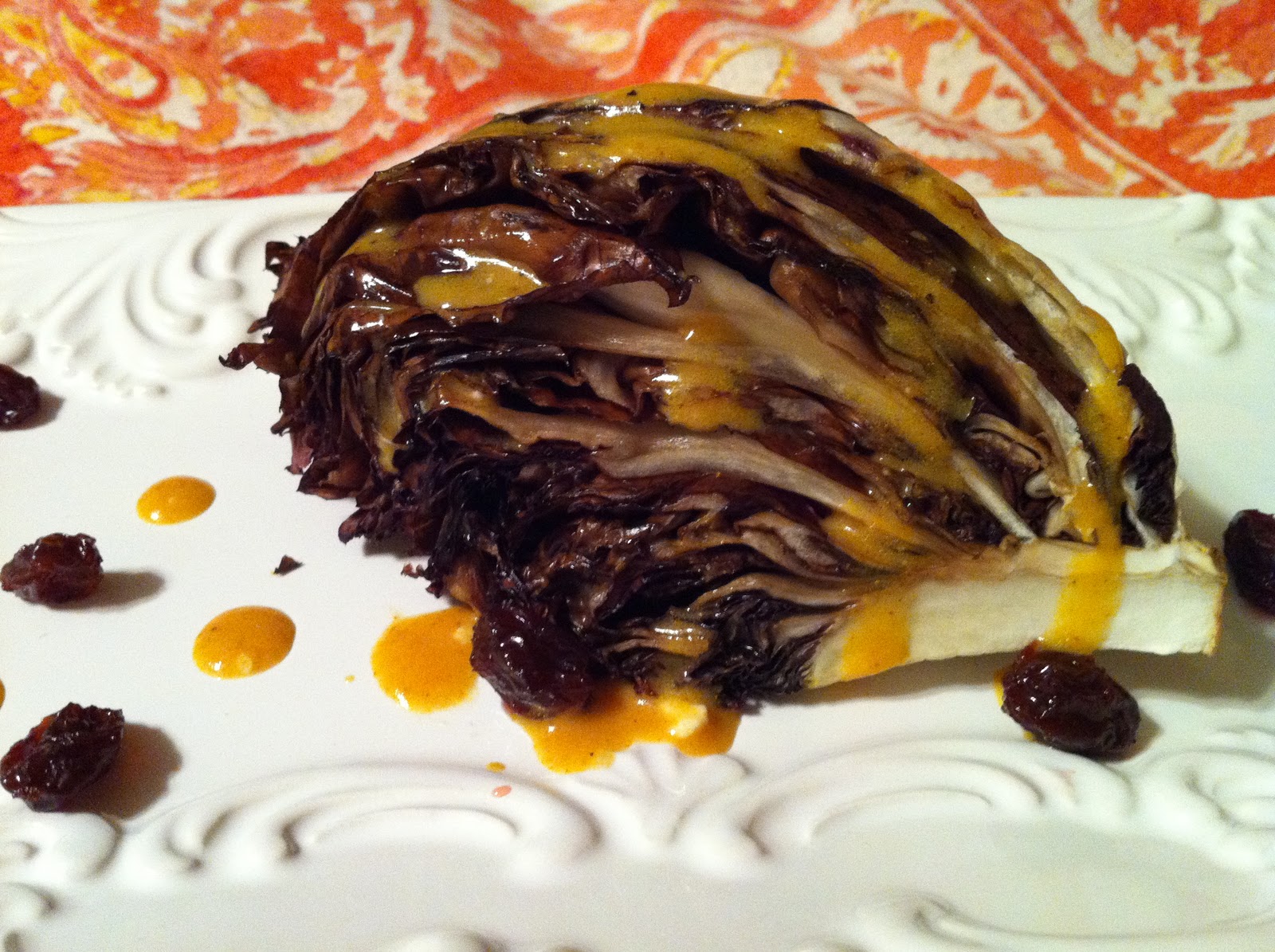
Radicchio Wedge Salad with Curried Blue Cheese Dressing and Campari Raisins
The iceberg wedge salad. Now a common steakhouse and “New American” restaurant menu staple, the iceberg wedge wasn’t always so readily accepted by the hungry public. In fact, yours truly was waiting tables during the iceberg wedge’s rise to popularity, and I recall many a diner shooting me a barbed, “What the hell is this?” or “Um, did someone forget to chop the lettuce? Send it back.” I could feel my tips dwindling. But like hybrid cars, the Internet, and casual Fridays, the iceberg wedge went from shunned to tolerated to embraced. However, as eaters’ palates have become more adventurous, the iceberg wedge is now playing second fiddle to salads that use darker, more exotic greens, innovative dressings, and interesting touches like candied walnuts, pickled shallot, and marketable “superfoods” such as goji berries and pomegranate seeds.
Rather than burn out or fade away, perhaps the wedge salad simply needs a makeover!
Last night, I created a modern twist on the classic wedge salad, using radicchio instead of traditional iceberg lettuce. I originally planned on dressing it in a garlicky aioli, but I decided to at least stay parallel to tradition, so I concocted a runny blue cheese dressing with a punch of curry. The richness of the creamy blue cheese paired delightfully with the warm, bitter radicchio. Still, the plate needed something else, but what? Perhaps something sweet to counter the bitterness of the radicchio and the kick of heat in the curry? Raisins! But I’d have to plump them first; otherwise I’d risk having my plate look like it had been sprinkled with rabbit poo. I didn’t have any open wine, and I feared that whiskey or grappa would be far too strong, so I chose Campari. Campari is an Italian liqueur with a bitter, yet sweet and almost citrusy flavor; it seemed like a logical choice for this dish. I soaked the raising in warmed Campari to speed up the plumping process, and then I sprinkled the raisings on the plate with my radicchio wedge.
The result? Sheer perfection! If your palate is not accustomed to bitter ingredients, you may not appreciate the complexity of this dish, but if you like bold, unique flavors, you’ll surely fall in love with this modern twist on the classic iceberg wedge salad!
Radicchio Wedge Salad with Curried Blue Cheese Dressing and Campari Raisins
For the Campari Raisins:
2 T. raisins
3 T. Campari, warmed but not boiling
For the dressing:
3-4 T. high-quality blue cheese dressing
2 T. olive oil
2 t. Campari (use the liquid left after the raisins have soaked)
2 t. turmeric
1 t. garlic powder
¼ t. cayenne, or to taste
Dash finely ground black pepper
2 heads radicchio, quartered
1 T. olive oil
Soak the raisins in the warmed Campari for at least 20 minutes.
Preheat your oven’s broiler over a low setting, and if you can’t control the setting, simply use the rack farthest away from the heat source. In the meantime, make the dressing by whisking all the ingredients together until they are completely blended. Set aside until ready to use.
Now, it is time to broil the radicchio. Brush each cut surface of the radicchio quarters with the olive oil, lay the curved side on a baking sheet lined with tinfoil, and broil for 5-7 minutes. Do not let the radicchio burn.
Once the radicchio has broiled, place a quarter or two on individual serving plates, drizzle the dressing over the radicchio, and sprinkle each plate with a few raisins. Serve immediately.
Rather than burn out or fade away, perhaps the wedge salad simply needs a makeover!
Last night, I created a modern twist on the classic wedge salad, using radicchio instead of traditional iceberg lettuce. I originally planned on dressing it in a garlicky aioli, but I decided to at least stay parallel to tradition, so I concocted a runny blue cheese dressing with a punch of curry. The richness of the creamy blue cheese paired delightfully with the warm, bitter radicchio. Still, the plate needed something else, but what? Perhaps something sweet to counter the bitterness of the radicchio and the kick of heat in the curry? Raisins! But I’d have to plump them first; otherwise I’d risk having my plate look like it had been sprinkled with rabbit poo. I didn’t have any open wine, and I feared that whiskey or grappa would be far too strong, so I chose Campari. Campari is an Italian liqueur with a bitter, yet sweet and almost citrusy flavor; it seemed like a logical choice for this dish. I soaked the raising in warmed Campari to speed up the plumping process, and then I sprinkled the raisings on the plate with my radicchio wedge.
The result? Sheer perfection! If your palate is not accustomed to bitter ingredients, you may not appreciate the complexity of this dish, but if you like bold, unique flavors, you’ll surely fall in love with this modern twist on the classic iceberg wedge salad!
Radicchio Wedge Salad with Curried Blue Cheese Dressing and Campari Raisins
For the Campari Raisins:
2 T. raisins
3 T. Campari, warmed but not boiling
For the dressing:
3-4 T. high-quality blue cheese dressing
2 T. olive oil
2 t. Campari (use the liquid left after the raisins have soaked)
2 t. turmeric
1 t. garlic powder
¼ t. cayenne, or to taste
Dash finely ground black pepper
2 heads radicchio, quartered
1 T. olive oil
Soak the raisins in the warmed Campari for at least 20 minutes.
Preheat your oven’s broiler over a low setting, and if you can’t control the setting, simply use the rack farthest away from the heat source. In the meantime, make the dressing by whisking all the ingredients together until they are completely blended. Set aside until ready to use.
Now, it is time to broil the radicchio. Brush each cut surface of the radicchio quarters with the olive oil, lay the curved side on a baking sheet lined with tinfoil, and broil for 5-7 minutes. Do not let the radicchio burn.
Once the radicchio has broiled, place a quarter or two on individual serving plates, drizzle the dressing over the radicchio, and sprinkle each plate with a few raisins. Serve immediately.
Monday, January 16, 2012
Cavatappi with Roasted Cherry Tomato Sauce
Great tomatoes in January, in Boston. If you're a serious foodie, that sentence probably just made you raise your eyebrows and question my credibility; as well you should have. However, I've been buying these tomatoes for quite some time, and I've never been disappointed in them, even in January.
Grown locally by Backyard Farms, these tomatoes are packed with flavor and rival some tomatoes I've had in August. I probably go through at least one box of their cocktail tomatoes per week, if not two or three. The other day, I got the idea to roast them and make a garlicky tomato sauce, and the idea evolved into this quick, easy, and delicious pasta recipe. Try this one the next time you're able to find good tomatoes!
Cavatappi with Roasted Cherry Tomato Sauce
1/2 lb. cavatappi, or other textured short pasta
8 cherry tomatoes, quartered
1/4 c. butter
1 c. dry white wine
1/3 c. tomato paste
1 c. grated pecorino romano
3-4 garlic cloves, minced
generous amount coarsely ground black pepper
salt (if necessary)
handful fresh basil leaves, chiffonade-cut*
additional basil leaves, for garnish
Cook the pasta in heavily salted water. In the meantime, preheat the oven's broiler. Arrange the cherry tomatoes on a foil-lined baking sheet with one cut side down (as shown in picture above). Broil the tomatoes for 7-10 minutes, or until the tomatoes' skins have begun to blister and blacken. Remove from oven and set aside.
While the pasta cooks and the tomatoes broil, combine the butter, wine, and tomato paste in a large, heavy-bottomed pot over medium-high heat. Whisk vigorously until the tomato paste has completely broken down and blended with the wine and the butter has melted. Turn heat down to low and add the pecorino, garlic, and pepper (you probably won't need salt; pecorino is a salty cheese. Taste for seasonings and only add salt if absolutely necessary). Continue to whisk until the pecorino has completely melted. Once the pasta is cooked, drain it and add it to the sauce along with the roasted tomatoes and the chiffonade-cut basil leaves. Stir a few times until all the pasta is coated, then serve hot, garnished with fresh basil leaves.
* Chiffonade-cut is a technique often used on fresh herbs. To cut basil, stack the leaves on top of each other, roll up lengthwise, and cut into 1/8" strips. By placing the largest leaf on the bottom of the stack, the smaller leaves will be contained in the roll and the leaves will be easier to slice.
Grown locally by Backyard Farms, these tomatoes are packed with flavor and rival some tomatoes I've had in August. I probably go through at least one box of their cocktail tomatoes per week, if not two or three. The other day, I got the idea to roast them and make a garlicky tomato sauce, and the idea evolved into this quick, easy, and delicious pasta recipe. Try this one the next time you're able to find good tomatoes!
Cavatappi with Roasted Cherry Tomato Sauce
1/2 lb. cavatappi, or other textured short pasta
8 cherry tomatoes, quartered
1/4 c. butter
1 c. dry white wine
1/3 c. tomato paste
1 c. grated pecorino romano
3-4 garlic cloves, minced
generous amount coarsely ground black pepper
salt (if necessary)
handful fresh basil leaves, chiffonade-cut*
additional basil leaves, for garnish
Cook the pasta in heavily salted water. In the meantime, preheat the oven's broiler. Arrange the cherry tomatoes on a foil-lined baking sheet with one cut side down (as shown in picture above). Broil the tomatoes for 7-10 minutes, or until the tomatoes' skins have begun to blister and blacken. Remove from oven and set aside.
![]() |
| chiffonade-cut basil |
* Chiffonade-cut is a technique often used on fresh herbs. To cut basil, stack the leaves on top of each other, roll up lengthwise, and cut into 1/8" strips. By placing the largest leaf on the bottom of the stack, the smaller leaves will be contained in the roll and the leaves will be easier to slice.
Sunday, December 4, 2011
Ingredient Spotlight - Cardoons
After years of curiosity, I was recently able to find cardoons. I didn’t hunt them down, I simply saw them in the produce section of my local supermarket. Cardoons are not a common vegetable in America, and they are very hard to find, so imagine my surprise when I saw them displayed next to common leaf lettuce and carrots!
Cardoons grow wild in Mediterranean countries, and they are a very popular vegetable in Italy. They grow in bunches and resemble celery, although the flavor tastes nothing like celery - more like a mild artichoke. If you ever see cardoons in the market, pick up a bunch and try this simple pasta recipe that showcases this hard-to-find vegetable!
Spaghetti with Cardoons and Pecorino Romano
1 bunch cardoons, sliced
Salt
Juice of 1 lemon
Splash mild vinegar
1 lb spaghetti rigati (textured long pasta) or plain spaghetti
Splash olive oil
2 slices bacon, chopped
2 large shallots, minced
1 cup chopped parsley
2 T. Butter
½ - 1 teaspoon crushed red pepper flakes
Generous amount of coarsely ground black pepper
Pecorino Romano, grated
Place the cardoons in a large pot with enough water to cover them. Add a few pinches of salt, the lemon juice and the vinegar. Cover; bring to a boil, and boil for 30-40 minutes. Once they are done cooking, drain them and set aside.
Cook the pasta in salted water. In the meantime, heat the olive oil over medium-high heat in a large, heavy-bottomed pan and add the bacon. Once the bacon begins to crisp, add the shallots and cook for a few more minutes, or until the shallot softens. Add the cardoons, then add the cooked pasta. Toss to combine, then add the parsley, butter, crushed red pepper flakes, and ground pepper. Toss again, then serve with lots of grated pecorino romano.
Cardoons grow wild in Mediterranean countries, and they are a very popular vegetable in Italy. They grow in bunches and resemble celery, although the flavor tastes nothing like celery - more like a mild artichoke. If you ever see cardoons in the market, pick up a bunch and try this simple pasta recipe that showcases this hard-to-find vegetable!
Spaghetti with Cardoons and Pecorino Romano
| Cooked cardoons |
1 bunch cardoons, sliced
Salt
Juice of 1 lemon
Splash mild vinegar
1 lb spaghetti rigati (textured long pasta) or plain spaghetti
Splash olive oil
2 slices bacon, chopped
2 large shallots, minced
1 cup chopped parsley
2 T. Butter
½ - 1 teaspoon crushed red pepper flakes
Generous amount of coarsely ground black pepper
Pecorino Romano, grated
Place the cardoons in a large pot with enough water to cover them. Add a few pinches of salt, the lemon juice and the vinegar. Cover; bring to a boil, and boil for 30-40 minutes. Once they are done cooking, drain them and set aside.
Cook the pasta in salted water. In the meantime, heat the olive oil over medium-high heat in a large, heavy-bottomed pan and add the bacon. Once the bacon begins to crisp, add the shallots and cook for a few more minutes, or until the shallot softens. Add the cardoons, then add the cooked pasta. Toss to combine, then add the parsley, butter, crushed red pepper flakes, and ground pepper. Toss again, then serve with lots of grated pecorino romano.
Friday, September 17, 2010
Miso Soup with Soba Noodles and Tempeh
Yes, I am aware that this headline might inspire you to ask, "Um, are you cooking soup, or are you trying to see how many ingredients most Americans can't identify will fit into a stockpot?" Valid question. After cooking this soup, I did notice that most of the ingredients aren't common in American cooking. Good. At least it's not boring.
Everything I've eaten and cooked this week has been either vegetarian or vegan. This started out as a choice, but it kind of turned into a default when I realized I had a lot of leftovers, and then it became an experiment - how long can I cook vegetarian and vegan food? I do love vegetarian food, and I will cook vegetarian and vegan recipes in the future - but I am really starting to miss seafood. Although I seem to have stumbled across a magnificent loophole - although subject to much debate, some claim that vegans can eat oysters because oysters have no central nervous system and cannot feel pain. I mean, they are kind of blob-like...but I digress. Back to the soup....
There are several ingredients in this soup that are not common - szechuan peppercorns, which taste almost like a pungent, mentholated coriander seed or a peppercorn that's lost it's spicy kick; tempeh, a cake of fermented soybeans and grains with a nutty flavor and slightly chewy texture; tung ho, an asian vegetable whose name sounds like something mean girls would call each other, is available in better supermarkets, and its flavor resembles grassy spinach; and miso, which is fermented soybean paste with a delicate, mellow flavor. If you've never tried any of these things, please give this soup a try - it will be a delicious surprise!
Miso Soup with Soba Noodles and Tempeh
6 cups vegetable broth
1 T. minced fresh ginger
1 t. szechuan peppercorns
1 t. chipotle pepper flakes
4 oz. tempeh, diced
3 T. white miso (sometimes called "mellow miso")
4 oz. soba noodles
2 T. soy sauce
2 cups tung ho leaves
green onion, sesame oil, and toasted sesame seeds (for garnish)
Combine the vegetable broth, ginger, szechuan peppercorns, chipotle flakes, and tempeh in a large soup pot. Bring to a boil. Now, add the miso, and stir until miso has dissolved in the boiling broth.
Everything I've eaten and cooked this week has been either vegetarian or vegan. This started out as a choice, but it kind of turned into a default when I realized I had a lot of leftovers, and then it became an experiment - how long can I cook vegetarian and vegan food? I do love vegetarian food, and I will cook vegetarian and vegan recipes in the future - but I am really starting to miss seafood. Although I seem to have stumbled across a magnificent loophole - although subject to much debate, some claim that vegans can eat oysters because oysters have no central nervous system and cannot feel pain. I mean, they are kind of blob-like...but I digress. Back to the soup....
![]() |
| Tung Ho |
Miso Soup with Soba Noodles and Tempeh
![]() |
| Tempeh |
1 T. minced fresh ginger
1 t. szechuan peppercorns
1 t. chipotle pepper flakes
4 oz. tempeh, diced
3 T. white miso (sometimes called "mellow miso")
4 oz. soba noodles
2 T. soy sauce
2 cups tung ho leaves
green onion, sesame oil, and toasted sesame seeds (for garnish)
Combine the vegetable broth, ginger, szechuan peppercorns, chipotle flakes, and tempeh in a large soup pot. Bring to a boil. Now, add the miso, and stir until miso has dissolved in the boiling broth.
Add the soba noodles and cook until the noodles are soft. Now, add the soy sauce and tung ho leaves. Stir once or twice until the leaves are limp. Remove from heat, ladle into bowls, and serve, garnishing with green onion, a few drops of sesame oil, and a pinch of toasted sesame seeds.
Tuesday, September 14, 2010
Hooray for Cauliflower!
Tonight, I made a beautiful penne dish with cauliflower, a greatly underrated vegetable. Cauliflower tends to be forgotten in this country outside of raw veggie trays; a shame, because it is loaded with fiber, folate, and B and C vitamins. Next time you're hungry for something unusual, simple, and nutritious, try this recipe that I adapted from one of Mario Batali's. This was originally intended to be included in my vegetarian/vegan post, but limited refrigerator space dictated that I hold off on this one until today. This is a vegan dish.
Penne with Sauteed Cauliflower
1 pound penne
olive oil
2 cloves garlic, minced
1 small onion, minced
1 t. dried chipotle pepper flakes
1 bunch mint, chopped
1 head cauliflower, sliced into florets
1/4 c. white wine
salt and pepper to taste
Bring a large pot of salted water to a rolling boil.
Meanwhile, heat the olive oil in a large pot over medium-high heat. Add the garlic, onion, chipotle, and mint, and saute until the garlic and onion begin to soften. Do not let them brown. Next, add the cauliflower and the wine, and reduce to a simmer. Cook for 10 minutes, stirring occasionally, and cook the pasta while the cauliflower is simmering.
Once the pasta is fully cooked, drain the pasta and add it to the pot with the cauliflower. Add another splash of olive oil, season with salt and pepper, and serve hot.
Penne with Sauteed Cauliflower
1 pound penne
olive oil
2 cloves garlic, minced
1 small onion, minced
1 t. dried chipotle pepper flakes
1 bunch mint, chopped
1 head cauliflower, sliced into florets
1/4 c. white wine
salt and pepper to taste
Bring a large pot of salted water to a rolling boil.
Meanwhile, heat the olive oil in a large pot over medium-high heat. Add the garlic, onion, chipotle, and mint, and saute until the garlic and onion begin to soften. Do not let them brown. Next, add the cauliflower and the wine, and reduce to a simmer. Cook for 10 minutes, stirring occasionally, and cook the pasta while the cauliflower is simmering.
Once the pasta is fully cooked, drain the pasta and add it to the pot with the cauliflower. Add another splash of olive oil, season with salt and pepper, and serve hot.
Sunday, September 12, 2010
This Weekend's Meat-Free Menu
This weekend, hundreds of dogs and their owners gathered on Boston Common to raise hundreds of thousands of dollars for the Massachusetts Society for the Prevention of Cruelty to Animals. To honor animals and all the work advocates do on their behalf, I not only volunteered at today’s walk, but everything I’ve cooked this weekend has been either vegetarian or vegan.
So what is the difference between vegetarians and vegans? Vegetarians do not eat meat or fish, but they may choose to eat eggs, dairy products, and other products obtained from live animals. Vegans neither eat nor otherwise use any products derived from animals, including honey and wool.
Because this blog is written to celebrate food - nothing more, nothing less - I do not believe that this is the forum to discuss the plethora of issues surrounding meat consumption. I’ll skip the sociology lesson and let you investigate the economic, political, medical and ethical questions on your own time, but I will highlight a few of the benefits of vegetarian and vegan cooking. I’m not expecting meataholics to put down their steak knives and start mainlining tofu, but consider these facts*:
Even if you don’t want to give up meat, try cooking a vegetarian or vegan meal once or twice a week - most vegetarian recipes are so delicious that you won’t even miss the meat!
Preheat the oven to 400. Cook the pasta in a large pot of salted boiling water. Whole wheat pasta takes a little bit longer to cook than regular pasta, so be patient.
* information obtained from www.tryveg.com and www.bostonveg.org
So what is the difference between vegetarians and vegans? Vegetarians do not eat meat or fish, but they may choose to eat eggs, dairy products, and other products obtained from live animals. Vegans neither eat nor otherwise use any products derived from animals, including honey and wool.
Because this blog is written to celebrate food - nothing more, nothing less - I do not believe that this is the forum to discuss the plethora of issues surrounding meat consumption. I’ll skip the sociology lesson and let you investigate the economic, political, medical and ethical questions on your own time, but I will highlight a few of the benefits of vegetarian and vegan cooking. I’m not expecting meataholics to put down their steak knives and start mainlining tofu, but consider these facts*:
- Vegetarian/vegan diets are lower in saturated fat and cholesterol than omnivorous diets
- Factory-farmed meat products are more likely to contain antibiotic-resistant strains of salmonella, E. coli, etc.
- No animals have to suffer to make falafel, beans & rice, or quinoa salad
- Intensive livestock production is one of our country’s greatest sources of environmental pollution
- Vegetarian dishes are generally easier on the wallet than dishes containing meat and/or fish
Even if you don’t want to give up meat, try cooking a vegetarian or vegan meal once or twice a week - most vegetarian recipes are so delicious that you won’t even miss the meat!
Before I did any real cooking, I had to try vegan bacon. Oxymoron, right?!? The stuff isn’t bad. I am thankful that someone has been able to make such a great substitute. No one should be denied the joys of bacon, butter, and booze.
This stuff cooks up just like real bacon. Grease the frying pan for a more authentic flavor, turn it over a few times, and voila! Vegan goodness.
The flavor is very spot-on, and the texture isn’t an exact match, but it’s pretty darn close. And honestly, people who cook bacon in the microwave probably won’t know the difference. The smell of vegan bacon frying is so alluring that Tessie, my roommate’s pup, joined me in the kitchen, barked to get my attention and showed off her “sit” skills when I picked up a piece!
The first dinner recipe I tried was a vegetarian casserole with whole wheat pasta, Savoy cabbage, fontina cheese, and fresh dill. The cabbage is extremely high in vitamins and minerals, and both cheese and 100% whole wheat pasta contain protein. Choose a high quality Italian brand of whole wheat pasta made with durum wheat, which is naturally higher in protein than other varieties of wheat. This dish is rich, gooey, hearty, and delicious - this one will stick to your bones on a cold day.
The next dinner recipe was more of an experiment, and it turned out to be fantastic! I was inspired to make this after accidentally buying a bag of Roland Sweet Dried Tomatoes - sounds like plain old sun-dried tomatoes, right? Wrong - these are sweetened with sugar, and their flavor and texture remind me of a tomato-tinged prune or raisin. I thought their sweet quality could enhance a recipe much in the way that adding raisins to a savory recipe deepens the flavors. In Sicily, golden raisins are sometimes added to tomato-based sauces; this was a perfect starting point.
I decided that I wanted to give myself a greater challenge than simply creating a vegan dish - I wanted to make one that was both vegan and gluten-free. Flavors? Check. Proteins? I call on my favorite legume, red lentils. Carbohydrates? Herein lies the challenge. Gluten-free pasta? Nah, just ate pasta last night. Rice? That’s for gluten-free amateurs. I chose millet.
Millet is the seed of a grass, and it is commonly used in parts of Asia and Africa. It is readily available in health food stores, co-ops, and better supermarkets. Try and get over the fact that you’ll without a doubt recognize it as a key component in commercially prepared birdseed; it’s inexpensive, nutritious, and has a wonderful, fluffy texture. If you cannot find millet, quinoa or amaranth are also great whole grains suitable for those on gluten-free diets, and they also carry the added perk of being two of the only plant sources of complete proteins. Check out more gluten-free grains here.
Whole grains are a great substitute for couscous, the preferred starch source in Moroccan cooking. Knowing this, and knowing that my sweet dried tomatoes could work in a Sicilian-inspired dish, I decided to try a dish that blended Sicilian and Moroccan flavors, which was not a difficult task since their cuisines are very similar to begin with due to their proximity.
Now, it’s time to get cooking. Try these recipes and eat up!
Cabbage, Fontina, and Dill Casserole with Whole-Wheat Rotini
8 oz. 100% whole wheat rotini
1 small head Savoy cabbage, quartered and shredded into ¼” strips
1 clove garlic, minced
4 T. chopped fresh dill
Olive oil
2 T. chardonnay (try using an Italian variety, known as Sciardonne, produced in Italy’s Alto Adige region)
5 oz. Fontina cheese, shredded (fontina is soft, so grate it fresh from the fridge or it will melt)
Preheat the oven to 400. Cook the pasta in a large pot of salted boiling water. Whole wheat pasta takes a little bit longer to cook than regular pasta, so be patient.
Meanwhile, combine the cabbage, garlic, 3 T. of the dill, a splash of olive oil, and chardonnay in an ovenproof dish. Place in oven. Check after 5 minutes, if the cabbage has wilted, remove from oven. If not, cook for a few more minutes, no more than 10, and remove from oven. Do not let the cabbage brown.
Once the pasta is cooked, add it to the cabbage in the casserole. Add half the fontina, mix well until all ingredients are blended evenly, adding another splash of olive oil to the mix. Once the pasta, cabbage, and cheese are well-blended, top with the remaining fontina. Place in oven and bake for 8-10 minutes. Remove from oven, let sit for 5 minutes, and serve.
Millet with Sweet Tomato and Lentil Stew
Splash olive oil
1 small onion, chopped
2 tomatoes, chopped
Pinch crushed red chile flakes
Pinch fresh ground black pepper
1 cup chopped sweet dried tomatoes
½ cup red lentils
1 cup white wine
¼ t. ground cumin
¼ t. ground coriander
1 t. smoked paprika
½ cup water or vegetable broth (if necessary)
2 T. fresh parsley, chopped
2 T. fresh mint, chopped
2 T. capers, rinsed and drained
Salt to taste
1 batch cooked millet
Chopped toasted hazelnuts
Heat the olive oil in a heavy-bottomed saucepan over medium heat until the onions become translucent. Do not let them brown. Next, add the chopped tomatoes, chile flakes, and ground pepper. Cook, stirring occasionally, for about 10 minutes or until the tomatoes have cooked down and released some of their liquid.
Add the sweet dried tomatoes, lentils, wine, cumin, coriander, and paprika. Cook for 15 more minutes, stirring occasionally. By this point, the lentils should be cooked but still firm. If the lentils need more cooking time and/or no liquid remains, add the ½ cup water or vegetable broth and simmer for 5-10 more minutes.
The final step is to add the parsley, mint, capers and salt, stirring until well-blended. To serve, spoon over cooked millet and sprinkle with chopped toasted hazelnuts.
* information obtained from www.tryveg.com and www.bostonveg.org
Subscribe to:
Posts (Atom)