Showing posts with label special occasion recipes. Show all posts

Tuesday, February 19, 2013

Lemongrass Shrimp Skewers with Kiwi & Avocado Guacamole

Recently, I was lucky enough to spot U-7 shrimp at Seaport Fish (U-7 indicates that there are 7 or fewer shrimp per pound – these babies are pretty big!). Originally, I planned on cooking them simply with butter and garlic, but when I spotted kiwis at the local market, I decided to try something more exotic.

In addition to my kiwis, I picked up an avocado, some Serrano chiles, and on a whim, a few stalks of lemongrass. While the lemongrass didn’t contribute much flavor-wise, it certainly added to the presentation. Try this next time you’re craving spicy, tropical flavors!


Lemongrass Shrimp Skewers with Kiwi & Avocado Guacamole

4 stalks lemongrass
8 U-7 (jumbo) shrimp
Kiwi & Avocado Guacamole, as prepared below

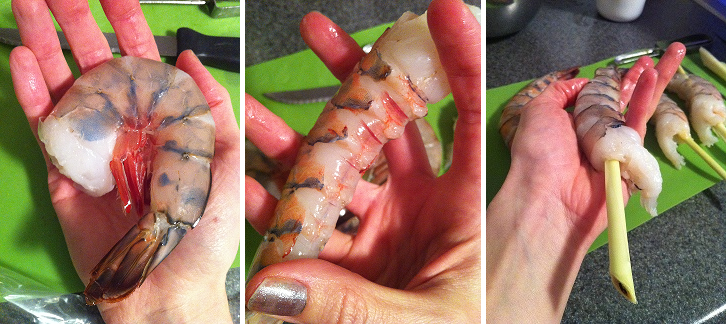
Prepare a grill or preheat your oven’s broiler. In the meantime, remove shells from shrimp, leaving the tail shell intact (this helps prevent the smaller end of the shrimp from drying out while cooking. Cut the lemongrass stalks in half, cutting diagonally so that a sharp point is formed (as shown in photo below right). Use your fingers to straighten the raw shrimp, and using the pointed end of the lemongrass spear, insert the lemongrass into the shrimp lengthwise (see photos below).


If using the broiler, line a baking sheet with foil, and place a wire rack on top of the foil. Place the skewered shrimp on the wire rack, and put the shrimp under the broiler. Cook the shrimp for 3-4 minutes, or until the shrimp are firm and pink. If using the grill, place the shrimp over slow coals and grill for 2-4 minutes, or until the shrimp are firm and pink.

While the shrimp cook, prepare two plates by spreading about ½ cup of the Kiwi & Avocado Guacamole on each plate. Once the shrimp are cooked, arrange four shrimp on each plate in a spoke formation.

* Nutritional info: serves 2. 335 calories, 11 g fat, 17 g carbohydrates, 45 g protein.


Kiwi & Avocado Guacamole

3 cloves garlic, very finely minced
2 serrano chiles, very finely minced*
1 T. finely minced onion
2 kiwis, peeled and minced
1 avocado, chopped

Combine all the ingredients in a large mixing bowl. Using a potato masher or a fork, mash until the guacamole is smooth and well-blended (you can use a food processer, but the texture will be almost too smooth—mashing manually gives a heartier texture). Cover the bowl with plastic film and set aside. This recipe makes about 2 cups.

*You can adjust the heat by using a milder or a hotter chile in place of serranos, or simply adjusting the number of chiles used.

* Nutritional info: serves about 4. 111 calories, 7.5 g fat, 15 g carbohydrates, 1.5 g protein.


Sunday, December 30, 2012

It’s Nigiri! It’s Maki! No, it’s…Antipasti?!?

It’s almost New Year’s Eve! If you’re hosting a party, this means you’ve got to upgrade your appetizers—your taco dip may be delicious, but it doesn’t quite go with the gallons of champagne you’re bound to pour. Special holidays call for dishes that are unique and presented with some flair!

Try my twist on the traditional antipasti platter, where rich cheese, prosciutto, and roasted red peppers and eggplant are shaped and formed into Roasted Eggplant and Prosciutto "Maki" rolls and Roasted Red Pepper "Nigiri." Perfect for a festive occasion, these delightful nibbles will certainly surprise your guests!

To save time on party day, prepare the cheese blend and roast the peppers and the eggplants in advance.


Cheese Blend for Antipasti “Sushi”

15 oz. / 425 g. whole milk ricotta, drained
8 oz. / 225 g. mozzarella, finely diced (pieces should be about the size of rice grains)
1 small clove garlic, pressed
1 t. salt
Freshly ground black pepper
Pinch dried oregano

Combine all the ingredients in a large bowl. Mix well so that the garlic is evenly blended throughout. Cover with plastic film and refrigerate until ready to use.


Roasted Eggplant

1 t. salt
1 t. dried oregano
½ t. freshly ground black pepper, fine grind
1 small eggplant, sliced lengthwise into ½” slices

Combine the salt, dried oregano, and pepper in a small bowl and set aside. Lay the eggplant on a wire rack, and sprinkle with the seasoning. Rub the seasoning into the eggplant slices.

Preheat the oven’s broiler. In the meantime, line a baking sheet with foil and place the wire rack with the eggplant on top of the foil. When the oven is ready, place the eggplant under the broiler and broil for 5-7 minutes. Remove and set aside to cool until ready to use.


Roasted Red Peppers

2 red bell peppers*, cored and sliced lengthwise at natural rib

Preheat the broiler on high. Arrange the peppers on a baking sheet covered in foil (this makes clean-up much easier). Put the peppers under the broiler for 5-10 minutes, or until the peppers' skins have turned black and charred.

Remove the baking sheet from the oven. Using tongs, place the roasted peppers in a bowl. Cover the bowl and let the peppers cool.

Once peppers have cooled, gently peel off the charred skin and discard skin. The peppers are now ready to use.

* For this recipe, use the boxiest, most evenly square-shaped peppers you can find


Roasted Eggplant and Prosciutto “Maki”

Roasted eggplant, as prepared above
4 oz. / 115 g. prosciutto, very thinly sliced
Cheese blend, as prepared above

Prepare the eggplant by slicing lengthwise into thin batons, then slicing in half crosswise so that the batons are about as long as the prosciutto’s width. Set aside.

Lay a slice of prosciutto on your work surface. Heap a spoonful or two of the cheese blend onto about half of the prosciutto and spread until it is about ¼” thick. Place 2-3 eggplant batons about an inch in (see photo below), and roll up.

Using a sharp knife, slice each roll in half (see photo below), then trim the ends so that they will lay flat on a serving tray.

Repeat with the remaining eggplant, prosciutto, and cheese.


* Nutritional info per piece: 58 calories, 4 g fat, 2.7 g carbohydrates, 4.7 g protein.


Roasted Red Pepper “Nigiri”

Roasted red peppers, as prepared above
Cheese blend, as prepared above

Slice the roasted red peppers into rectangles, approximately 1 x 2.5 inches.

Place 2 heaping spoonfuls of the cheese blend into your hands and shape into pieces that are about an inch thick, and inch wide, and 2 inches long. Handle the cheese as little as possible, as the warmth of your hands will cause the cheese to soften.

Place a red pepper slice on the shaped cheese piece. Repeat with the remaining peppers and cheese.

* Nutritional info per piece: 97 calories, 7 g fat, 1.7 g carbohydrates, 6 g protein.


Tuesday, December 18, 2012

Feast of the Seven Fishes: Vodka-Braised Calamari with Celery and Tomatoes

It’s almost time for the Feast of the Seven Fishes! Stemming from the Catholic tradition of abstaining from meat on Christmas Eve, many Italians create elaborate meals featuring seven seafood dishes. If you’re in the mood for a less-traditional preparation, try this calamari dish that I created this weekend.

My inspiration for this recipe arrived while I wrestled with whether or not to make a bottle of chile-infused vodka—I wondered what I could do with the spicy booze other than pour it into bloody marys, and I decided to try cooking calamari in vodka with some chiles. The result? A fantastic, fresh-tasting sauce that would be a delight on any Christmas Eve table! If you’re bored with the same old calamari recipes, give this one a shot!


Vodka-Braised Calamari with Celery and Tomatoes

16 oz. / 455 g dry linguine
3 slices streaky bacon (optional)
1 T. butter (if omitting bacon, increase to 2 T. butter)
2 leafy stalks celery, minced (reserve minced leaves)
2 shallots, minced
2 serrano chiles, minced
2 bay leaves
3 medium tomatoes, chopped
1/3 c. golden raisins
1 T. capers in salt
1 c. vodka
1.5 lb. calamari (I prefer a 50/50 mix of tubes and tentacles)
Generous splash olive oil


First, cook the pasta in heavily salted water. In the meantime, if using the bacon, cook the bacon slices in a large, heavy-bottomed pot over medium-high heat until crisp, then remove and place on paper towels. Do not drain the bacon fat from the pot. Add the butter and let it melt (if not using the bacon, simply add the butter to the pot and let it melt), then add the minced celery stalk (keep the minced celery leaves set aside for later), shallot, chiles, and bay leaves. Cook, stirring frequently, for 3-5 minutes or until the shallot and celery are translucent.

Next, add the tomatoes, raisins, capers and vodka. Stir, scraping up any browned bits of bacon from the bottom of the pot. Lower heat to simmer and cook for 8-10 minutes.

When the pasta is just about ready and the tomatoes have simmered in the vodka, add the calamari to the pot with the vodka and tomatoes and raise the heat to medium-high. Cook, stirring frequently, for 1-2 minutes.

Drain the pasta from the cooking water and add the cooked pasta to the pot with the vodka and calamari. Add a generous splash of olive oil, and stir gently until blended. Serve the pasta in individual bowls, and garnish by sprinkling with the minced celery leaves.

* To purchase ingredients used in this recipe, click the picture below:


* Nutritional info: serves six. 610 calories, 13.5 g fat, 68 g carbohydrates, 30 g protein.


Saturday, December 15, 2012

Italian Christmas Cake (Panforte di Siena)

For several years now, I’ve made a traditional Italian Christmas cake called “panforte di Siena” for Christmas. It is an extremely rich, chewy cake loaded with dried fruits, toasted nuts, chocolate, and honey. I’ve experimented with a few variations—some have worked, some have not, but either way, baking this cake has been on my December “to do” list ever since 2007 when I discovered the recipe in “World Food: Italy” by Linda Doeser.

This year, I enhanced it with kahlua, chipotle pepper, and chia seeds, a “superfood” packed with fiber, protein, and omega-3 fatty acids. This cake is extremely rich, so one cake will easily serve 16 people, as portions are best kept small.

Slices of this are lovely when served with a light, tannic red wine!


Italian Christmas Cake (Panforte di Siena)


Cake "batter"
Dry ingredients:
2/3 c. toasted hazelnuts, chopped
2/3 c. toasted almonds, chopped
2 T. toasted pine nuts, chopped
2 T. chia seeds
2/3 c. candied citrus peel, minced
1/3 c. dried cranberries
1/3 c. dried pineapple rings, minced
Grated rind of 1 orange
2 T. unsweetened cocoa powder
1 t. ground cinnamon
½ t. ground chipotle pepper
¼ t. ground coriander
¼ t. ground cloves
¼ t. freshly grated nutmeg
1/3 c. almond flour
¼ c. all-purpose flour

Wet ingredients:
½ c. sugar
½ c. chestnut honey
1 T. butter
1 T. Kahlua
1 t. rose water (optional)

To prepare, line an 8-inch cake pan with removable sides with parchment paper, and preheat the oven to 300. In the meantime, combine the dry ingredients in a large bowl and mix well.

Combine the sugar, chestnut honey, butter, Kahlua, and rose water (if using) in a large, heavy-bottomed pot over low heat. Stir until the sugar is dissolved, then bring to a boil, cooking for about 5 minutes (the mixture should foam a bit). Stir in the dry ingredients and remove from heat.

Using a wooden spoon, continue to stir the mixture off of the heat source, then spoon the mixture into the parchment-lined cake pan. The mixture will be thick and sticky, so flatten it out with the back of the wooden spoon (dampen the spoon with warm water if the mixture sticks too much). Place in the oven and bake for one hour. When baking is complete, remove the pan from the oven, place the pan on a heatproof surface, and allow to cool for at least 30 minutes.

Once the cake has cooled, invert the cake on a serving platter or plate, remove the parchment paper, and slice into thin wedges to serve.

* Nutritional info: you don’t want to know…


Removing parchment paper


Italian Christmas Cake with a slice removed

Slice of Italian Christmas Cake


Saturday, November 17, 2012

Trout in Red Wine with Chiles, Cocoa, and Hazelnuts

If you have a fisherman in the family, surely you’re familiar with cooking trout in lemon butter or simply grilling them over a campfire. In Northern Italy, where trout is plentiful, it is often cooked red wine with lemon, cloves, parsley and dill. In France, Trout Amandine, a preparation featuring lots of butter and toasted almonds, is king. In Mexico, fresh trout are grilled with chiles, garlic, and lemon or lime juice.

Unable to decide which of these three traditional preparations I wanted to use on some fresh rainbow trout I scored at Mercato del Mare, I decided not to make a decision, but to whip together a recipe combining all three recipes. Cooked in red wine, topped with toasted hazelnuts, and simmered with chiles, garlic, and a bit of unsweetened cocoa, which adds depth to this dish just as it does in traditional Mexican molé sauce, you get to experience the best of three very different trout dishes!


Trout in Red Wine with Chiles, Cocoa, and Hazelnuts

For the trout:
2 whole trout, cleaned
1 clove garlic, minced
1 cup / 235 mL red wine vinegar

For the sauce:
2 slices streaky bacon, chopped
1 tablespoon / 15 g butter
1 large shallot, minced
2 cloves garlic, minced
1-2 dried chiles, crushed
2 bay leaves
A few sprigs fresh thyme
1 cup / 235 mL dry red wine, such as Chianti or Montepulciano d’Abruzzo
Juice and rind of 1 lemon
1 teaspoon / 5 g unsweetened cocoa powder*

To serve:
Handful minced flat-leaf parsley
¼ cup / 60 g toasted hazelnuts
2 tablespoons / 30 g. minced pea shoots
Salt
Freshly ground black pepper
Hazelnut oil*


First, place the trout in a glass or ceramic dish. Pour in the wine and minced garlic, shake, and set aside to marinate for a half hour.

While the trout is marinating, prepare the sauce. Using a heavy-bottomed pot large enough to fit both trout, heat the butter over medium-high heat, then add the bacon. Cook for 3-5 minutes or until the bacon begins to crisp, then add the shallot, garlic, and chiles and continue to cook until the shallot begins to soften. Add the bay leaves, thyme, red wine, lemon juice and rind, and cocoa powder. Cook for 8-10 minutes, stirring frequently to loosen up any browned bits of bacon at the bottom of the pot.

While the wine sauce is cooking, remove the trout from the vinegar and discard the vinegar and garlic. Place the trout in the pot with the wine sauce, shake the pan a bit to distribute the sauce over the trout, then reduce heat to medium-low and cook, covered, for 15-20 minutes, or until the trout flakes easily.

While the trout is cooking, combine the parsley, hazelnuts, pea shoots, salt and pepper in a small bowl.

To serve, use a fish spatula to transfer each trout to a warmed plate. Sprinkle the inside of each trout with the parsley/hazelnut/pea shoot mixture, and sprinkle on top as well. Drizzle each trout with hazelnut oil, and serve piping hot alongside roasted potatoes.

* To purchase ingredients used in this recipe, click the link(s) below:

Scharffen Berger Cocoa Powder (Google Affiliate Ad)

La Tourangelle Roasted Hazelnut Oil (Google Affiliate Ad)

Nutritional information: serves two. 711 calories, 25 g fat, 10 g carbohydrates, 45 g protein.


Monday, October 29, 2012

Restaurant Recap: O Ya, Boston, MA

The next time I complain about having bad luck, please remind me about the time I was lucky enough to snag bar seats at O Ya on a Friday night.

A few girlfriends and I decided to try O Ya, a Boston sushi restaurant famous for its creative preparations and impeccable presentation. We sat at the bar in full view of the theatre before us, watching three sushi chefs preparing a wide variety of dishes for each table of eager diners. Small, unassuming, and tucked away on East Street, a small side street off of Atlantic Ave., O Ya is the definition of hidden gem.

While I’d like to think that I have a way with words, I cannot pretend to have the talent to describe each of the preparations we sampled in O Ya’s Omakase, a 17-course tasting menu that can be customized to accommodate diners’ preferences. Every plate that came out had me saying, “There’s no way they’ll be able to top the last dish.” They made a liar out of me each and every time.

Paired with a few glasses of sparkling sake, here are the dishes we sampled in the Omakase, with a few additional plates added in along the way:


Kumamato Oyster – watermelon pearls, cucumber mignonette


Hamachi – spicy banana pepper mousse


Salmon Tataki – torched tomato, smoked salt, onion aioli

 
Warm Eel – Thai basil, kabayaki, fresh Kyoto sansho


Homemade Fingerling Potato Chip – burgundy truffle


Wild Santa Barbara Spot Prawn – garlic butter, white soy, preserved yuzu


Fried Kumamato Oyster – yuzu kosho aioli, squid ink bubbles


Wild Bluefin Maguro – soy braised garlic, micro greens


Kyoto Style Enoki Mushrooms – garlic, soy


Shima Aji & Santa Barbara Sea Urchin – ceviche vinaigrette, cilantro


Scottish Salmon – spicy sesame ponzu, yuzu kosho, scallion oil


Hamachi – viet mignonette, thai basil, shallot


Bluefin Tuna Tataki – smoky pickled onion, truffle oil


Shiso Tempura with Grilled Lobster – charred tomato, ponzu aioli


Eclectic Eel – tamago, foie gras, Kyoto sansho


Grilled Chanterelle & Shiitake Mushroom Sashimi – rosemary garlic oil, sesame froth, soy


Seared Petit Strip Loin of Wagyu Beef – smoked potato, grilled onion, fresh wasabi

Kushiyaki Of Strip Loin of Wagyu Beef – roasted onion, yuzu kosho, maple soy sauce


Foie Gras – balsamic chocolate kabayaki, Claudio corallo raisin cocoa pulp, sip of aged sake


We also tried three of the desserts:


Yuzu Curd – Almond, blackberry-jasmine, meringue


Warm Mochi cake – soy gelato, coconut kaffir, blackberry


Passion Fruit Mango – white chocolate coconut soy milk, lychee shiso


Chocolate Truffles


Other than the telephone number to call and make a reservation, there is little else you need to know about O Ya. Come in with an open mind and an empty stomach—O Ya will be one of the most memorable dining experiences you’ll have in Boston, and probably in your lifetime. Cheers!

Tuesday, March 20, 2012

Chestnut Flour Pasta with Sautéed Radicchio, Chicken Livers, and Grapefruit

chestnut honey, chestnut flour pasta,
parsley, radicchio
This is one of those recipes that snowballs from a basic idea until I have no choice but to give into my curiosity and try a recipe that sounds like a long shot flavor-wise. First, I wondered if chestnut honey and grapefruit juice would taste good together. They did. I wanted to carry the chestnut theme through the dish, and I had about a cup of chestnut flour in my pantry, so that got thrown in a bowl with some eggs and I turned it into pasta. Chestnut flour is a bit gritty and earthy tasting, so I needed ingredients that would not be overpowered by the chestnut flavor. Radicchio and chicken livers seemed perfect. Would it work?

It worked! It would have been more appropriate in autumn, but it tasted great! This dish is not for everyone - you have to be a true lover of intensely earthy, woodsy, bitter flavor combinations in order to appreciate this one, but if you’re anything like me and you can’t bear to not try something, take a chance on this recipe!


Chestnut Flour Pasta with Sautéed Radicchio, Chicken Livers, and Grapefruit

1 batch cooked chestnut flour pasta (recipe below)
Splash olive oil
1 large shallot, minced
12 oz. Chicken livers, chopped into bite-sized pieces
2 T. chestnut honey
1/3 c. grapefruit juice
½ c. coarsely grated pecorino romano
2 heads radicchio, shredded
Salt and coarsely ground pepper
Handful coarsely chopped parsley
Pecorino romano shavings, to garnish

In a large, heavy-bottomed pan, heat the olive oil over medium-high heat. Add the shallot and chicken livers and saute for about 5-7 minutes, stirring frequently, until the shallots are softened and the chicken livers have browned.

Add the chestnut honey, grapefruit juice, and pecorino romano, stirring gently a few more times until the mixture is well-blended. Add the radicchio, cover, and reduce heat to low. Cook for 5-7 minutes, stirring once or twice, until the radicchio is wilted.

Add the salt and parsley to the mixture, stir until blended, and spoon over the cooked chestnut flour pasta. Garnish with extra chopped parsley and shaved pecorino romano.


Chestnut Flour Pasta

¾ c. chestnut flour
¾ c. unbleached white flour
1 t. salt
1 t. olive oil
2 eggs

Combine the ingredients in a bowl and blend, using your hands. Work the ingredients together until you have a stiff dough, and knead for 6-8 minutes. Wrap the dough in plastic and refrigerate for at least one hour, if not overnight.

After the dough has refrigerated, use a pasta machine to roll out the dough. Don’t use the thinnest setting; chestnut flour pasta tends to be more brittle than wheat flour pasta. I recommend the 2nd or 3rd thinnest setting. Cut the dough into 1/3” wide noodles, and let dry for at least 30 minutes.

When you are ready to cook the chestnut flour pasta, cook it in heavily salted water and stir as little as possible, as it has a tendency to break easily. Serve with the recipe above.


Friday, December 30, 2011

Good Luck Recipes for the New Year!

Happy almost New Year, folks!  Whether you're going out and partying or staying home and skipping the whole thing, January 1 is just around the corner.  New Year's Day brings with it culinary traditions from around the world involving foods and dishes symbolic of good luck, wealth, and longevity.  Much like music and love, rich meat and leafy greens seem to transcend cultural differences and geographical and political borders, appearing as an integral part of the New Year's meal across the globe.  Here are a few of my favorite New Year's recipes!


Cotechino e Lenticchie (Cotechino Sausage & Lentils)

black lentils
Cotechino is an especially fatty, mildly spiced pork sausage made in Italy and traditionally eaten at midnight on New Years Day to bring in the new year.  The pork symbolizes richness, while the round lentils are thought to look like coins, also symbolizing wealth.


1 cotechino sausage (fully cooked), approximately 1 lb.
generous splash olive oil
3 shallots, minced
1 carrot, finely chopped
3-4 whole dried sage leaves, finely crumbled
generous grinds of coarse black pepper
1/4 c. dried porcini mushrooms, chopped
light splash wine
8 oz. French lentils (also called Le Puy lentils)*
2.5 cups water
salt
truffle oil

Pierce the sausage all over with the tip of a knife.  Cover with water, bring to a boil, and then simmer for 20-30 minutes.

In the meantime, heat the olive oil in a large, heavy-bottomed pot over medium heat.  Add the shallot, carrot, sage, and black pepper; saute, stirring occasionally, until the shallot is translucent and soft. Next, add the porcini mushrooms.  Stir until the mushrooms are coated with the oil, then add the wine.  Stir thoroughly. 

Now, add the lentils to the pot. Stir for 1-2 minutes, or until the lentils are thoroughly coated with the oil/wine mixture.  Add the water.  Bring to a boil, and then reduce heat to low.  Simmer for 30 minutes, or until the lentils are soft, but not mushy. 

Once the sausage has cooked, remove it from the water, and when cool enough to touch, slice it into thin rounds.  When the lentils are done, spoon portions of the lentil mixture into individual dishes and finish with a light drizzle of truffle oil.  Top the lentils with 2-3 slices of the sausage, garnish with fresh herbs of your choice, and serve. 

* You can use regular lentils, but the beauty of French lentils is that they do not lose their firmness or their shape during the cooking process.


Hoppin' John

Hoppin' John is eaten on New Years Day in the American South to bring wealth in the new year.  Pork symbolizes wealth because it is a rich, fatty meat, and collards symbolize wealth because they are green, the color of money. 
 

5 oz. thick-cut bacon, sliced into 1/2" chunks
1 T. butter
1 large onion, diced
12 oz. lager or pilsner-style beer
1 large bunch fresh collards (approx. 2 pounds), ribs removed, chopped
2 t. dried thyme
2 garlic cloves, smashed
1/4 - 1/2 t. cayenne pepper
2 bay leaves
1 16-oz. can black-eyed peas
3 cups cooked white rice
salt & pepper to taste

In a large, heavy bottomed stock pot, cook the bacon, butter, and onion over medium heat for 8-10 minutes, or until the onion has softened and much of the fat has rendered off of the bacon.  Next, add a splash of the beer and stir until the liquid stops frothing, scraping up any browned bits from the bottom of the pan as you stir.  Now, add the collards, thyme, garlic, cayenne, bay leaves, and the remaining beer.  Cover, reduce heat to medium-low, and simmer for 40-45 minutes, stirring occasionally. 

Once the collards have cooked, add the black-eyed peas, rice, and salt & pepper.  Stir, then cook for 5-7 minutes or until the black-eyed peas and the rice are thoroughly heated.  Serve in small bowls. 


Pork & Sauerkraut

The Pennsylvania Dutch believe that because it is not possible for a pig to look backwards without turning completely around, therefore pork is associated with moving forward.
 

Amazing Breaded Pork Chops

bone-in pork chop
2 bone-in pork chops, about an inch thick
1 t. salt
generous amount coarsely ground black pepper
4-6 whole dried sage leaves, finely crumbled
1/4 c. mild red wine vinegar
1/4 c. balsamic vinegar*
1/4 c. water
1/4 - 1/2 c. flour
1 egg, beaten
1/4 - 1/2 c. Italian-style bread crumbs
1 t. dried thyme
1 t. dried oregano
1/2 t. salt
1/2 t. freshly ground black pepper
1/4 c. olive oil, for frying*

Rub the pork chops with the salt, coarsely ground pepper, and half the sage leaves (reserve the other half for later).  Place the pork chops in a shallow dish with the wine vinegar, balsamic vinegar, and water.  Marinate for 30 minutes, turning the pork chops halfway through. 


chops cooking
Set up three plates in the following order - first, flour, second, egg, and third, bread crumbs.  Add the thyme, oregano, salt, pepper, and remaining sage leaves to the bread crumbs, mix well.  Heat the olive oil over medium-high heat in a large, heavy bottomed frying pan (preferably cast iron).  While the oil is heating, bread the chops by dredging (lightly coating) each chop with the flour on both sides, then dipping each chop in the beaten egg, and then coating each of the egged chops with bread crumbs in a thick, even layer.  Coat generously; no moisture should come through. 

Once the oil is heated, add the chops to the hot oil and cook for 4-5 minutes on each side.  Once they are done cooking, set aside to rest for 5-7 minutes, then serve with sauerkraut. 

* No need to use an expensive aged balsamic vinegar for this marinade; the cheap stuff in the salad dressing aisle will work just fine for this purpose


Sauerkraut

To step up your sauerkraut, simply add a splash of gin, a generous grind of coarse black pepper, 2 halved garlic cloves, and 2 teaspoons of caraway seeds to store-bought sauerkraut (just don't buy the stuff in a can, it's crap - the stuff in plastic bags and glass jars has a fresher flavor).  Cook it over medium-low heat for 20-30 minutes, drain, and serve with pork chops. 


Longevity Noodles

The Chinese eat uber-long noodles called li mein during new year's celebrations.  The length of the noodles symbolizes a long life, and therefore cutting the noodle with a utensil is symbolic of cutting one's life short - never cut the noodle!  You can, however, chew them once they're in your mouth.  Chinese folks also serve steamed dumplings called "jiaozi" or "Yuanbao," both of which contain pork and cabbage. 

While I'm not familiar enough with Asian noodles to take a stab at this recipe, I've been told that many authentic Chinese restaurants serve longevity noodles, and in some restauarants, diners can watch as the chefs make the noodles - quite a process, which involves pulling and stretching the dough, not unlike taffy.  I find it so incredible that cultures on opposite ends of the globe include the same types of ingredients in their traditional dishes!


Hot-Blooded Mary

This isn't really a tradition, but if you're going to party on New Year's Eve, you might wake up on January 1 with a hangover that makes you curse the day your father met your mother.  If that happens, sometimes a little hair of the dog is the best cure.  Even if this doesn't cure your hangover, its spiciness will certainly wake you up! 

juice of 1/2 lime
1/2 t. prepared horseradish
1/4 t. Old Bay seasoning
splash worcestershire sauce
2 oz. vodka
6 oz. tomato juice
splash ghost pepper oil*
dusting of freshly ground black pepper
celery stick with leaves to garnish

Cmbine the lime juice, horseradish, Old Bay seasoning, worcestershire sauce, and vodka in a highball glass.  Mix well.  Add an ice cube or two, then pour in the tomato juice.  Stir again.  Top with a few drops of ghost pepper oil and a dusting of freshly ground black pepper. 

Be prepared to forget that you were hung over!!!

* If you haven't made ghost pepper oil, substitute a few drops of ultra-hot hot sauce and a few drops of olive oil.