Dear Readers,
I'm writing this post from lovely Key West, Florida. On a whim, I decided to spend the holiday weekend in the sunshine with one of my best friends, and naturally, being away from home means that I'll get to sample plate after plate and glass after glass of delicious dishes and drinks that I just can't find in New England!
Stay tuned, and follow me on Facebook and Twitter for photos and updates!

Saturday, May 26, 2012


Tuesday, May 8, 2012
Sweet Potato, Kale, and Shiitake Mushrooms with Miso Sauce over Millet
Recently, during a trip to Central Square in Cambridge, I passed what I thought was a café called Life Alive. I didn’t stop in, but I looked it up on my train ride back to the city and discovered that Life Alive is a vegetarian/vegan restaurant. I checked out the menu and a few Yelp reviews, and I wished I’d stopped in! Instead, I did what I thought was the next best thing—I cooked a vegetarian dish full of nutrient-rich vegetables and whole grains, seasoning it with a sauce made from soy sauce, sake, miso, and pungent ginger & garlic paste, a condiment that can be purchased at Indian markets or grocery stores with a good selection of ethnic foods.
Next time you feel the need to clean up your diet, give this recipe a try!
Sweet Potato, Kale, and Shiitake Mushrooms with Miso Sauce over Millet
For the millet:
2 ½ c. / 550 mL water
1 t. / 15 g salt
1 c. / 230 g millet
For the vegetables:
2 sweet potatoes, peeled and diced
12 shiitake mushrooms, halved
1 bunch kale, mid-ribs removed, chopped
2 cloves garlic, minced
1 t. / 15 g salt
2/3 c. / 150 mL water
For the sauce:
½ c. / 115 mL sake
¼ c. / 60 mL low-sodium soy sauce
¼ c. / 60 g miso
2 T. / 30 g ginger & garlic paste
1-2 sliced green onions, to garnish
Butter or vegan butter substitute
First, cook the millet by bringing the water to a boil. Add the millet, reduce heat to low, and simmer for 20 minutes, covered. Let stand for 5 minutes, then fluff with a fork.
In the meantime, add the sweet potatoes, kale, garlic, salt and water to a large stockpot with a lid. Cook over medium heat, stirring occasionally, until the kale has wilted and the sweet potatoes are fork-tender.
While the vegetables and millet are cooking, make the sauce by combining the sake, soy sauce, miso, and ginger & garlic paste in a small saucepan over high heat. Whisk until the miso and the garlic & ginger paste have dissolved completely.
Once all the components are cooked, serve in individual bowls by adding the millet, then the vegetables, then the sauce, and finally, finish with a few sprinkled green onions and a pat of butter or vegan butter substitute.
Nutritional information: serves four. 340 calories, 2.2 g fat, 65.8 g carbohydrates, and 11 g protein per serving.

Wednesday, April 25, 2012
Ingredient Spotlight - Fava Beans; Recipe - Fresh Fava Beans with Tomato and Pecorino
Can anyone in the US hear the word “favas” without thinking of Hannibal Lecter and his nice Chee-antee? (It’s one of my favorite movies, but I still curse it for launching 100,000 mispronunciations of my favorite wine!) Outside of mentions in movie references, favas are not often featured in American cuisine. The Italians, however, have been spinning up great fava bean dishes for centuries, and the June issue of La Cucina Italiana features an entire spread of recipes starring these beans.
Tonight, I spotted a basket of fresh fava pods in Savenor’s market, so I added a few handfuls to my bag. Originally, I was going to bring them home and set them aside until I procured the ingredients necessary to make one of La Cucina’s recipes, but instead, I chose to use them immediately and make one of my tried-and-true springtime favorites - favas with tomato and pecorino.
If you come across fresh fava bean pods during your next trip to the market, be sure to try this recipe. It takes some time, but the fresh, clean flavors make it worth the effort.
 Fresh Fava Beans with Tomato and Pecorino
4 lb. / 1.75 kilo favas in pods (about 4 c. when shelled)
4 medium sized fresh tomatoes, seeded and cut into small dice
4 T / 60 g pecorino romano, chopped or coarsely grated
1 large clove garlic, crushed with the flat edge of a knife
5 T / 75 mL top-quality olive oil
Freshly ground black pepper
1 t. / 15 g smoked sea salt
First, you must prepare the favas. This step can be done ahead of time. Some people like to boil the pods whole and then shell them, but I prefer to peel the pods open and pop the individual beans out - it takes a little longer, but if you’re cooking with others, this is a great shared task to do over a glass of wine and some great conversation. Or, if you’re cooking alone, pop on your hands-free headset and call someone you haven’t talked to in a while, or do it while you’re watching your favorite TV show.
Once the favas are out of the pods, boil them for 1-2 minutes in boiling water. Once they’ve cooked for about 2 minutes and they’ve swelled a bit, drain them immediately and rinse in cold water. Now, you’re ready to slip the beans out of their skins - simply pierce the skins with your thumbnail and squeeze; the bean should pop right out. Once the skin is removed from all the beans, you’re ready to prepare the salad.
Combine the shelled and peeled favas with the tomatoes, pecorino, garlic, and olive oil. Gently stir to combine. Refrigerate for about an hour, checking at 10-15 minute intervals to gently toss.
Once the salad has chilled for at least an hour, remove the garlic clove, and add the smoked salt and a generous sprinkling of freshly ground black pepper. Stir to combine, and serve in individual bowls with a crisp Italian white wine.
Nutritional info: 4 servings. Per serving - 505 calories, 22 g fat, 34.6 g carbohydrates, 24.2 g protein


 |
| from Popscreen.com |
Tonight, I spotted a basket of fresh fava pods in Savenor’s market, so I added a few handfuls to my bag. Originally, I was going to bring them home and set them aside until I procured the ingredients necessary to make one of La Cucina’s recipes, but instead, I chose to use them immediately and make one of my tried-and-true springtime favorites - favas with tomato and pecorino.
If you come across fresh fava bean pods during your next trip to the market, be sure to try this recipe. It takes some time, but the fresh, clean flavors make it worth the effort.

4 lb. / 1.75 kilo favas in pods (about 4 c. when shelled)
4 medium sized fresh tomatoes, seeded and cut into small dice
4 T / 60 g pecorino romano, chopped or coarsely grated
1 large clove garlic, crushed with the flat edge of a knife
5 T / 75 mL top-quality olive oil
Freshly ground black pepper
1 t. / 15 g smoked sea salt
First, you must prepare the favas. This step can be done ahead of time. Some people like to boil the pods whole and then shell them, but I prefer to peel the pods open and pop the individual beans out - it takes a little longer, but if you’re cooking with others, this is a great shared task to do over a glass of wine and some great conversation. Or, if you’re cooking alone, pop on your hands-free headset and call someone you haven’t talked to in a while, or do it while you’re watching your favorite TV show.
Once the favas are out of the pods, boil them for 1-2 minutes in boiling water. Once they’ve cooked for about 2 minutes and they’ve swelled a bit, drain them immediately and rinse in cold water. Now, you’re ready to slip the beans out of their skins - simply pierce the skins with your thumbnail and squeeze; the bean should pop right out. Once the skin is removed from all the beans, you’re ready to prepare the salad.
Combine the shelled and peeled favas with the tomatoes, pecorino, garlic, and olive oil. Gently stir to combine. Refrigerate for about an hour, checking at 10-15 minute intervals to gently toss.
Once the salad has chilled for at least an hour, remove the garlic clove, and add the smoked salt and a generous sprinkling of freshly ground black pepper. Stir to combine, and serve in individual bowls with a crisp Italian white wine.
Nutritional info: 4 servings. Per serving - 505 calories, 22 g fat, 34.6 g carbohydrates, 24.2 g protein


Monday, April 16, 2012
Feeding Tube Diets: It’s Official; the World Has Gone Mad
It’s not too often that I see a news headline that actually shocks me. I’m used to the media’s “if it bleeds, it leads” approach to journalism, but this one left me with a deer-in-headlights stare, asking myself, “Did I read that right?!?”
The K-E Diet: Brides-to-Be Using Feeding Tubes to Rapidly Shed Pounds
After reading the entire story, my brain morphed into a melting pot of shock, anger, confusion, pity, scorn, and frustration. Once my head stopped spinning, I sunk into a low place of despondency and helplessness.
As my loyal readers know, I do not believe in restrictive dieting. I believe that food is a great source of pleasure, and we should not deny ourselves that pleasure. That being said, I don’t encourage overindulgence and gluttony. I sigh and shake my head when I hear people expressing the belief that enjoyment can only be achieved by eating portions large enough to feed an entire county, desserts that contain a month’s worth of sugar, and extreme combinations of meat, cheese, and fats that are overly processed and deep-fried to the point where one cannot distinguish the individual flavors of each ingredient.
On the other end of the spectrum is the diet industry. I abhor the concept of restrictive dieting, and I am sickened by the things that people are willing to do to themselves in order to drop a few pounds. As we get wider and otherwise less healthy, the diet industry laughs all the way to the bank. This makes me so angry, not only at the diet companies, but at our society in general. What have we become? We’re more willing to spend obscene amounts of money on books, powders, potions, pills, and other snake oils when simply buying and eating more fresh vegetables and taking the stairs instead of the elevator would produce more sustainable results.
People receive praise, or at least social acceptance, when they prove that they’re willing to kill themselves at the gym, malnourish their bodies, and choose drastic surgical options like gastric bypass and liposuction, all because carrying a few extra pounds is viewed as a mortal sin in our culture. Offenses such as lying, cheating, and stealing are often waived off and sometimes even encouraged, but gaining ten pounds is unforgiveable. I hate watching what people, especially women, are willing to do to themselves just to conform to some random, arbitrary societal standard that changes every five minutes and rarely has anything to do with physical or emotional health. And just when I thought nothing the diet industry foists onto the masses could shock me, I find out that women are willfully shoving feeding tubes up their noses just to fit into goddamn dresses?!?
I have no choice but to close my eyes, lower my head, and say, “I give up.” I can spout off about the joys of eating real food. I can lend my Michael Pollan books to everybody in my social circle. I can write blogs and send tweets and encourage my representatives to vote in favor of truth in food labeling, ending industrial agriculture, limiting food marketing targeting children, taxing soft drinks, and supporting small organic farmers, but what the hell good is it going to do? If it’s not dirt-cheap and it’s not a quick fix, nobody fucking cares.
I am struggling to keep my composure and not cry as I write this post. Our culture is broken beyond repair, and it breaks my heart to know that I can’t fix it.
The K-E Diet: Brides-to-Be Using Feeding Tubes to Rapidly Shed Pounds
 |
| Photo taken from Yahoo/ABC News link |
After reading the entire story, my brain morphed into a melting pot of shock, anger, confusion, pity, scorn, and frustration. Once my head stopped spinning, I sunk into a low place of despondency and helplessness.
As my loyal readers know, I do not believe in restrictive dieting. I believe that food is a great source of pleasure, and we should not deny ourselves that pleasure. That being said, I don’t encourage overindulgence and gluttony. I sigh and shake my head when I hear people expressing the belief that enjoyment can only be achieved by eating portions large enough to feed an entire county, desserts that contain a month’s worth of sugar, and extreme combinations of meat, cheese, and fats that are overly processed and deep-fried to the point where one cannot distinguish the individual flavors of each ingredient.
On the other end of the spectrum is the diet industry. I abhor the concept of restrictive dieting, and I am sickened by the things that people are willing to do to themselves in order to drop a few pounds. As we get wider and otherwise less healthy, the diet industry laughs all the way to the bank. This makes me so angry, not only at the diet companies, but at our society in general. What have we become? We’re more willing to spend obscene amounts of money on books, powders, potions, pills, and other snake oils when simply buying and eating more fresh vegetables and taking the stairs instead of the elevator would produce more sustainable results.
People receive praise, or at least social acceptance, when they prove that they’re willing to kill themselves at the gym, malnourish their bodies, and choose drastic surgical options like gastric bypass and liposuction, all because carrying a few extra pounds is viewed as a mortal sin in our culture. Offenses such as lying, cheating, and stealing are often waived off and sometimes even encouraged, but gaining ten pounds is unforgiveable. I hate watching what people, especially women, are willing to do to themselves just to conform to some random, arbitrary societal standard that changes every five minutes and rarely has anything to do with physical or emotional health. And just when I thought nothing the diet industry foists onto the masses could shock me, I find out that women are willfully shoving feeding tubes up their noses just to fit into goddamn dresses?!?
I have no choice but to close my eyes, lower my head, and say, “I give up.” I can spout off about the joys of eating real food. I can lend my Michael Pollan books to everybody in my social circle. I can write blogs and send tweets and encourage my representatives to vote in favor of truth in food labeling, ending industrial agriculture, limiting food marketing targeting children, taxing soft drinks, and supporting small organic farmers, but what the hell good is it going to do? If it’s not dirt-cheap and it’s not a quick fix, nobody fucking cares.
I am struggling to keep my composure and not cry as I write this post. Our culture is broken beyond repair, and it breaks my heart to know that I can’t fix it.
Tuesday, April 10, 2012
Chickpea and Rice Salad with Lime Pickle
“If you marry him, you’ll live on pickles and rice!” So goes the admonition of Indian fathers in many of the curry-flavored versions of the familiar Gatsby-esque Rich Girl/Poor Boy love story. Thanks to a Groupon for Shalimar, an Indian market in Cambridge, MA, I was able to try these famed pickles, and frankly, I don’t understand why living on pickles and rice is a bad thing!
Lime pickle is made throughout India and in other Southeast Asian countries as well. Recipes often vary from region to region - some versions use sesame oil, others use castor or peanut oil. The spice blends also vary. Once blended, the pickle mix is set aside for at least two weeks, and then it is ready to be used as a condiment or a punchy seasoning, as I’ve done in the recipe below.
If you do not have a reputable Indian grocery in your area, jars of lime pickle can be purchased online via Amazon.
Chickpea and Rice Salad with Lime Pickle
2 ears fresh corn, kernels removed
½ c. / 115g. lime pickle
2 16oz / 439g cans chickpeas, drained
1 8.5oz / 240g can Le Sueur peas, drained
1 large tomato, chopped
½ t / 2g brown mustard seeds
½ t / 2g yellow mustard seeds
½ t / 2g ground cumin
2t. / 10mL malt vinegar
3 c. steamed basmati rice
Handful chopped cilantro
Salt and pepper to taste
First, prepare the corn by microwaving the fresh corn kernels for one minute. Alternatively, heat them in a pan with a splash of water, cook them for a minute or two, then drain. Set aside.
If the lime chunks in your lime pickle are large, use a sharp knife and chop them into small bits.
Now, combine the corn, the lime pickle, and all remaining ingredients in a large bowl. Stir until blended well. Cover with plastic film and chill in the refrigerator for at least two hours. Serve cold, or serve hot with a dollop of plain yogurt or sour cream.
* Usually, I post at least one photo with my recipes. Unfortunately, I forgot to take a picture of this one before I ate all the leftovers. OOPS!
Nutrition information: serves 6. 488 calories, 7.7g fat, 59.6g carbohydrates, 15.3g protein
Monday, April 2, 2012
Orechiette with Sausage, King Oyster Mushrooms, and Roasted Red Pepper Crème
Sausage and peppers - a classic flavor combo that really can’t be beat! Whether served on some sort of toasted bread, spooned over pasta, or stewed together and served as a simple side dish, this is one pairing that everyone seems to love in one form or another.
For every written recipe for sausage and peppers, there must be 100 unwritten variations, passed down over time from one person to the next. Here, I tried an unusual variation, roasting and pureeing the peppers, and blending them into a creamy sauce with bits of hot Italian sausage, shallot, pecorino romano, and flavorful, meaty mushrooms.
 I chose king oyster mushrooms for this recipe because of their ability to hold their firm texture during cooking. These large, trumpet-shaped mushrooms (shown left) are recognized by their thick, trunk-like stems and a small caps, and they may be labeled with other names, such as king trumpet mushroom, French horn mushroom, trumpet royale, or in an Asian market, xing bao gu or eringi. Although the flavor is not overpoweringly rich, the texture is very meaty, so if you cannot find these, substitute a mushroom like portabella or porcini - something with a texture that won’t wilt and become lifeless during cooking.
Try this recipe when you need a break from the same old sausage and peppers!
Orechiette with Sausage, King Oyster Mushrooms, and Roasted Red Pepper Crème
 16 oz. orechiette or other short pasta
Splash olive oil
8 oz / 230 g hot Italian sausage, removed from casing
8 oz / 230 g king oyster mushrooms, sliced
1 large shallot, minced
2-3 red bell peppers, roasted*
1 cup / 240 ml dry white wine
½ c. / 115 g coarsely grated pecorino romano
Handful basil, cut chiffonade-style
Salt and pepper to taste
Extra basil leaves, to garnish
Cook the pasta in salted water. In the meantime, heat the olive oil in a large, heavy-bottomed pot, then add the sausage. Brown the sausage for a minute or two, then add the mushrooms and the shallot. Cook for 5-7 minutes, or until the sausage is browned, stirring occasionally and breaking up any large chunks of sausage into smaller bits.
While the sausage, mushrooms, and shallots are cooking, put the roasted red bell peppers and the white wine in a blender or food processor, and puree until mo large chunks remain and the mixture is somewhat emulsified.
Once the sausage has cooked, add the red pepper and wine puree to the pot with the sausage. Cook for another 5-10 minutes or so, stirring frequently to ensure that the sauce is not sticking to the bottom of the pot. Next, add the pecorino and cook for another 2 minutes, stirring frequently, or until the pecorino has melted and blended completely into the sauce.
Finally, drain the pasta and add the cooked, drained pasta to the pot with the sauce (if the mixture seems a little dry, add a small splash of the pasta cooking water). Stir until each piece of pasta is coated with sauce, then add in the basil, salt and pepper. Give the pasta mix a few gentle stirs to work in the basil, then serve in a decorative bowl or on individual plates, garnished with the extra basil leaves.
* As I’ve said many a time, roasted red peppers in a jar ALWAYS taste like roasted red peppers in a jar. Roasting them yourself gives a much better flavor, and it is very easy. Click here for instructions on how to roast red peppers!
Nutrition facts: Serves four. 858 calories, 11.5 g fat, 100 g carbohydrates, 35 g protein


For every written recipe for sausage and peppers, there must be 100 unwritten variations, passed down over time from one person to the next. Here, I tried an unusual variation, roasting and pureeing the peppers, and blending them into a creamy sauce with bits of hot Italian sausage, shallot, pecorino romano, and flavorful, meaty mushrooms.

Try this recipe when you need a break from the same old sausage and peppers!
Orechiette with Sausage, King Oyster Mushrooms, and Roasted Red Pepper Crème

Splash olive oil
8 oz / 230 g hot Italian sausage, removed from casing
8 oz / 230 g king oyster mushrooms, sliced
1 large shallot, minced
2-3 red bell peppers, roasted*
1 cup / 240 ml dry white wine
½ c. / 115 g coarsely grated pecorino romano
Handful basil, cut chiffonade-style
Salt and pepper to taste
Extra basil leaves, to garnish
Cook the pasta in salted water. In the meantime, heat the olive oil in a large, heavy-bottomed pot, then add the sausage. Brown the sausage for a minute or two, then add the mushrooms and the shallot. Cook for 5-7 minutes, or until the sausage is browned, stirring occasionally and breaking up any large chunks of sausage into smaller bits.
While the sausage, mushrooms, and shallots are cooking, put the roasted red bell peppers and the white wine in a blender or food processor, and puree until mo large chunks remain and the mixture is somewhat emulsified.
Once the sausage has cooked, add the red pepper and wine puree to the pot with the sausage. Cook for another 5-10 minutes or so, stirring frequently to ensure that the sauce is not sticking to the bottom of the pot. Next, add the pecorino and cook for another 2 minutes, stirring frequently, or until the pecorino has melted and blended completely into the sauce.
Finally, drain the pasta and add the cooked, drained pasta to the pot with the sauce (if the mixture seems a little dry, add a small splash of the pasta cooking water). Stir until each piece of pasta is coated with sauce, then add in the basil, salt and pepper. Give the pasta mix a few gentle stirs to work in the basil, then serve in a decorative bowl or on individual plates, garnished with the extra basil leaves.
* As I’ve said many a time, roasted red peppers in a jar ALWAYS taste like roasted red peppers in a jar. Roasting them yourself gives a much better flavor, and it is very easy. Click here for instructions on how to roast red peppers!
Nutrition facts: Serves four. 858 calories, 11.5 g fat, 100 g carbohydrates, 35 g protein


Tuesday, March 27, 2012
Restaurant Week - The Method to My Madness, Restaurant Review - Forum (Boston, MA), Restaurant-Inspired Recipe
Restaurant Week in Boston officially kicked off last week! For two weeks, dozens of restaurants in the Boston metro area offer prix-fixe menus for lunch and/or dinner. Normal people browse the listings, check out a handful of menus, and pick a spot, but I am not a normal person. As usual, I scoured every single menu, making notations here and checkmarks there, creating The List that my friends have come to expect (though I suspect no one fully understands).
There is a method to my madness. I only consider restaurants I haven’t yet tried, and I carefully evaluate restaurants and menus based on the following criteria:
Once I’ve color-coded my chart, my choices are based on if/when I can get reservations at the green restaurants. I always aim to hit four new restaurants, but usually I’m lucky if I can squeeze in two. However, I’m not going to complain about getting to try two new restaurants!
This year, my trusty spreadsheet got thrown for a loop for one reason and one reason only¾I never expected the need to create an “outdoor seating” column in March! Mother Nature certainly felt generous last week, blessing us with a sunny, 80-degree day (why she can’t wait until the weekend to give us these little gifts is beyond my comprehension). I ignored my spreadsheet completely and set out on a mission to sit on a patio.
My mission landed me at Forum, a Back Bay fixture for trendy, manicured types who like to imbibe in style. While I knew that Forum served dinner, its reputation as a place to sip cocktails with shiny strangers is what puts Forum on the map, at least among my age demographic. Had I not been desperate for a patio fix, I would have never considered Forum as a dining destination.
Whoa¾when I’m wrong, I cop to it. I was wrong. The meals my friend and I had at Forum were excellent! We had to wait a while for a patio table, but that’s not the restaurant’s fault; I blame a four-top of really stiff-looking MetroWest types that lingered at their table far longer than acceptable by any standard of courtesy. But, I enjoyed an Aviation at the bar while we waited for our table.
Having studied the menu earlier that day, I already knew what I was going to order, and knowing my friend as well as I do, I was fairly certain I could predict his picks as well. I had the Trio Tartare (tuna, steak, and salmon tartare), Salmon with Bulgur Wheat, Rapini, Pomelo, and King Oyster Mushrooms, and for dessert I had the Meyer Lemon Meringue with Graham Cracker and Earl Gray. My friend had the Tortellini (duck confit and butternut squash filling in sage brown butter), Mock “Wellington” (filet mignon in puff pastry with wild mushrooms and bordelaise sauce), and the German Chocolate Cake with coconut, pecans and Guinness.
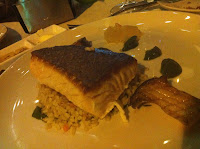 My salmon dish was delicious. The fish was perfectly cooked, skin crisped and served atop a bed of bulgur wheat and rapini that had been pureed into a pesto-like sauce. The plate featured a few bite-sized bits of pomelo, and a few small sautéed king oyster mushrooms. Serving the rapini as a puree was a great idea, as its flavor blended very well with the bulgur. I liked that the eater could control how much or how little of the rapini went on his/her fork; otherwise, such a strongly-flavored vegetable could have been overpowering for diners that do not appreciate rapini’s ultra-bitter flavor.
The meringue? Eh. I like meringues, and my lukewarm reaction is certainly no reflection on the chef, I’m just not very likely to fawn over dessert. In fact, I would love to see more restaurants allow diners to skip dessert and instead choose an additional appetizer, a side dish, or an aperitif or cordial.
All of the appetizer and entrée dishes were amazing, but the one that I felt a compulsive need to replicate was the steak tartare. While I used to find the idea of raw beef repulsive, my mind opened up at some point. I’ve been on a mission to try steak tartare for a few weeks now, and the discounted price and small portion on the restaurant week menu allowed me to try it without committing to an entire order (not that there’s ever much of a chance that I’m not going to like a new dish, but I’m very mindful when it comes to animal proteins).
To make steak tartare, start with good, naturally raised sirloin¾if you can find grass fed sirloin, this would be the time to buy it. Although you can cheat and have your butcher grind it for you, true steak tartare is not made with ground beef, but with very finely chopped steak. Time to sharpen your chef’s knife!
I chopped and chopped and chopped until the steak was broken up into miniscule bits. However, I decided to stray from the classic steak tartare, and I flavored it a bit differently. Although I stuck with the classic capers and egg yolk, a bit of grated orange peel, ground coriander, and rose water gave a Middle Eastern flavor to my very first batch of steak tartare. If you’re a steak lover, try this recipe served with some toasted pita crisps!
Recipe - Steak Tartare with Middle Eastern Flavors
8 oz/230 g top-quality sirloin
2 t/10 g ground coriander
1 t/5 g orange rind, very finely grated
½ t/2.5 g rose water
1 t/5 g salt-packed capers, chopped
Coarsely ground black pepper, to taste
2 egg yolks
Four whole wheat mini-pitas, quartered and toasted, to serve
Using your sharpest knife, chop the sirloin until its consistency is very fine, but coarser than ground beef. In a mixing bowl, combine the chopped sirloin, coriander, orange rind, rose water, capers, and black pepper. Using a wooden spoon, fold the seasonings into the chopped sirloin. Set aside in the refrigerator for 30 minutes to an hour.
After the sirloin mixture has chilled, divide the mixture in half. Using ring molds, press the steak into the molds on individual plates. Make an indentation in the top surface, creating a “well” for the egg yolk. Top the steak tartares with a raw egg yolk, and serve with quartered and toasted mini-pitas.


Nutritional information: Serves two. With pita crisps, 393 calories, 23 g fat, 25.9 g carbohydrates, 29.4 g protein. Without pita crisps, 273 calories, 22 g fat, 1.9 g carbohydrates, 23.4 g protein
There is a method to my madness. I only consider restaurants I haven’t yet tried, and I carefully evaluate restaurants and menus based on the following criteria:
- Value: Does the restaurant week price discount allow me to dine at a restaurant I couldn‘t otherwise afford?
- Choice: Does this restaurant offer three or more offerings per course?
- Differentiation: Does this menu offer one or more unique dishes and/or does the menu feature an ingredient or dish I’ve never tried?
- Special features: Does this menu offer any special features, i.e. a wine pairing or complimentary drink?
Once I’ve color-coded my chart, my choices are based on if/when I can get reservations at the green restaurants. I always aim to hit four new restaurants, but usually I’m lucky if I can squeeze in two. However, I’m not going to complain about getting to try two new restaurants!
This year, my trusty spreadsheet got thrown for a loop for one reason and one reason only¾I never expected the need to create an “outdoor seating” column in March! Mother Nature certainly felt generous last week, blessing us with a sunny, 80-degree day (why she can’t wait until the weekend to give us these little gifts is beyond my comprehension). I ignored my spreadsheet completely and set out on a mission to sit on a patio.
 |
| at Forum, 755 Boylston St. |
Whoa¾when I’m wrong, I cop to it. I was wrong. The meals my friend and I had at Forum were excellent! We had to wait a while for a patio table, but that’s not the restaurant’s fault; I blame a four-top of really stiff-looking MetroWest types that lingered at their table far longer than acceptable by any standard of courtesy. But, I enjoyed an Aviation at the bar while we waited for our table.
Having studied the menu earlier that day, I already knew what I was going to order, and knowing my friend as well as I do, I was fairly certain I could predict his picks as well. I had the Trio Tartare (tuna, steak, and salmon tartare), Salmon with Bulgur Wheat, Rapini, Pomelo, and King Oyster Mushrooms, and for dessert I had the Meyer Lemon Meringue with Graham Cracker and Earl Gray. My friend had the Tortellini (duck confit and butternut squash filling in sage brown butter), Mock “Wellington” (filet mignon in puff pastry with wild mushrooms and bordelaise sauce), and the German Chocolate Cake with coconut, pecans and Guinness.

The meringue? Eh. I like meringues, and my lukewarm reaction is certainly no reflection on the chef, I’m just not very likely to fawn over dessert. In fact, I would love to see more restaurants allow diners to skip dessert and instead choose an additional appetizer, a side dish, or an aperitif or cordial.
All of the appetizer and entrée dishes were amazing, but the one that I felt a compulsive need to replicate was the steak tartare. While I used to find the idea of raw beef repulsive, my mind opened up at some point. I’ve been on a mission to try steak tartare for a few weeks now, and the discounted price and small portion on the restaurant week menu allowed me to try it without committing to an entire order (not that there’s ever much of a chance that I’m not going to like a new dish, but I’m very mindful when it comes to animal proteins).
To make steak tartare, start with good, naturally raised sirloin¾if you can find grass fed sirloin, this would be the time to buy it. Although you can cheat and have your butcher grind it for you, true steak tartare is not made with ground beef, but with very finely chopped steak. Time to sharpen your chef’s knife!
I chopped and chopped and chopped until the steak was broken up into miniscule bits. However, I decided to stray from the classic steak tartare, and I flavored it a bit differently. Although I stuck with the classic capers and egg yolk, a bit of grated orange peel, ground coriander, and rose water gave a Middle Eastern flavor to my very first batch of steak tartare. If you’re a steak lover, try this recipe served with some toasted pita crisps!
Recipe - Steak Tartare with Middle Eastern Flavors
8 oz/230 g top-quality sirloin
2 t/10 g ground coriander
1 t/5 g orange rind, very finely grated
½ t/2.5 g rose water
1 t/5 g salt-packed capers, chopped
Coarsely ground black pepper, to taste
2 egg yolks
Four whole wheat mini-pitas, quartered and toasted, to serve
Using your sharpest knife, chop the sirloin until its consistency is very fine, but coarser than ground beef. In a mixing bowl, combine the chopped sirloin, coriander, orange rind, rose water, capers, and black pepper. Using a wooden spoon, fold the seasonings into the chopped sirloin. Set aside in the refrigerator for 30 minutes to an hour.
After the sirloin mixture has chilled, divide the mixture in half. Using ring molds, press the steak into the molds on individual plates. Make an indentation in the top surface, creating a “well” for the egg yolk. Top the steak tartares with a raw egg yolk, and serve with quartered and toasted mini-pitas.


Nutritional information: Serves two. With pita crisps, 393 calories, 23 g fat, 25.9 g carbohydrates, 29.4 g protein. Without pita crisps, 273 calories, 22 g fat, 1.9 g carbohydrates, 23.4 g protein
Friday, March 23, 2012
Chicken with Crunchy Veggies and Thai Flavors
This is yet another one of my recipes that wasn’t necessarily inspired, but came together when I said, “I’m hungry!” Thinking of what I could cook, I realized that I rarely cook chicken. I eat a lot of seafood, pork, beef, and vegetarian dishes, but I don’t do chicken too often. Why not? No conscious reason. I like chicken, but since starting this blog, I’ve leaned towards recipes with stronger flavors and uncommon ingredients.
When I do cook chicken, I buy organic, free-range, air-chilled chicken. Organic and free-range chicken is better for your body, the environment, and the chickens themselves. If you’ve never heard of air-chilled chicken, seek it out¾while normal chickens are dunked in an ice water bath to lower their temperature after slaughter and processing, air-chilled chickens are sent through several courses of cold air. This significantly lowers the risk of bacterial contamination (one infected chicken in an ice water bath can contaminate an entire lot), but it is also more economical - chickens given ice baths absorb water, and the consumer ends up paying for water. When chickens are air-chilled, you're not paying for anything but chicken. Air-chilled poultry costs a little more than conventional chicken, but I think it’s worth it to pay a slightly higher price for clean, unadulterated chicken.
Chicken pairs with pretty much everything, as does rice. But plain chicken and plain rice isn’t very exciting; I wanted to spice it up a bit. When you add in bold flavors, a little meat goes a long way, so if you’re looking to cut down on meat consumption, crunchy vegetables and Thai-inspired flavorings provide flavor and textural contrasts to the rather neutral chicken and jasmine rice. Even better, this recipe couldn’t be easier!
Chicken with Crunchy Veggies and Thai Flavors
1 T. coconut oil
8 oz. Boneless skinless chicken breasts, chopped into bite-sized pieces
1 lb. Green beans, cut into 1” lengths
1-2 cloves garlic, crushed
1 t. grated fresh ginger
2 T. low sodium soy sauce
2 T. fish sauce
2 T. Boston Olive Oil Company’s lemongrass & mint white balsamic vinegar
1 cucumber, seeded and chopped
1 large tomato, seeded and chopped
2 Serrano chiles, minced
2 fresno chiles or red jalapenos, minced
3 green onions, sliced into rings
Handful chiffonade-cut basil
1 T. toasted sesame oil
Coked rice, to serve
Extra basil, to garnish
A few very thin slices Serrano chile, to garnish
In a large metal pan or wok, heat the coconut oil over high heat until it becomes fluid. Add the chicken pieces and brown for 3-4 minutes, stirring constantly.
Reduce heat to medium. Add the green beans, garlic, ginger, soy sauce, fish sauce, and lemongrass & mint vinegar. Cook for 5-7 minutes, continuing to stir constantly. Next, add the cucumber, tomato, Serrano chile, and fresno chile. Continue to stir constantly, and cook for an additional 5 minutes, or until the green beans are no longer raw tasting but still retain their crunch.
Finally, add the green onions, basil, and sesame oil. Stir until blended, then spoon over cooked rice. Garnish with basil sprigs and thin slices of serrano chile.


Tuesday, March 20, 2012
Chestnut Flour Pasta with Sautéed Radicchio, Chicken Livers, and Grapefruit
 |
| chestnut honey, chestnut flour pasta, parsley, radicchio |
It worked! It would have been more appropriate in autumn, but it tasted great! This dish is not for everyone - you have to be a true lover of intensely earthy, woodsy, bitter flavor combinations in order to appreciate this one, but if you’re anything like me and you can’t bear to not try something, take a chance on this recipe!
Chestnut Flour Pasta with Sautéed Radicchio, Chicken Livers, and Grapefruit
1 batch cooked chestnut flour pasta (recipe below)
Splash olive oil
1 large shallot, minced
12 oz. Chicken livers, chopped into bite-sized pieces
2 T. chestnut honey
1/3 c. grapefruit juice
½ c. coarsely grated pecorino romano
2 heads radicchio, shredded
Salt and coarsely ground pepper
Handful coarsely chopped parsley
Pecorino romano shavings, to garnish
In a large, heavy-bottomed pan, heat the olive oil over medium-high heat. Add the shallot and chicken livers and saute for about 5-7 minutes, stirring frequently, until the shallots are softened and the chicken livers have browned.
Add the chestnut honey, grapefruit juice, and pecorino romano, stirring gently a few more times until the mixture is well-blended. Add the radicchio, cover, and reduce heat to low. Cook for 5-7 minutes, stirring once or twice, until the radicchio is wilted.
Add the salt and parsley to the mixture, stir until blended, and spoon over the cooked chestnut flour pasta. Garnish with extra chopped parsley and shaved pecorino romano.
Chestnut Flour Pasta
¾ c. chestnut flour
¾ c. unbleached white flour
1 t. salt
1 t. olive oil
2 eggs
Combine the ingredients in a bowl and blend, using your hands. Work the ingredients together until you have a stiff dough, and knead for 6-8 minutes. Wrap the dough in plastic and refrigerate for at least one hour, if not overnight.
After the dough has refrigerated, use a pasta machine to roll out the dough. Don’t use the thinnest setting; chestnut flour pasta tends to be more brittle than wheat flour pasta. I recommend the 2nd or 3rd thinnest setting. Cut the dough into 1/3” wide noodles, and let dry for at least 30 minutes.
When you are ready to cook the chestnut flour pasta, cook it in heavily salted water and stir as little as possible, as it has a tendency to break easily. Serve with the recipe above.

Tuesday, March 6, 2012
Nothing on my "To-Do" List But Eating, Drinking, and Relaxing!
 |
| Peter Gibbons, my hero! taken from examiner.com |
Once the work day was finally done, I bolted out the door, scrambling to get to Salumeria Italiana before close. I made it in time and filled my basket with an assortment of goodies, including burrata and taleggio cheeses, farro pasta, and a jar of eucalyptus honey produced by Alce Nero, a group of organic farmers based in Italy’s Emilia-Romagna region. Somehow I resisted the salumi counter―no small feat, considering what a rare occurrence it is for me to leave this shop without at least a few strips of their 24-month prosciutto.
Treats in tow, I rounded the corner onto Hanover Street, on my way to The Wine Bottega, where the team was pouring French, Italian, and Portuguese wines from Oz Wine Co., a Massachusetts-based importer of organic/biodynamic/sustainable wines. I left with two wines: an Aglianico-based red from Campania featured in the Oz array, and a recommended Montepulciano d’Abruzzo that I passed on my way to the cash register but couldn’t pass up when I saw that it was only $12.00.
Next stop? Mercato del Mare, because a food-gathering excursion to the North End that doesn’t include oysters is like a martini without an olive. I left with 6 Onset oysters from Buzzards Bay, MA, as well as a half-pound of local cod and inspiration for an interesting mignonette (recipe below).
Finally home! I changed into pajamas, uncorked the Montepulciano, threw “What About Bob?” in the DVD player, shucked my oysters, plated my cheeses, kicked up my feet, sipped my wine, and basked in the glory of doing nothing. It was everything I thought it could be!
Curry Mignonette for Oysters
1 t. malt vinegar
1 T. mild white vinegar
1-2 drops vanilla extract
Dash hot curry powder
Stir the ingredients together in a small bowl; use a few drops to season oysters on the half-shell.
 |
| Onset oyster, Buzzards Bay, MA |
 |
| Onset oyster with Curry Mignonette |
 |
| Burrata - Cow's Milk; Puglia, Italy |
 |
| Taleggio - Cow's Milk; Lombardy, Italy - drizzled with Alce Nero Eucalyptus Honey |
Subscribe to:
Posts (Atom)